
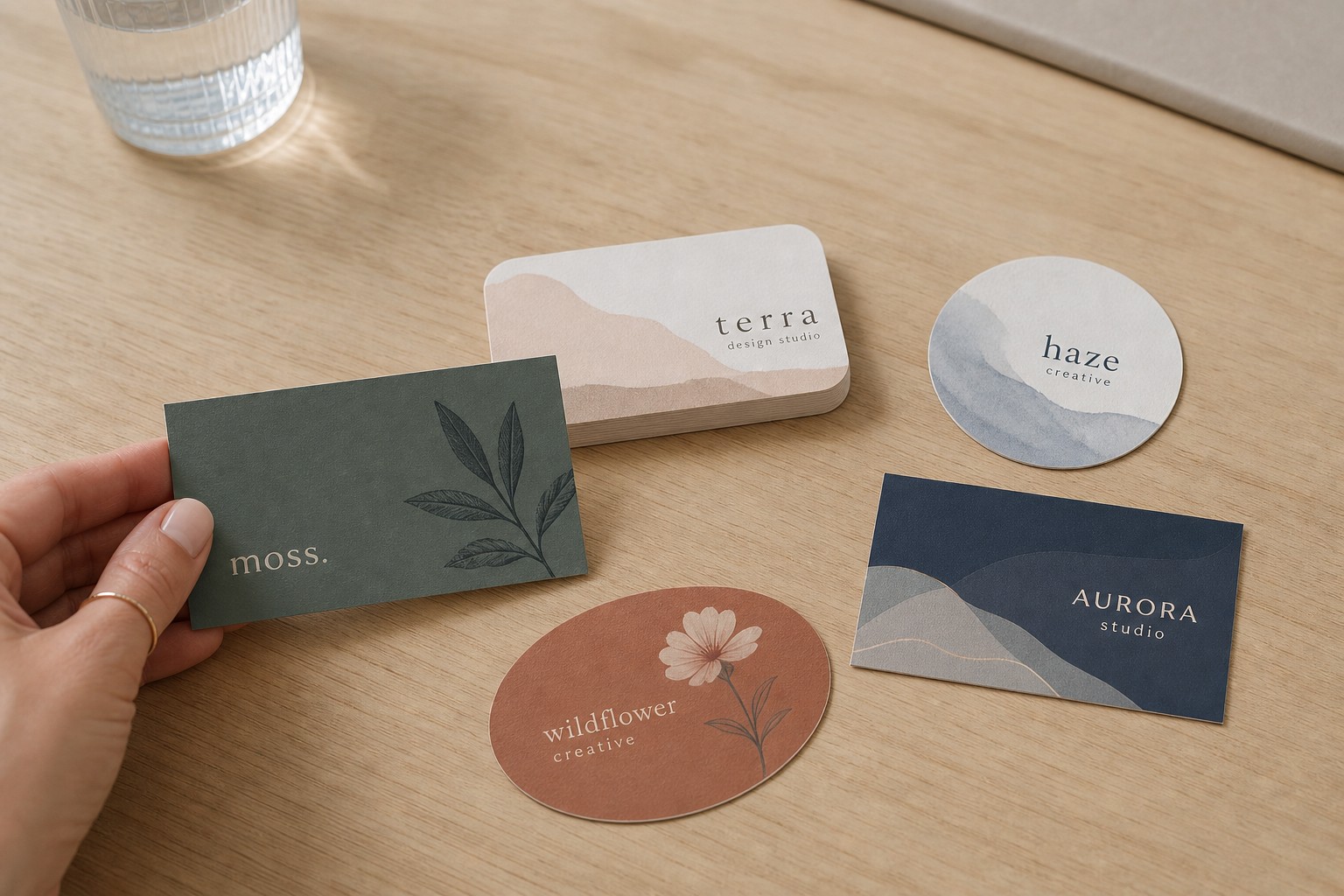
The Australian standard business card is 90mm wide by 55mm tall. In centimetres that is 9.0 x 5.5cm. In inches it is approximately 3.54 x 2.17in. Every measurement on this page is listed in all three units so you can copy the number your software needs without doing the conversion yourself.
| Format | Millimetres | Centimetres | Inches |
|---|---|---|---|
| Australian standard card | 90 x 55 mm | 9.0 x 5.5 cm | 3.54 x 2.17 in |
- Australian standard card: 90 x 55mm / 9.0 x 5.5cm / 3.54 x 2.17in
- Add 3mm bleed on all sides for print-ready artwork: 96 x 61mm / 9.6 x 6.1cm / 3.78 x 2.40in
- US standard card: 88.9 x 50.8mm (defined as exactly 3.5 x 2.0in)
- European standard card: 85 x 55mm / 8.5 x 5.5cm / 3.35 x 2.17in
- Note: 90mm is 3.5433in, not 3.5in exactly. Entering 3.5 introduces a 1.1mm sizing error.
Australian Standard Business Card: All Three Units
The table below shows the Australian 90 x 55mm card in millimetres, centimetres, and inches, including the artwork dimensions you need when your software asks for bleed.
| Measurement | Width | Height |
|---|---|---|
| Millimetres (trim size) | 90mm | 55mm |
| Centimetres (trim size) | 9.0cm | 5.5cm |
| Inches (trim size, rounded) | 3.54in | 2.17in |
| Millimetres (with 3mm bleed) | 96mm | 61mm |
| Centimetres (with 3mm bleed) | 9.6cm | 6.1cm |
| Inches (with 3mm bleed, rounded) | 3.78in | 2.40in |
A note on rounding: 90mm is 3.5433in exactly. 55mm is 2.1654in exactly. The rounded figures above (3.54 x 2.17in) introduce a sub-millimetre tolerance, which is fine for most software. Where your software accepts millimetres or centimetres, prefer those values. Entering the common approximation of 3.5in for the width introduces a 1.1mm error that can shift where an edge-to-edge background sits at trim.
Business Card Shape Dimensions in mm, cm and Inches
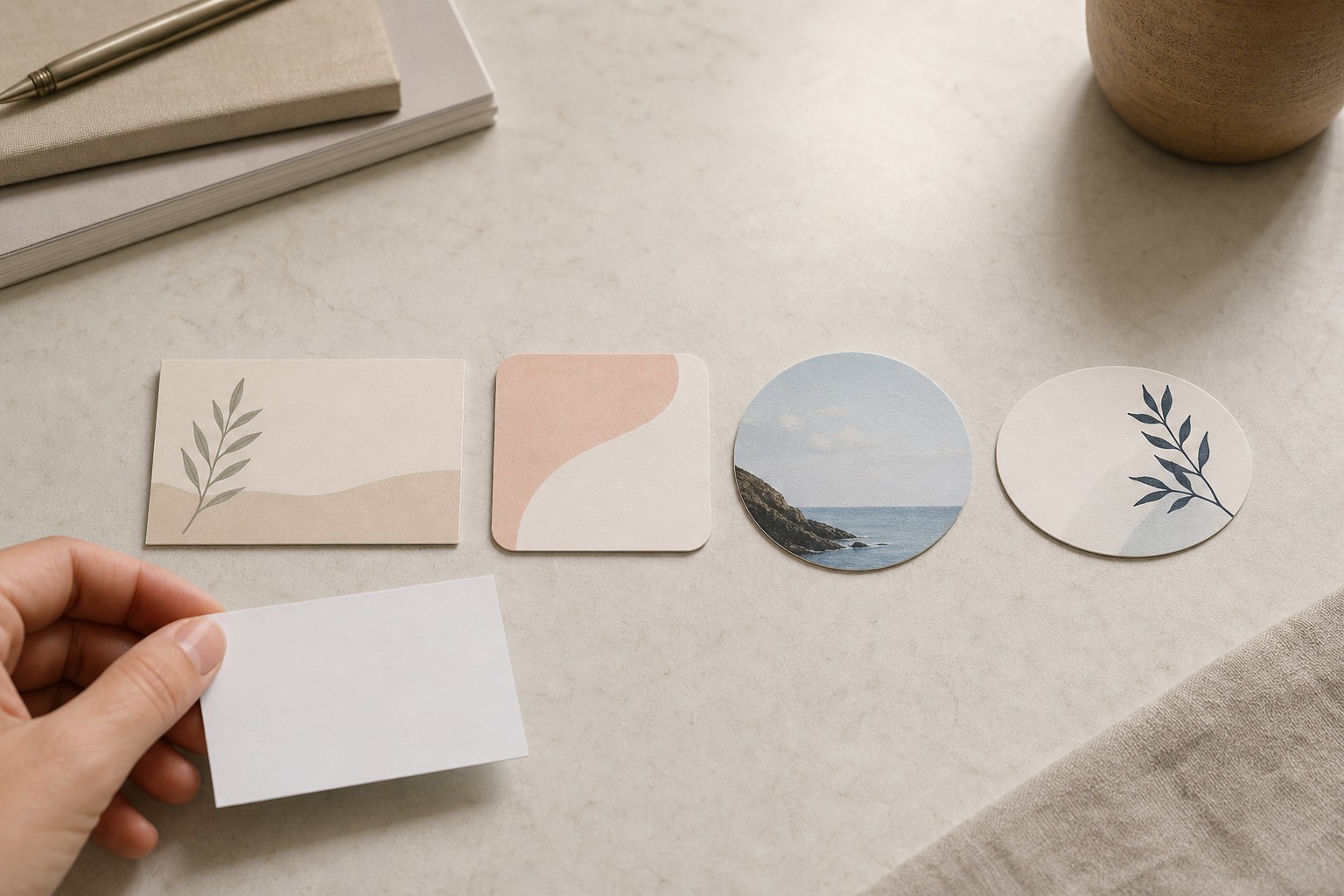
Paperlust prints four business card shapes. The physical footprint of each shape in all three units is listed below.
| Shape | mm | cm | Inches (approx.) |
|---|---|---|---|
| Rectangle | 90 x 55mm | 9.0 x 5.5cm | 3.54 x 2.17in |
| Rounded corners | 90 x 55mm | 9.0 x 5.5cm | 3.54 x 2.17in |
| Circle (diameter) | 60 x 60mm | 6.0 x 6.0cm | 2.36 x 2.36in |
| Oval | 90 x 50mm | 9.0 x 5.0cm | 3.54 x 1.97in |
The rectangle and rounded-corner shapes share the same 90 x 55mm footprint. The corner treatment is a printing finish applied after cutting, so your artwork dimensions stay the same. The oval is 5mm shorter than the rectangle and the circle is the most compact option at 60mm square.
International Business Card Sizes Compared
Different countries use different standards. A template from a US design site will not be the right size for an Australian printer; the following table shows why.
| Region | mm | cm | Inches | Defined in |
|---|---|---|---|---|
| Australia | 90 x 55mm | 9.0 x 5.5cm | 3.54 x 2.17in | Millimetres |
| USA / Canada | 88.9 x 50.8mm | 8.9 x 5.1cm | 3.5 x 2.0in (exact) | Inches |
| Europe / UK | 85 x 55mm | 8.5 x 5.5cm | 3.35 x 2.17in | Millimetres |
The US card is defined in inches (exactly 3.5 x 2.0in), which is why its millimetre equivalent comes out as an untidy decimal. The Australian card is defined in millimetres (90 x 55mm), which is why its inch equivalent is 3.5433in rather than a clean 3.5. This is not a rounding convention. It reflects the fact that the two standards were established independently in different measurement systems.
Setting Up in Software for an Australian Business Card
Canva
Canva’s default “Business Card” template uses the US size of 3.5 x 2.0in. For an Australian card, you need to start with a custom size:
- Select Custom size when creating a new design.
- Enter 90mm x 55mm (or 9cm x 5.5cm if your Canva account is set to centimetres).
- For a print-ready file with bleed, resize to 96 x 61mm and keep all content at least 3mm inside each edge.
- Export as PDF Print for best compatibility with an Australian printer.
Adobe Illustrator
- New Document, choose the Print preset.
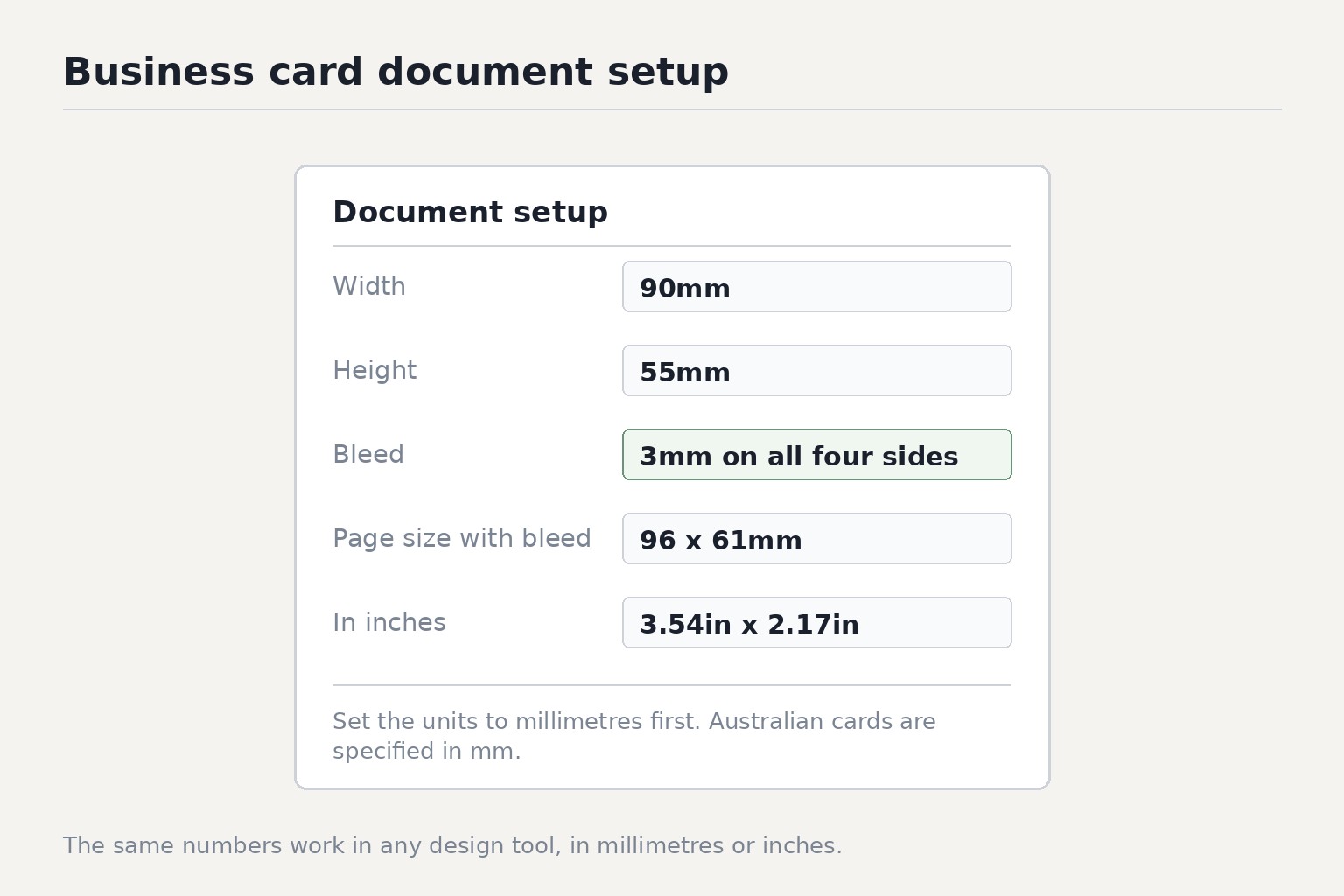
- Width: 90mm, Height: 55mm. Units: millimetres.
- Bleed: 3mm on all four sides.
- Colour mode: CMYK. Place any raster images at 300ppi or above.
- Export as PDF with “Use Document Bleed Settings” ticked.
If your workflow requires inches: Width 3.54in, Height 2.17in, Bleed 0.118in (3mm). The rounded inch values introduce a small sub-millimetre tolerance that is within normal commercial print acceptance.
Adobe Photoshop
- New > Width: 96mm, Height: 61mm (this already includes the 3mm bleed on all sides).
- Resolution: 300 pixels/inch. Colour mode: CMYK.
- The canvas will be 1134 x 721 pixels at 300ppi.
- Add a guide 3mm in from each edge to mark the trim boundary. Keep all content inside that guide.
Microsoft Word
Word does not support bleed, so it is suitable for layout proofing only, not for supplying print-ready files to a commercial printer.
- Page Setup, Paper tab, select Custom size.
- Width: 9cm, Height: 5.5cm (or 3.54in x 2.17in in imperial mode).
- Set all margins to at least 3mm to prevent content from being cut.
Why a US Template Prints Wrong on an Australian Card
The US standard card is 88.9 x 50.8mm. The Australian card is 90 x 55mm. The width difference is 1.1mm. The height difference is 4.2mm.
The height gap is the bigger problem. At 4.2mm shorter, content placed near the lower edge of a US template sits in the bleed zone when printed at Australian trim size. The safe area that looked correct in the template is no longer safe.
The width gap (1.1mm) is subtler but still causes a visible white strip along one side when a background designed to reach the edge does not quite reach the new trim line.
If you have a template labelled “3.5 x 2 inch business card,” resize the document to 90 x 55mm and review all content margins before sending to an Australian printer. Any element within 4mm of the original trim boundary should be repositioned.
Visiting Cards and Calling Cards: What Size Are They?
“Visiting card” and “calling card” are older terms for a personal contact card. They carry no separate size standard in Australia. The convention is to print them at the same 90 x 55mm as a business card.
If you are searching for “visiting card size in inches” or “calling card size in inch,” the answer is the same as for a business card: approximately 3.54 x 2.17in, or 9.0 x 5.5cm in centimetres, or 90 x 55mm in millimetres.
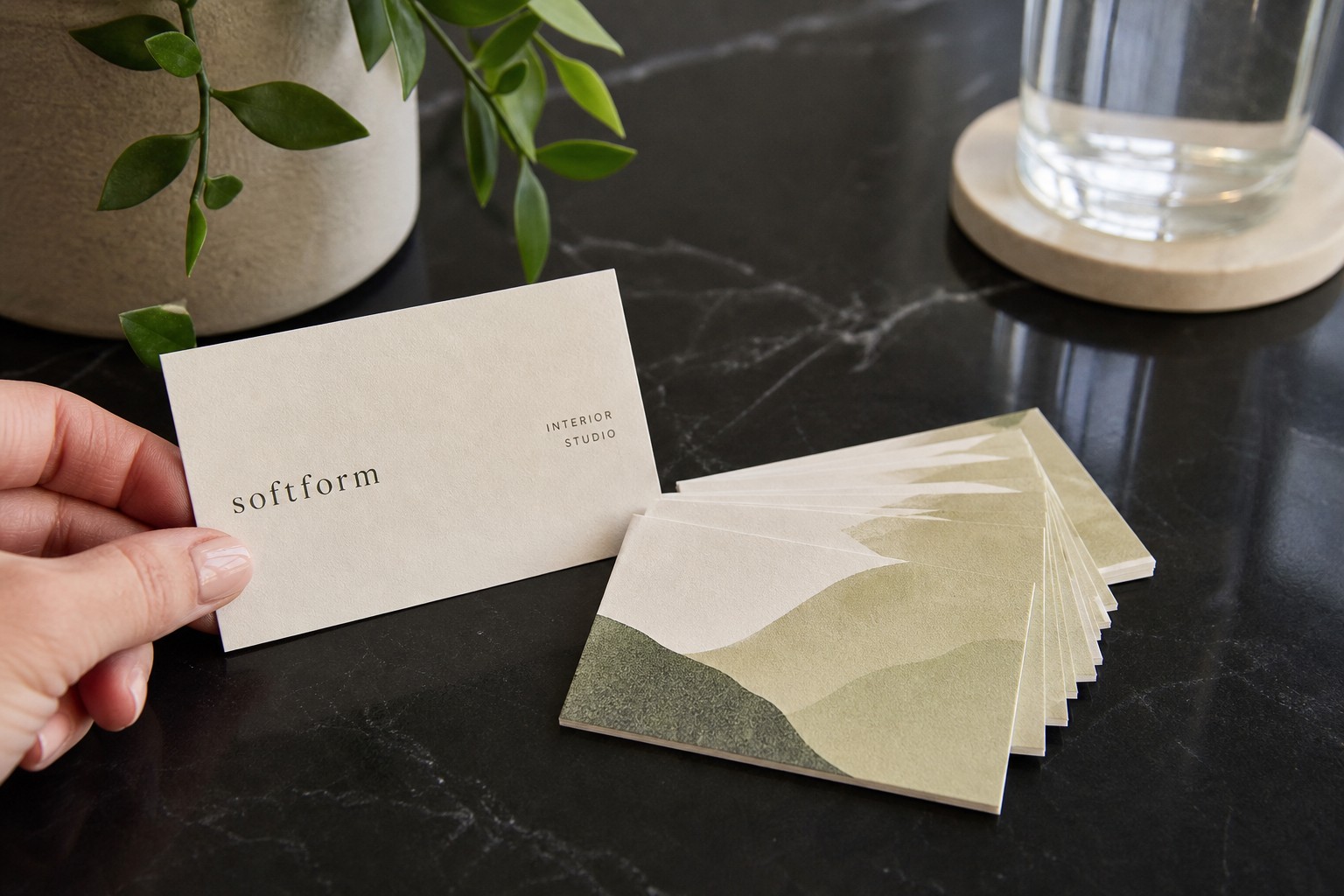
Paperlust standard business cards are printed to the full Australian 90 x 55mm specification across all four shapes, on paper stocks from 300gsm Matte through Cotton, Metallic, Linen, and Artboard with Velvet Laminate. The full range of finishes including Flat Foil, Spot UV, Scodix, and Raised Foil is available in the custom business cards category. Standard business cards on 300 GSM Matte run on 24 Hour Production (other stocks 3 to 5 business days), while flat foil business cards run on 48 Hour Production, so the size decision does not slow the order. Standard cards drop from $0.44 a card at 100 down to $0.08 a card at 5,000, while flat foil moves from $1.59 a card at 100 down to $0.18 a card at 5,000.
Frequently Asked Questions
What is the standard business card size in Australia in cm?
The Australian standard business card is 9.0 x 5.5cm (90 x 55mm). Rectangle and rounded-corner cards use this size. Circle cards are 6.0cm in diameter and oval cards are 9.0 x 5.0cm.
What is the standard business card size in inches in Australia?
Approximately 3.54 x 2.17in. That is 90 x 55mm converted to inches. The US standard is a different size: exactly 3.5 x 2.0in, which is 88.9 x 50.8mm.
What size do I set for a business card in Canva for Australian printing?
Canva’s default business card is the US size (3.5 x 2.0in). For an Australian card, create a custom size of 90mm x 55mm or 9cm x 5.5cm. For a print-ready export, set the canvas to 96 x 61mm to include 3mm bleed on all sides.
What bleed dimensions should I use for a 90 x 55mm business card?
Add 3mm of bleed on every side. Your print-ready artwork should be 96 x 61mm. In inches that is approximately 3.78 x 2.40in. Keep all text and logos at least 3mm inside the trim boundary.
Is a visiting card the same size as a business card in Australia?
Yes. Visiting card and calling card are older names for the same product. The Australian convention is 90 x 55mm (9.0 x 5.5cm, 3.54 x 2.17in) for all three terms.
Why does 90mm not convert to exactly 3.5 inches?
The Australian card is defined in millimetres. 90mm converts to 3.5433in. The US card is defined as exactly 3.5 x 2.0in, which converts to 88.9 x 50.8mm. The two standards were set independently in different measurement systems, so neither converts cleanly into the other.
What size is a business card in millimetres in Australia?
The standard Australian business card is 90mm wide by 55mm tall. Add 3mm bleed on all sides and your artwork file should be 96 x 61mm.
Can I use a US business card template for an Australian printer?
Not without resizing. The US card is 88.9 x 50.8mm (3.5 x 2.0in), which is 1.1mm narrower and 4.2mm shorter than the Australian 90 x 55mm standard. Resize the document and recheck all margins before supplying it to an Australian printer.