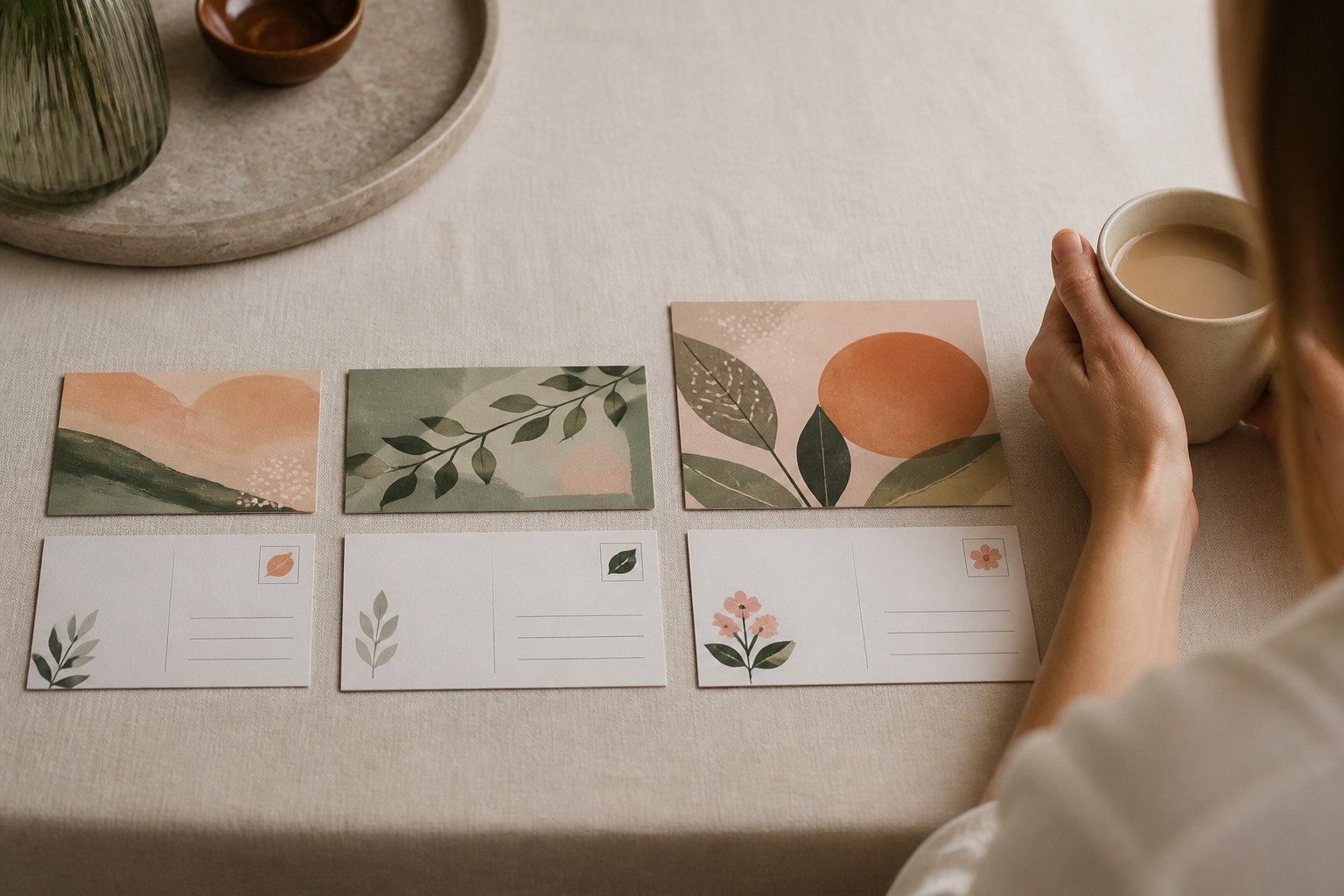
Australia’s three standard postcard sizes are A6 (105 x 148 mm), DL (99 x 210 mm) and A5 (148 x 210 mm). A6 is the classic format for direct mail drops and save the dates, DL suits rack display and envelope-addressed campaigns, and A5 gives you a larger canvas for menus, premium mailers and high-impact trade materials.
As the most commonly ordered direct-mail postcard format in Australia, the A6 postcard size has a dedicated page covering its postage and setup detail.
All three sizes are printed on 350 GSM Artboard in full colour on both sides at Paperlust Print Shop. Pricing starts from $5.42 per card at 50 cards, falling to $0.16 per card at 10,000, with flat-rate shipping Australia-wide.
- A6: 105 x 148 mm. Best for direct mail drops, save the dates and event promos.
- DL: 99 x 210 mm. Best for rack display, DL envelopes and promotional inserts.
- A5: 148 x 210 mm. Best for restaurant menus, premium mailers and trade show materials.
- Stock: 350 GSM Artboard, both sides printed in full colour.
- Bleed: add 3 mm on every edge when setting up artwork files.
- Australia Post: A6 and DL qualify as small letters; A5 is classed as large letter.
- Pricing: from $5.42 per card at 50, to $0.16 per card at 10,000.
What Each Postcard Size Is Used For
A6 Postcards (105 x 148 mm)
A6 is the default postcard format in Australia. At 105 x 148 mm it fits comfortably in a standard letterbox, stands out in a pile of mail without overwhelming the recipient, and keeps print and postage costs lower than larger formats.
Direct mail campaigns are A6’s strongest application. Letterbox drops and addressed mail runs are built around this size because it meets Australia Post’s small letter dimension requirements, keeping per-piece mailing costs as low as possible. A6 is also a popular format for wedding and event save the dates posted without an envelope: the size carries a photograph and key details cleanly, and 350 GSM Artboard is stiff enough to survive the postal journey without bending.
Other well-suited uses include retail loyalty cards, cafe and restaurant promotions, real estate open-house cards, and any campaign where a clear single message needs to reach a large number of recipients efficiently.
DL Postcards (99 x 210 mm)
DL stands for “dimension lengthwise” and measures 99 x 210 mm, the same width and height as a standard DL envelope. This makes it the natural format for rack card displays, letterhead inserts and promotions that need to slip into a DL envelope without folding.
The tall, slim aspect ratio lends itself to a strong vertical hierarchy: headline at the top, offer or key detail in the middle, call to action and contact details at the base. The DL racks found in cafes, gyms, medical waiting rooms and retail stores are sized for exactly this format.
DL’s long-to-short ratio of approximately 2.1 to 1 sits well within Australia Post’s aspect ratio requirements for addressed mail, and the finished dimensions fall inside the small letter size range. This makes DL one of the most cost-efficient postcard formats for high-volume addressed mail campaigns.
A5 Postcards (148 x 210 mm)
A5 is half of A4 and measures 148 x 210 mm. At this size a postcard has room for a full-bleed photograph, a structured menu layout or a detailed event programme without the content feeling cramped.
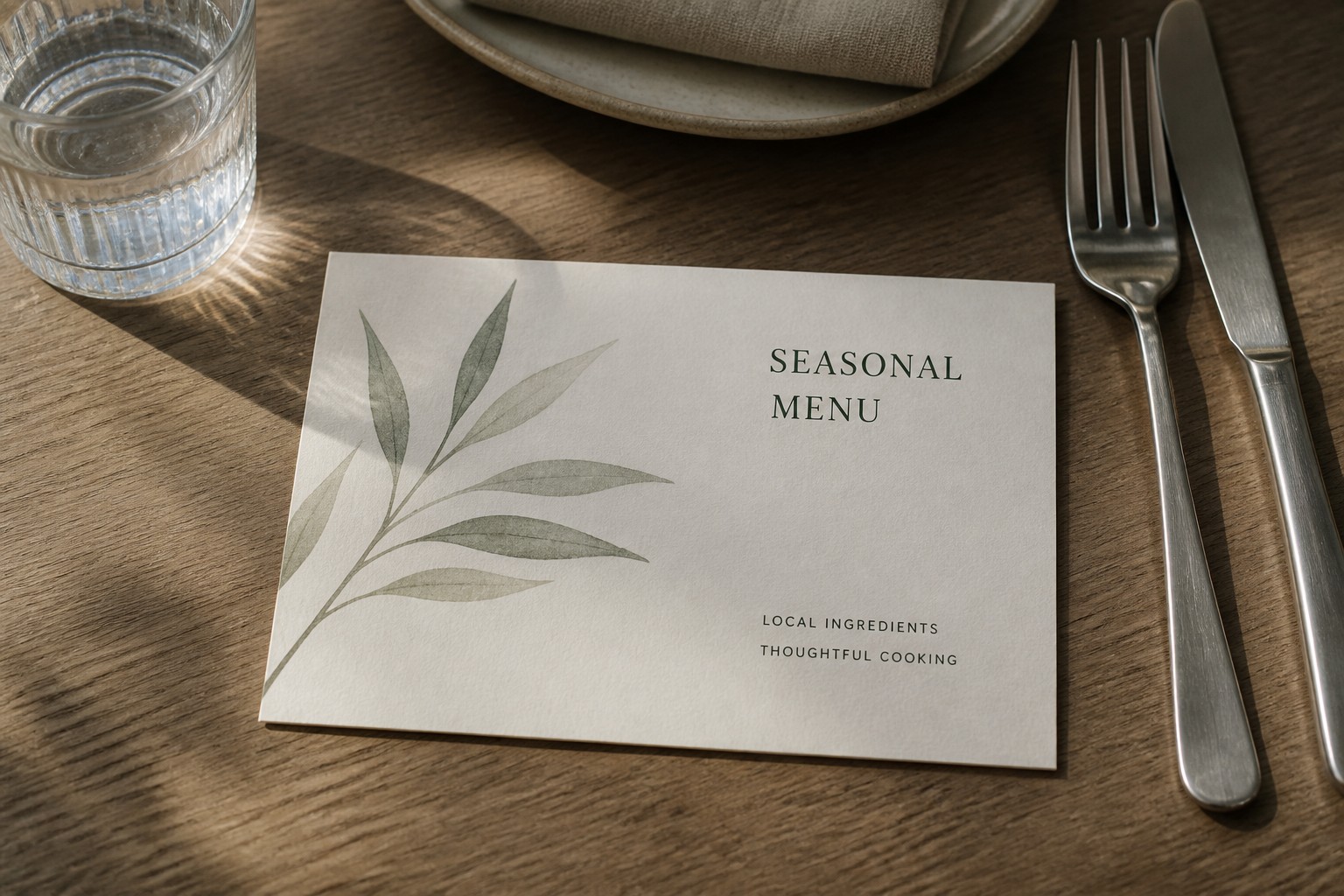
Restaurant table cards and takeaway menus are a natural fit for A5, as are premium direct mailers where the extra surface area signals quality before the reader has absorbed a single word. Trade show giveaways, accommodation welcome cards, settlement packs and event programmes are also well served by this format.
Worth knowing for mail planning: A5’s short side of 148 mm exceeds Australia Post’s 130 mm maximum short dimension for small letters, so A5 cards are classed as large letters for postage purposes. This affects per-piece mailing cost but not deliverability. Many businesses accept the difference knowing that a larger card commands more attention in a letterbox.
Australia Post Size Considerations
If you are planning a mail campaign, postcard size has a direct bearing on which postage tier applies.
Australia Post classifies addressed mail by finished dimensions. A card qualifies as a small letter when its short side is no more than 130 mm and its long side is no more than 240 mm, with a thickness up to 5 mm. Both A6 (105 x 148 mm) and DL (99 x 210 mm) sit inside these limits. A5 (148 x 210 mm) has a short side of 148 mm, which exceeds the 130 mm maximum, placing it in the large letter category.
A practical rule for campaign planning: if budget-per-piece is the primary constraint, start with A6 or DL. If impact per piece matters more than postage cost, A5’s larger canvas is often worth the additional mailing expense.
Australia Post also sets aspect ratio requirements that vary by service type. DL clears the minimum ratio with significant headroom. If you are running a high-volume Promo Post, PreSort or unaddressed mail campaign, confirm your finished dimensions against the current Australia Post postcard fact sheet for your specific service before placing your order. The classifications here are planning guidance; Paperlust Print Shop does not quote postage costs.
Setting Up Artwork: The 3 mm Bleed Rule
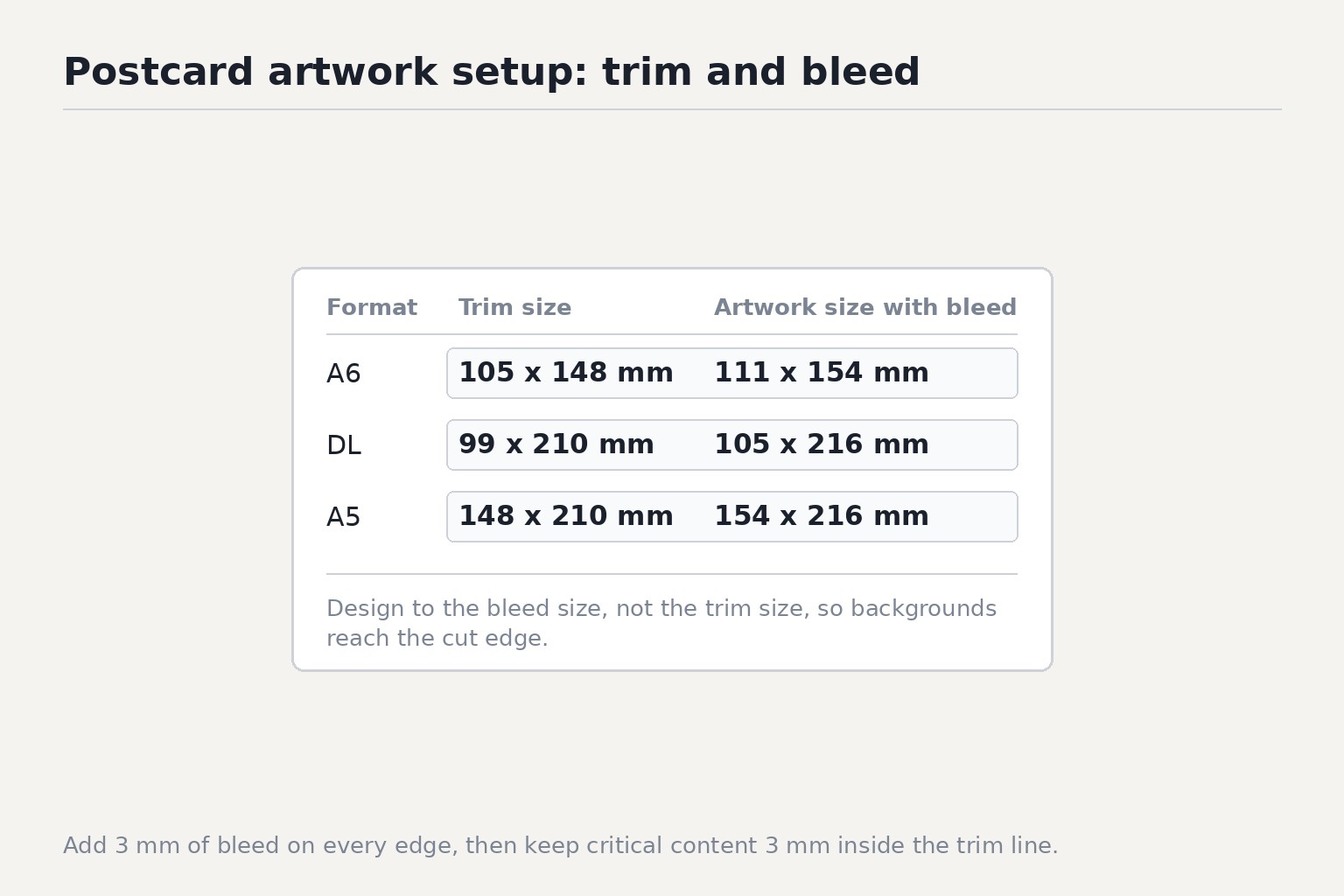
Every postcard print file needs 3 mm of bleed on all four edges. Bleed extends your background colour or edge-to-edge imagery beyond the finished trim line. This extra area is cut away during production and ensures backgrounds and edge graphics print cleanly to the card’s edge, with no white slivers appearing at the trim.
Artwork dimensions with 3 mm bleed added on each side:
| Format | Finished size | Artwork file with bleed |
|---|---|---|
| A6 | 105 x 148 mm | 111 x 154 mm |
| DL | 99 x 210 mm | 105 x 216 mm |
| A5 | 148 x 210 mm | 154 x 216 mm |
Keep all text and critical design elements at least 3 mm inside the finished trim line. This safe zone prevents important content being clipped if sheets shift slightly during cutting.
Export your file as a high-resolution PDF at 300 DPI, with colour mode set to CMYK and all fonts embedded. If your design uses a white or light background, extend it to the bleed edge rather than stopping at the trim line so any minor cutting variation is invisible on the finished card.
When a Shaped Postcard Outperforms a Rectangle
Standard rectangle postcards cover most use cases well. Some briefs, though, call for a card that stands apart in a letterbox, on a retail counter or at a trade show display table.
Die-cut postcards let you define the shape of the card itself. Common options include rounded corners, arch tops and fully custom contours cut to match a logo or product silhouette.
A shaped card is worth the additional step when:
- The shape reinforces the brand. A florist sending a petal-shaped card, or a property business using a house-outline format, creates a direct link between the form of the piece and what the business does.
- The piece is a keepsake. Wedding save the dates and anniversary cards are kept far longer than a rectangular direct mail piece. An arch or scalloped edge signals that the card is worth keeping, not discarding.
- You need shelf or counter differentiation. On a display surface covered in rectangles, a shaped card interrupts the expected grid and prompts a hand to reach for it.
The trade-off is a modest increase in production time and per-unit cost, and your artwork will need a custom die line file. For most high-volume addressed mail campaigns the standard rectangle wins on cost efficiency. For occasions where a single piece needs to make a lasting impression, the shaped option earns its place.
Frequently Asked Questions
What is the standard postcard size in Australia?
A6 (105 x 148 mm) is the most widely used standard postcard size in Australia. It fits Australia Post’s small letter dimensions, suits the broadest range of use cases from direct mail to event stationery, and is the size most Australians associate with a received postcard.
What is the largest postcard size that still qualifies as a small letter with Australia Post?
Australia Post allows a maximum finished size of 130 x 240 mm for small letters, at a thickness of up to 5 mm. A6 (105 x 148 mm) and DL (99 x 210 mm) both fall inside this range. A5 (148 x 210 mm) has a short side of 148 mm, exceeding the 130 mm limit, so it is classed as a large letter.
Can I order postcards in a custom size or shape?
The standard postcard formats at Paperlust Print Shop are A6, DL and A5. For custom shapes, contour cuts or rounded corners, the die-cut postcards product is the right starting point. For other custom size requirements, contact the Print Shop team directly to discuss your brief.
What paper stock are Paperlust Print Shop postcards printed on?
Postcards are printed on 350 GSM Artboard. This is a rigid, solid card stock that handles well through the post, sits flat on display stands and has a substantial feel in the hand. Both sides are printed in full colour as standard.
How much do postcards cost?
Pricing starts at $5.42 per card for a run of 50 and falls to $0.16 per card at 10,000. Volume pricing is calculated automatically when you enter your quantity on the postcard product page.
Do I need to add bleed to my postcard artwork file?
Yes. Add 3 mm of bleed on every edge of your file, extending backgrounds and any edge-touching elements beyond the finished trim size. Keep text and logos at least 3 mm inside the finished trim line as a safe zone. Export as a 300 DPI PDF in CMYK with all fonts embedded.
What is a DL postcard used for?
DL (99 x 210 mm) is the format of choice for rack card displays, letterhead inserts and promotions that need to fit inside a standard DL envelope without folding. Its tall, slim proportions suit a clear vertical hierarchy of information: headline, offer, call to action. DL also qualifies as a small letter with Australia Post, making it one of the most cost-efficient formats for addressed direct mail campaigns.
What is the difference between a postcard and a flyer?
The key differences are stock weight and construction. Postcards at 350 GSM Artboard are substantially heavier and more rigid than typical flyer stock, giving them a premium feel and the durability to travel through the post without damage. Flyers are printed on lighter stock and are optimised for high-volume distribution where cost per piece is the priority. Both product types are available across a range of formats including A6, DL and A5.