
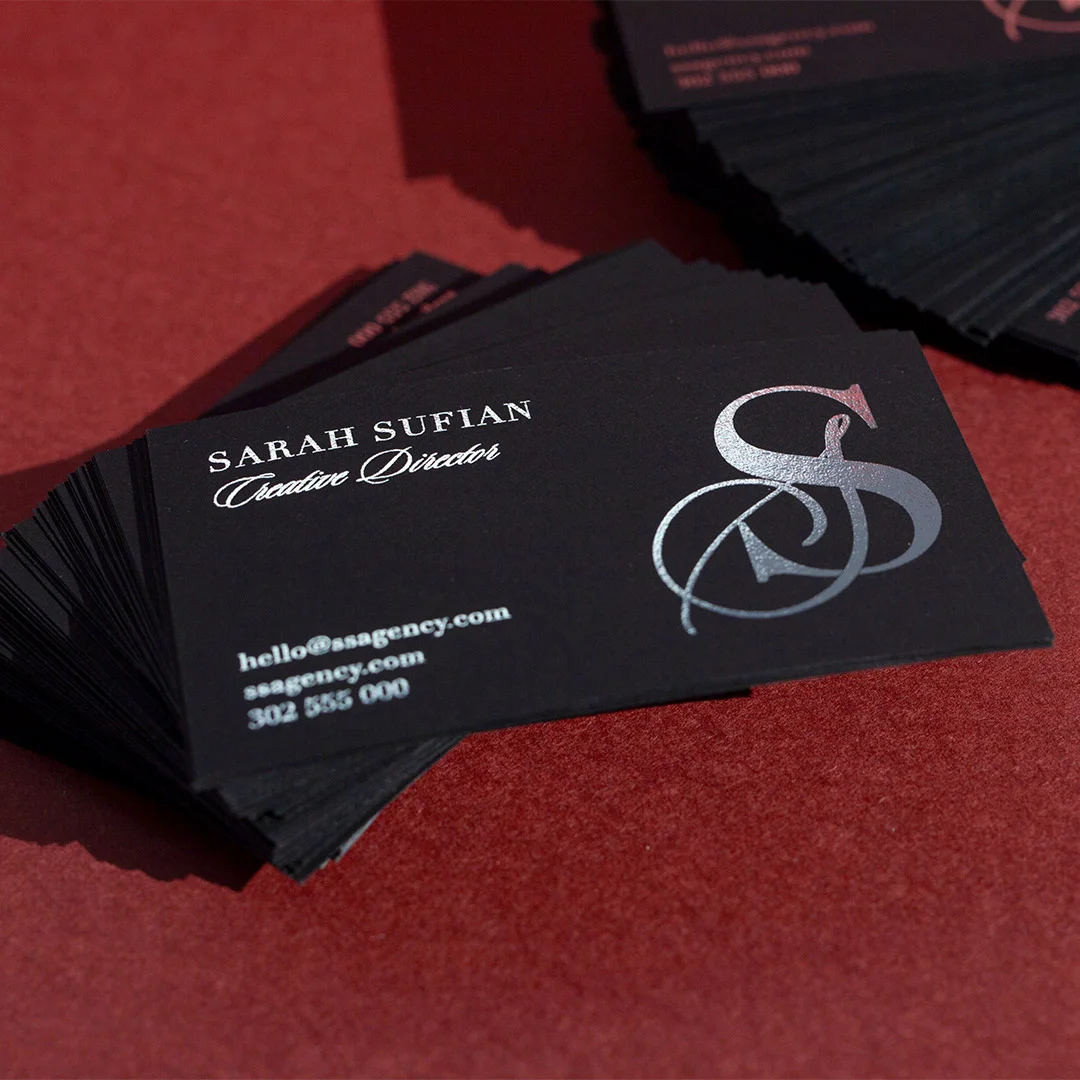
Black business cards occupy a small slice of the overall cards market, but they do disproportionate work when it comes to being remembered. The challenge for most buyers is navigating the technical side: true black paper looks completely different from printed-black-on-white, foil colours each create a different character on a dark substrate, and not every finish technique works equally well on black stock. This guide covers every option available at Paperlust Print Shop, with clear guidance on which combination suits your industry, your budget, and your aesthetic goals.
Black Business Card Selector: Design Direction to Finish Recommendation
| Design Direction | Best Paper / Finish | Print Shop Option |
|---|---|---|
| Classic full-black card, no embellishment | True black coloured paper, uncoated matte | Coloured Paper Business Cards |
| Gold or silver logo on black – the signature look | Black paper + gold or silver raised foil | Raised Foil Business Cards |
| Tonal black-on-black, understated luxury | Matte black paper + spot UV on logo or name | Spot UV Business Cards |
| Budget foil on black – flat metallic, no impression | Black paper + flat foil (gold, silver, holographic) | Flat Foil Business Cards |
| Raised tactile gloss on black, no colour shift | Black paper + Scodix clear gloss polymer layer | Scodix Business Cards |
| Extra-thick premium card, heavier presence | Duplex laminated construction, black outer layer | Duplex Business Cards |
| Not sure yet – want to see and feel the options first | Sample pack (includes coloured paper + foil options) | Business Cards Sample Pack |
Why Black Business Cards Command Attention in 2026
Black business cards are statistically rare. Most Australian professionals still default to white or off-white stock, which is exactly why a black card stands out in a jacket pocket, on a restaurant pass, or across a boardroom table. The psychology is direct: a dark card signals deliberate intent. When you hand someone a black business card, the implicit message is that your brand operates at a considered level, that you made a deliberate aesthetic choice rather than accepting the default.
In Australia, the industries that gravitate toward black cards have expanded well beyond the traditional creative-agency and hospitality clusters. Boutique finance firms, architecture practices, luxury real estate agents, and music-industry professionals have all adopted black as a core identity signal. High-end restaurants hand black cards across at the chef’s table. Fashion brands use them for backstage handoffs at shows. Interior design firms include them with mood board presentations.
The aesthetic delivers three things that white cards cannot easily replicate:
- Rarity signal – black cards occupy roughly 5% of all business cards printed in Australia, so recipients notice them immediately
- Foil contrast – gold, silver, copper, and holographic foils read more vividly against black than against white, because there is no substrate brightness competing with the metallic reflection
- Finish amplification – matte black with spot UV creates a tonal black-on-black effect that is impossible on white stock; the finish becomes the design itself
The decision to print black is rarely trend-chasing. It is a substrate choice that matches a specific brand register – premium, deliberate, memorable. The technical question is which black format and which finish combination delivers that result reliably.
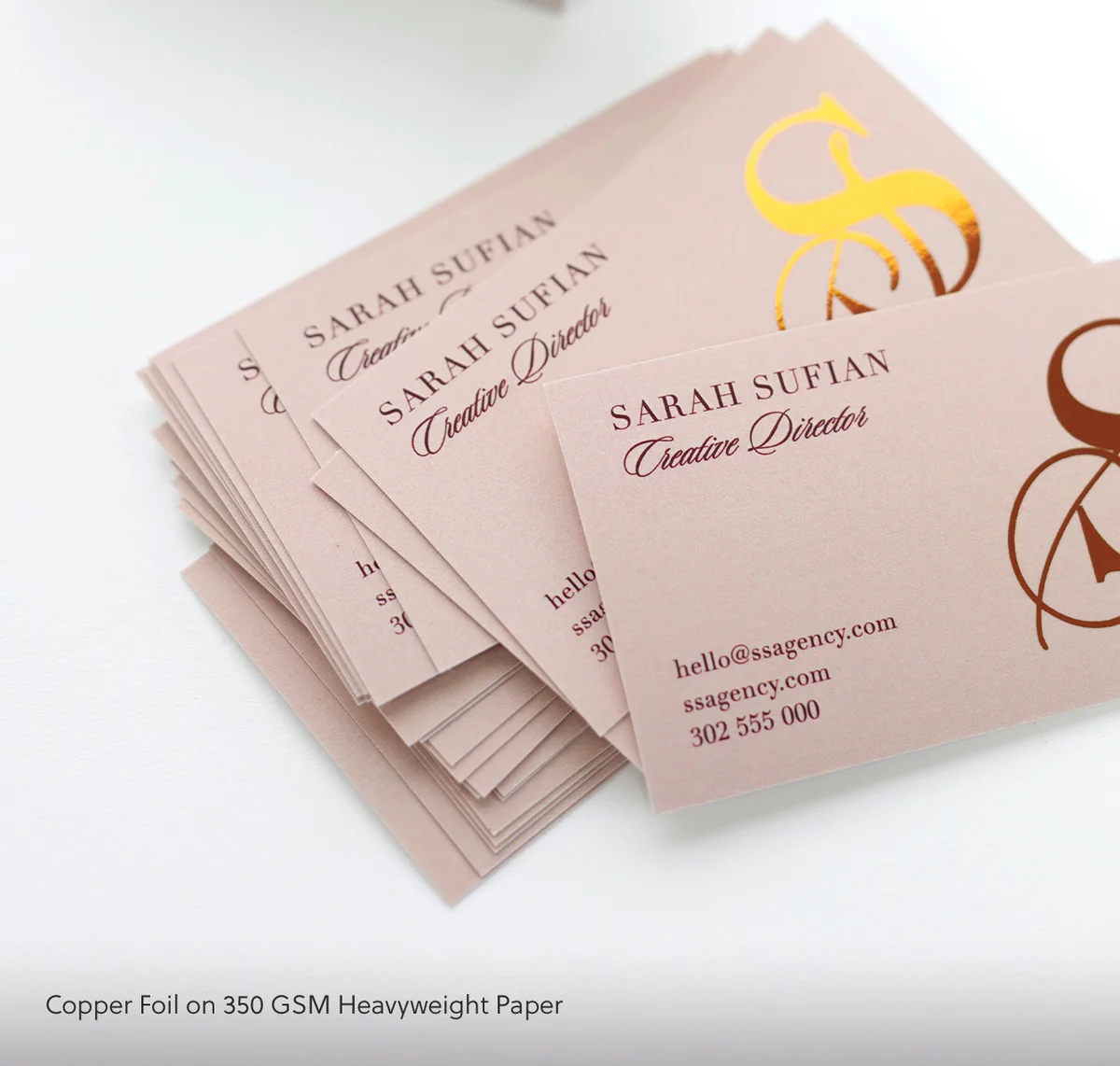
True Black Paper vs Printed Black on White Stock
The single most important technical distinction in black business cards is whether the card uses a genuine black coloured paper stock, or whether standard white card has been printed over with black ink. The visual difference between these two approaches is significant, and most buyers who have held both understand immediately why true black paper is the superior choice for a premium result.
The edge problem with printed black
When black ink is printed on white card stock, the face of the card appears dark. But the edges tell a different story. The paper substrate – white underneath – shows at the cut. Looking at the card from the side reveals a white or off-white band running the entire perimeter. On a standard card printed with 100% black ink, this edge contrast is visually jarring, particularly when the card is handed to someone and turned over naturally during inspection.
Achieving a clean edge on printed-black requires either an extremely heavy ink lay-down (which can crack or scuff with handling) or an additional edge-colouring step that most commercial printers do not include in a standard run. Neither approach matches what true coloured paper achieves automatically.
What true black coloured paper delivers
True black coloured paper is manufactured with colour throughout the substrate. The edges, the core, the face, and the back are all the same deep black. There is no white reveal at the cut because there is no white substrate beneath to reveal. The card reads as black from every angle, under any lighting condition, after any amount of handling.
Beyond edge quality, true black paper has a surface character that printed black cannot replicate. The stock carries a slight texture and an uncoated, softly matte finish. It absorbs ambient light differently from a printed-over-laminate surface, giving the card a warmer, more substantial presence. This tactile quality – the way the card feels, not just looks – is part of what makes coloured-paper black cards perform differently at the moment of handoff.
The design constraint to plan around
Printing onto black paper means standard CMYK text and imagery behaves very differently from printing on white. Dark text on black disappears. Photos printed directly on black stock lose tonal range. This is not a flaw – it is the design constraint that shapes how effective black business cards are built. The answer is to use print methods suited to dark substrates: foil, spot UV, Scodix, or placing text-heavy information on the back panel on a white or lighter layer.
For buyers who want a true-black-paper card at Paperlust Print Shop, the starting point is the coloured paper business cards range.
Black Coloured Paper Business Cards at Paperlust Print Shop
Paperlust Print Shop’s coloured paper business cards use a genuine European ECF/FSC-certified coloured card stock. The black option delivers a true, through-and-through black substrate with a matte uncoated surface. This is the foundation for virtually every premium black card aesthetic described in this guide.
Stock specifications
- Substrate: European coloured card, ECF/FSC certified, black option
- Weight options: 270gsm or 500gsm – the 500gsm option creates an unusually substantial feel in hand
- Surface: Matte, uncoated – tactile and light-absorbing rather than reflective
- Production: 24-hour turnaround available on coloured paper business cards
- Pricing: From $0.43 per card (inc. GST) – compared to $0.08 per card for standard white business cards
- Format: Standard business card dimensions (90mm x 55mm)
What to print on black paper
On a true black substrate, your effective options for visible artwork are foil (raised or flat), spot UV gloss, Scodix raised polymer, or content placed on the back of the card on a white or lighter-coloured panel. White ink on black is a specialist process discussed separately below. The coloured paper range pairs with the foil and finish options covered throughout this guide – selecting your finish at the time of ordering builds the combination into a single card.
True Black Paper Business Cards – From $0.43/card
Paperlust Print Shop’s coloured paper range uses genuine European coloured card stock – true black throughout, not printed-over-white. Available in 270gsm and 500gsm with 24-hour production on standard orders. Add foil, spot UV, or Scodix to complete the look.
Foil on Black – Colour Combinations and What Each Achieves
Foil is the natural partner for black business cards. When metallic foil is applied to a true black substrate, the result is cleaner and more vivid than the same foil on white – because the foil sits directly on the dark surface with no competing ink beneath it. The metallic catches light against the matte black background sharply and without interference from a lighter substrate reading through.
Paperlust Print Shop offers foil in two formats on black paper: raised foil (the tactile, premium version with a dimensional impression above the card surface) and flat foil (the faster, more affordable version without the raised dimension). Both deliver a true mirror-bright metallic finish. The choice of foil colour is where the aesthetic character of the card is determined.
Foil colour by visual character and industry fit
| Foil Colour | Character on Black | Best Industry Fit | Notes |
|---|---|---|---|
| Gold | Rich, warm, highest contrast against black | Luxury hospitality, high-end real estate, boutique finance, jewellery | The classic combination; instantly reads as premium across any industry |
| Silver | Cool, precise, high contrast with modern restraint | Architecture, technology, creative agencies, medical aesthetics | More contemporary than gold; suits minimal geometric logos and wordmarks |
| Rose Gold | Warm, approachable luxury without the formality of gold | Boutique beauty, wellness, interior design, wedding industry professionals | Bridges premium and personal; growing in popularity across AU hospitality |
| Copper | Warm, distinctive, deeper and earthier than rose gold | Craft bars and restaurants, artisan brands, music industry, fashion | Differentiated from gold; rarer and tends to generate conversation at handoff |
| Holographic | Rainbow spectral shift – eye-catching and kinetic | Music, entertainment, digital creative studios, streetwear brands | High-impact statement; works best on bold, simple logo marks rather than fine type |
| Pale Gold | Softer than standard gold; champagne warmth without high contrast | Luxury skincare, fine dining, premium beauty and fragrance brands | Less ostentatious than full gold; still highly legible on black substrate |
Raised foil vs flat foil on black paper
Raised foil adds a tactile dimension beyond the metallic visual – you can feel the foil element sitting above the card surface when you run a finger across it. This tactile relief makes the handoff experience more memorable and is perceptible immediately when someone picks up the card. Raised foil has a slightly longer production timeline to accommodate the foil stamping process, and does not qualify for 24-hour turnaround.
Flat foil delivers the same mirror-bright metallic surface without the raised dimension. It is faster to produce (available with 24-hour turnaround) and the per-card cost differs. For budgets where the visual impact of metallic-on-black matters more than tactile dimension, flat foil is a strong choice. For face-to-face handoffs where the card is meant to be noticed and held, raised foil earns the upgrade.
See the foil business cards guide for a detailed breakdown of the two techniques, including artwork requirements and minimum order information.
Gold and Silver Foil on Black – The Signature Combination
Paperlust Print Shop’s raised foil business cards deliver a mirror-bright metallic impression on true black stock. Available in gold, silver, rose gold, copper, holographic, and more – with a tactile relief that makes the card memorable to hold. From $0.24 per card (inc. GST).
Spot UV on Black – The Tonal Black-on-Black Effect
Spot UV on black creates one of the most sophisticated effects available in business card printing – and one that most people have never encountered until they hold a card that uses it. The technique applies a selective gloss coating to specific elements on a matte black surface. The result is a tonal contrast: gloss black reading against matte black, visible primarily as the card moves in light.
At a direct viewing angle, the spot-UV elements are subtle – a slight sheen difference. Tilt the card and the light catches the gloss areas sharply, making the logo or name appear to emerge from the surface. It is an effect built for the moment of handoff, when a person naturally tilts the card to read it and the treated elements suddenly become visible.
When spot UV on black works best
- Logo marks with strong shapes – spot UV rewards simple, bold geometry over fine text detail; hairlines and very small type can lose the effect in the coating
- Brands that avoid overtly metallic aesthetics – some industries (architecture, certain legal and finance sectors) find foil too decorative; spot UV delivers premium differentiation without the overt shimmer
- Cards where the face is pure brand surface – spot-UV logo on matte black front, contact information on a white or light back panel; the front functions as an identity object rather than a contact card
- Volume orders where cost matters – spot UV business cards start from $0.14 per card (inc. GST), making the aesthetic accessible at scale
Combining spot UV with duplex construction
A popular approach for the tonal-luxury aesthetic is a duplex construction: a true black front panel with spot UV, bonded to a white or contrasting back panel for text and QR code. Duplex business cards create an extra-thick card that reveals a colour contrast at the edge – a construction detail that communicates craft and quality without requiring metallics.
Raised Foil on Black – Premium Tactile and Visual Relief
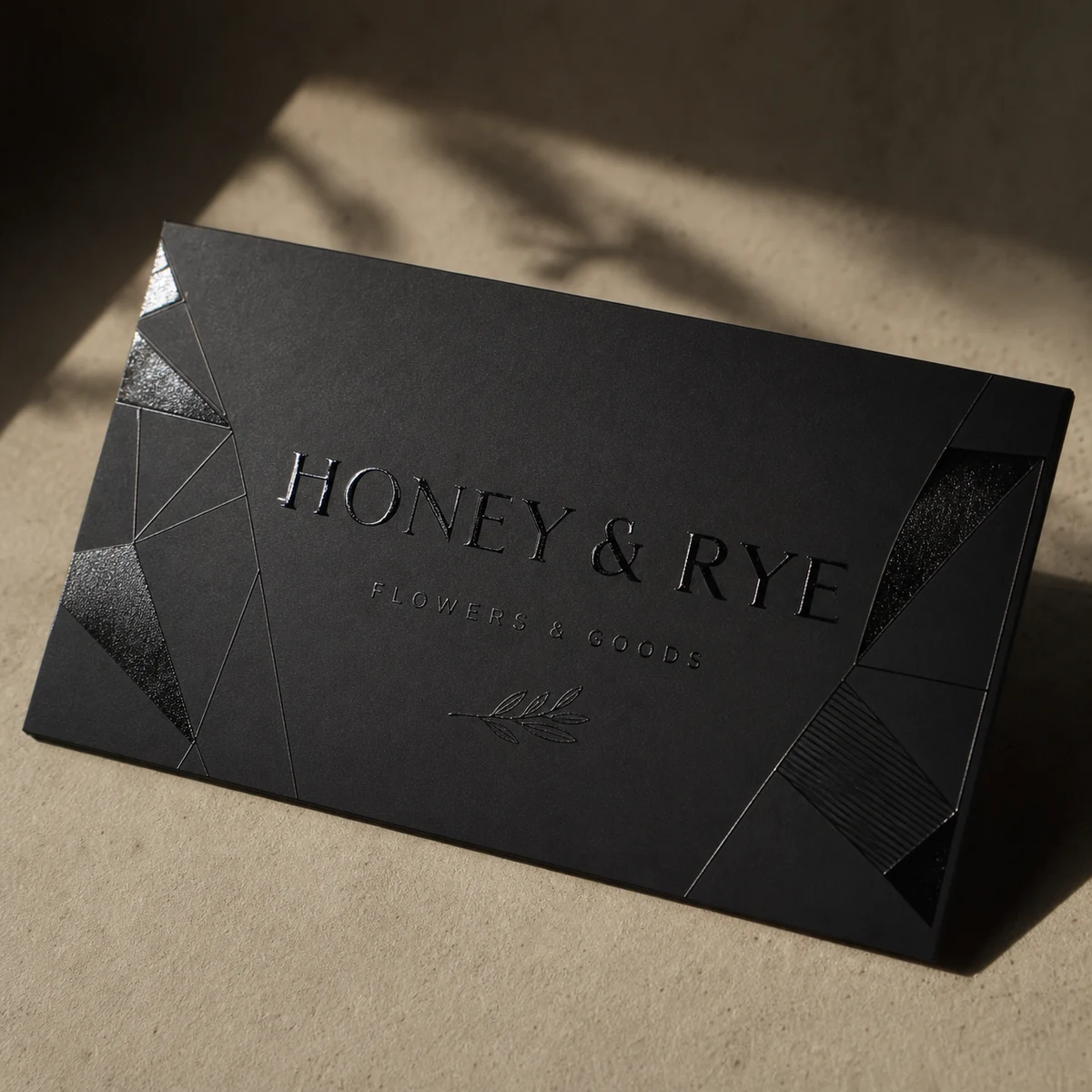
Raised foil sits at the top of the black business card format hierarchy. It combines the mirror-bright visual impact of metallic foil with a tactile relief – a slight but perceptible dimension above the card surface. Where flat foil is a visual treatment, raised foil is something you feel as well as see.
The process uses a heated die to press foil onto the card surface under controlled pressure, creating both the adhesion of the foil and a slight impression into the stock. The result is a logo or wordmark that has optical and tactile presence simultaneously. In a luxury retail or high-end hospitality context – where the card is handed across a counter or table – that tactile moment at pickup matters. The person receiving the card feels the impression under their thumb before they have read a single word.
When raised foil is worth the investment
- Your logo mark is bold enough to carry the dimensional treatment – very fine script or tiny type loses the relief in the finish process
- The card will be handed directly to individuals rather than mailed or bulk-distributed – the tactile element is experienced in person, not through an envelope
- Your brand competes at a premium price point where the perceived quality of physical collateral influences client decisions
- You are ordering at a quantity where the per-card rate makes sense for your budget – raised foil is priced from $0.24 per card (inc. GST)
Production for raised foil takes longer than standard or flat-foil options – plan accordingly and do not expect 24-hour turnaround for this format. Browse the full range at raised foil business cards.
Scodix on Black – Raised Clear Gloss for Textural Depth
Scodix is a raised clear gloss technique that creates a dimensional texture on the card surface without adding metallic colour. On a black substrate, Scodix produces a tonal-textural effect – similar in concept to spot UV, but with a significantly more pronounced three-dimensional relief that you can feel clearly under a fingertip.
The Scodix process builds up a polymer layer on selected areas of the card. Visually, the treated areas catch light differently from the surrounding matte black, creating depth and movement across the card surface. The effect is subtle when the card is stationary, conspicuous when it moves in light – which again maps perfectly to the handoff moment.
Scodix vs spot UV – the key difference for black cards
Both Scodix and spot UV create a gloss-against-matte tonal effect on black cards, but they are distinct treatments. Spot UV is a flat, surface-level gloss coating – you see the contrast but barely feel it. Scodix builds up a raised polymer layer with a tactile dimension similar in depth to raised foil, but delivering a clear gloss rather than a metallic finish.
The choice between them: if you want a visual tonal effect that is refined and subtle, spot UV is the more calibrated choice. If you want a textural tonal effect that rewards close inspection and touch, Scodix is the stronger option. For fashion and design industries where tactile detail is a deliberate signal of craft, Scodix on black makes a definitive statement.
Scodix business cards are available from $0.20 per card (inc. GST). Visit the Scodix business cards page for specifications and options.
White Ink on Black Cards – What to Know in Australia
White ink is a legitimate print technique for dark substrates, and it delivers readable text and graphics on black paper by printing a true white fifth-colour ink over the dark stock. In theory, it solves the contrast problem directly: white text on black reads clearly without foil or any other embellishment.
In practice, white ink on business cards is a specialist option. Most Australian print providers – including Paperlust Print Shop – do not routinely offer white ink as a standard business card specification. The technique requires a dedicated fifth-colour print unit and stock types that differ from the standard coloured-paper workflow. The results also require careful colour management: white ink can appear slightly translucent or uneven on certain surfaces without the right process control, and the opacity varies by printer and substrate combination.
What to do instead
If you need a white or light element on a black business card – a logo, a name, a URL – the most reliable and visually impactful approach is foil stamping in silver. Silver raised foil on black reads as a crisp, bright element that is, in many lighting conditions, more legible than printed white ink. It also benefits from the durability and tactile quality of the foil process.
For clients with a genuine white-ink requirement, the recommendation is to contact the Paperlust Print Shop team directly to discuss the specification. Where white ink is the right technical choice for the job, the team can advise on available options. For most use cases, silver foil delivers a more reliable and visually stronger result.
What Gets Lost on Black Business Cards
Black is not an upgrade for every business card design. Specific elements lose legibility, scannability, or visual impact when moved to a dark substrate. Knowing what to adjust before you finalise artwork avoids expensive reprints.
Low-contrast typography
The most common design error on black cards is using mid-grey or light-grey text. On white paper, a 60% grey reads clearly. On black paper, 60% grey disappears – it simply does not have enough contrast to read against the dark background. Any text element that carries information – name, title, phone number, website – needs either foil treatment or placement on a back panel with a lighter surface.
The safest text approach for black cards: use foil for the primary name or logo on the face, and put all contact information on the card back on a white or light-coloured panel. This sidesteps the contrast problem entirely and is how most premium black business cards are actually structured in practice.
Photographic images
Full-colour photography on black stock is problematic because the dark substrate shifts the tonal register of every colour in the image. Shadow areas merge with the background. Highlight areas may render, but midtones lose separation they would carry on white paper. The image will look different from any on-screen proof.
If photography is a critical element – as it is for real estate agents or commercial photographers – it works best on the back of the card on a white or light panel. Keep the black face as a pure brand surface with foil or spot UV treatment only.
QR codes
A QR code printed in dark ink on a black background cannot be scanned. QR readers require sufficient contrast between the code elements and the background to identify the pattern. A dark-on-dark QR code will fail to register with any reader.
The solution is to create a white or light-coloured panel behind the QR code on the card – even a small rectangular block – so the code reads clearly. Alternatively, QR codes sit on the back panel on a white surface. What you must never do is print a standard dark QR code directly over a black substrate and expect it to function.
Pale colour elements and brand palettes with light tones
Pastels, light blues, soft pinks, and other low-saturation light colours that work well on white card will not translate to black stock. If your existing brand palette depends on these lighter tones, true black paper is likely incompatible with your current brand assets without redesigning those elements specifically for the dark substrate. This is not a dealbreaker – many brands create a black-card version of their assets alongside their standard palette – but it is a step that needs to happen before print-ready artwork is submitted.
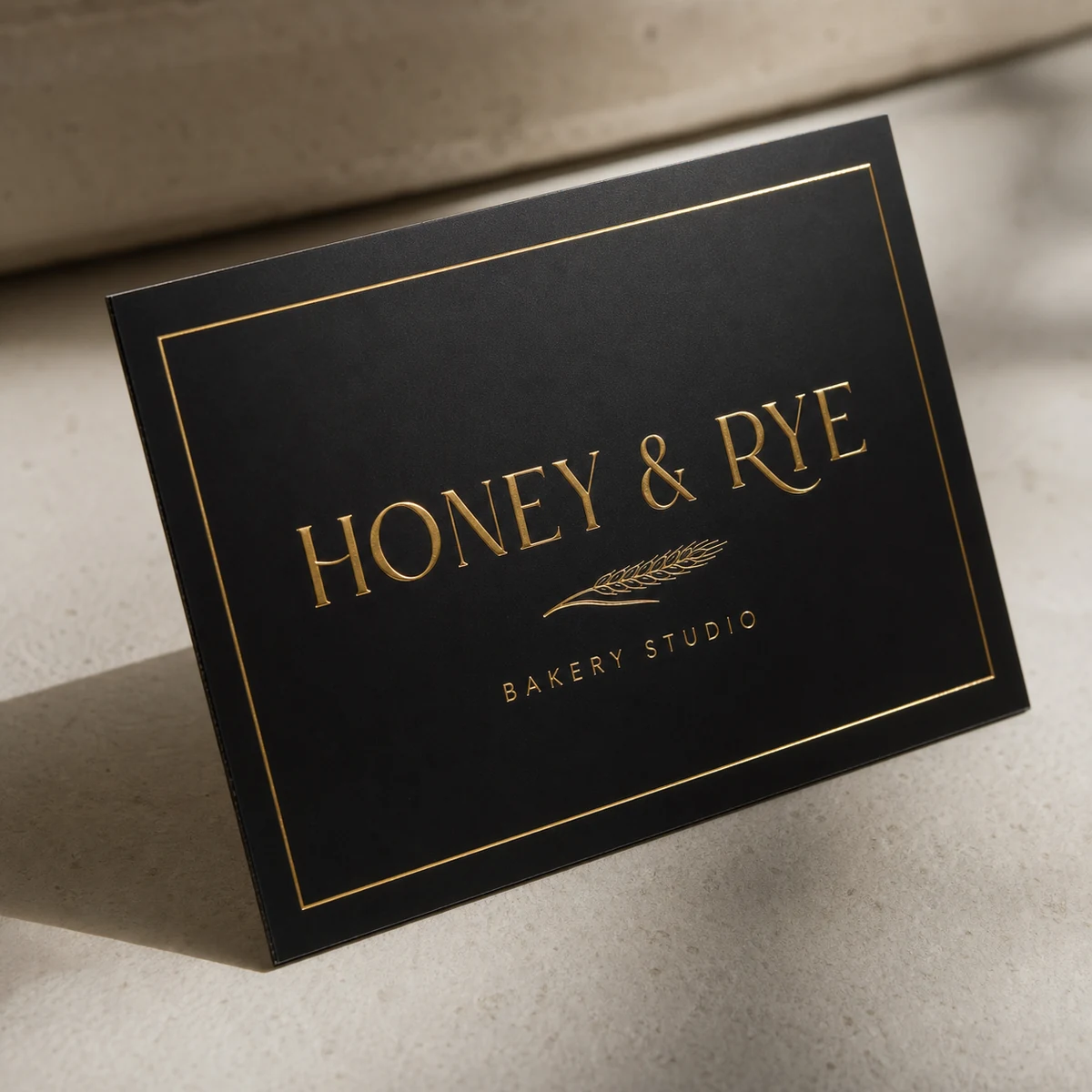
Design Directions for Black Business Cards
The most effective black business card designs share one characteristic: they treat the dark substrate as an intentional design choice, not a default background. Here are ten specific design directions that work reliably on black cards, with the finish recommendation for each.
| Design Direction | Finish Recommendation | Who It Suits |
|---|---|---|
| Minimalist gold foil signature – name only on the front in gold raised foil; back is plain matte black or carries contact details on a white reverse panel | Raised foil (gold) on coloured black paper | Directors, partners, senior executives where the name itself is the brand signal |
| Full-bleed black + raised foil logo mark – no text on the face at all; logo mark only in gold or silver raised foil; all information on back | Raised foil on coloured black paper, duplex construction | Creative agencies, architecture firms, luxury fashion brands |
| Tonal monogram – large initial or monogram in spot UV gloss on matte black; invisible at rest, striking when the card tilts in light | Spot UV on coloured black paper | High-end hospitality, boutique professionals, luxury real estate agents |
| Type-only architectural – all caps, tight tracking, name and title in silver raised foil; no logo; the geometry of the type is the entire design | Raised foil (silver) on coloured black paper | Architects, interior designers, industrial designers, typographers |
| Copper logo on black – warm metallic mark; copper reads as deliberate and differentiated from the gold default; generates conversation | Flat foil (copper) or raised foil (copper) on coloured black paper | Craft bars and restaurants, music industry, artisan and maker brands |
| Holographic foil statement mark – brand icon in holographic foil; catches all wavelengths of light and shifts as the viewing angle changes | Flat foil (holographic) on coloured black paper | Music producers, entertainment companies, streetwear and youth brands |
| Scodix texture pattern – geometric or organic texture in raised clear Scodix across the full card face; subtle depth that rewards close handling | Scodix on coloured black paper | Fashion, luxury retail, design-conscious professionals and studios |
| Duplex contrast edge – black outer bonded to a white or coloured core; the edge reveals both layers; no foil needed; the construction is the detail | Duplex construction with black outer panel | Design agencies, brand consultants, typographers |
| Rose gold on black – warm metallic against matte black; approachable premium; less formal than gold, warmer than silver | Raised foil (rose gold) on coloured black paper | Beauty, wellness, interior design, wedding planners and stylists |
| Scan-forward minimal – black face with a foil logo mark; white QR panel on the back only; the front functions as a pure identity object | Raised foil (gold or silver) on black paper, white back panel | Tech founders, consultants, freelancers with a strong digital presence |
For broader inspiration on current design directions across all finishes and formats, the business card design trends 2026 guide covers emerging aesthetics in depth.
By Industry – When Black Works and When It Doesn’t
Black business cards signal premium intent. But premium intent is not the right signal for every profession or context. The industries where black works best share a common characteristic: the recipient already operates within a visual framework where dark, understated, or luxury cues are familiar and expected. Where those conditions do not exist, a black card can read as out of place rather than elevated.
Industries where black cards are a natural fit
- Luxury hospitality – high-end restaurants, boutique hotels, cocktail bars and private dining venues; black cards are standard at the premium end of Australian hospitality and a dark-stock card handed at the chef’s table is entirely on-brand
- Fashion and luxury retail – the black card signals brand seriousness; gold foil on black is a near-universal premium retail choice across Australian fashion and accessories
- Creative agencies and design studios – the card itself is treated as brand collateral; black demonstrates design confidence and aesthetic self-awareness
- Architecture and interior design – monochrome, geometric and typographic aesthetics prevail in these sectors; black cards with silver raised foil or spot UV sit directly within the studio aesthetic
- Commercial and fine-art photography – the card is treated as an object; a black card communicates that image quality and deliberate aesthetic decisions are core to the practice
- Music industry – talent managers, producers, label representatives, promoters; dark cards are standard professional collateral in the Australian music ecosystem
- Luxury real estate – the premium residential tier where brand positioning is part of the agent’s value proposition and a card that reads cheap undermines the listing
- Boutique finance – private wealth management, alternative investments, family offices; a black card with gold or silver foil reads as serious without appearing ostentatious
- Medical aesthetics and cosmetic studios – high-end cosmetic clinics and aesthetic practices position in the luxury-health space where dark, clean cards align with the brand register
Industries where black cards are likely the wrong choice
- Clinical medical and healthcare – clinical professionalism signals approachability and trust; dark cards can feel cold in patient-facing contexts where warmth and accessibility are the priority
- Accounting and traditional legal – conservative professional services where navy, charcoal-on-cream, or white-card formats carry established authority; a black card risks reading as unconventional rather than premium
- Children’s services and education – warmth, colour and approachability are the visual grammar; black signals the opposite of these and can create dissonance with parents and families
- Government and public sector – institutional contexts where format consistency is expected; an unusual card choice reads as out of place rather than confident
- General trades and construction – practical utility matters more than aesthetic positioning; a black card that shows handling wear more visibly than white may be counterproductive in a sector where the card is often pocketed and retrieved from worksites
The test for borderline cases: would a client or professional peer immediately understand the black card choice as intentional and appropriate for your sector, or would it require explanation? If it requires explanation, the card is working against the brand.
For more guidance on matching print choices to brand positioning, the how to choose the right business cards guide walks through the full decision framework.
Artwork Preparation and Production Specs
Getting the artwork right before sending to print is critical for black card designs with foil. Unlike standard CMYK printing, foil processes require specific file setup that differs from what most design software exports by default. Submitting artwork incorrectly is the most common cause of delays and reprints.
File setup for foil on black cards
- Foil artwork as a separate layer or file. The foil element cannot be embedded in the main CMYK file as a coloured design element. It must be provided as a standalone vector file indicating the exact area to receive foil – typically a separate PDF with a 100% black solid fill on a white background, where black indicates the foil area and white indicates no foil.
- Vector-only for all foil elements. Artwork intended to receive foil must be in vector format – clean paths, not rasterised images. Foil requires a precise die, and foil element edges must be clean vector curves or lines. Raster logos must be vectorised before they can receive foil treatment.
- Knockout vs solid background for foil placement. For most black-card applications, a knockout is correct: the foil is applied directly to the black paper surface with no printed ink beneath the foil area. This gives the cleanest adhesion and the highest visual contrast between foil and substrate. Printing additional ink beneath the foil area can interfere with adhesion and reduce the quality of the finish.
- Minimum foil element size. Foil stamping has a practical minimum detail threshold – very fine script or hairline elements may not retain foil cleanly through the stamping process. Bold, clear geometry and solid letterforms perform best. If your logo includes very fine detail, discuss the artwork specification with the Paperlust Print Shop team before finalising your order.
Card face design rules for black stock
- Do not place readable text directly on the black face unless it is delivered via a print method that provides sufficient contrast – foil, spot UV, or a process the team has confirmed will work for your specific requirement.
- Bleed requirements apply as standard – 2-3mm bleed on all edges; on true black coloured paper this is especially important because edge alignment is clearly visible on the finished card.
- Safe zone for foil elements – keep foil elements at least 3mm from card edges to accommodate minor registration variation in the foil stamping process.
- File resolution for any non-foil elements – if you are printing on the back of the card on a white panel, that artwork should be submitted at 300dpi minimum at print size; the standard CMYK file prep rules apply to that panel in the same way they would for any white-stock card.
For a full breakdown of file setup, artwork decisions, and the ordering errors that most commonly cause reprints, the common business card mistakes guide covers the critical steps in detail.
Black Business Card Pricing in Australia
Black business cards cost more than standard white business cards across every format. The premium reflects the specialised paper stock, the more complex print processes involved in foil and finish techniques on dark substrates, and lower production volumes compared to standard white-card runs. The price uplift varies significantly depending on which finish you select.
Price comparison by format (Paperlust Print Shop, inc. GST)
| Format | From (per card, inc. GST) | Notes |
|---|---|---|
| Standard white (baseline) | $0.08 | Reference point; white stock, CMYK digital print |
| Spot UV | $0.14 | Competitive entry price; tonal gloss effect on matte black; not available with 24-hour turnaround |
| Scodix | $0.20 | Raised clear polymer; more tactile than spot UV; longer production timeline |
| Raised Foil | $0.24 | Mirror-bright metallic with tactile relief; premium face-to-face handoff experience; longer production |
| Coloured Paper (black stock) | $0.43 | True black European coloured card; 24-hour production available; pairs with foil and finish options |
| Flat Foil | $0.18 | Mirror-bright metallic without tactile dimension; 24-hour production available; higher per-card from price reflects foil process |
| Duplex | $2.27 | Double-layer bonded construction; extra-thick; edge contrast visible; longer production |
Order a sample before committing to a production run
For aesthetic-led buyers – which most black business card purchasers are – ordering before you have held the actual stock and finish in person carries real risk. The difference between printed-black and true coloured paper, between matte and spot UV on black, and between flat and raised foil is significant physically and practically invisible in digital proofs or screen renderings.
The business cards sample pack at Paperlust Print Shop lets you hold real examples across the key finishes before committing to a production run. For orders where per-card cost sits between $0.43 and $2.27 and quantities start at 250 cards or more, the investment in a sample pack first is easily justified.
Try Before You Commit – Business Cards Sample Pack
The difference between finishes is dramatic in person and nearly invisible on screen. Order the Paperlust Print Shop sample pack to hold examples of coloured paper, raised foil, spot UV, and Scodix before placing your production run. The investment is small; the confidence in your choice is significant.
Frequently Asked Questions
Are Paperlust Print Shop black business cards printed black or true black paper?
Paperlust Print Shop’s black option in the coloured paper business cards range uses a genuine European coloured card stock – black throughout the substrate, not a white card printed with black ink. The edges, the core, and both faces are all the same deep black. If you order standard business cards with a black design, those are printed on white stock. To get true black paper, select the coloured paper business cards range specifically.
Can I get gold foil on black business cards?
Yes. Gold foil on black is the most popular premium combination at Paperlust Print Shop. It is available in two formats: raised foil (tactile, dimensional impression, from $0.24 per card inc. GST) or flat foil (flat mirror-bright surface, faster production, from $0.18 per card inc. GST). Both deliver a true metallic gold finish on a true black substrate. The coloured paper range supports both foil options.
Will my white logo show up on a black business card?
Not via standard CMYK printing. The most reliable way to get a bright, legible logo element on a black card is to use silver raised foil or flat foil – silver foil on black reads as a crisp, high-contrast metallic mark that often outperforms printed white ink for legibility and longevity. White ink is a specialist technique that Paperlust Print Shop does not routinely offer for business cards; contact the team directly if you have a specific white-ink requirement.
Do you print on both sides of black business cards?
Yes. Black coloured paper business cards can be printed on both sides. The most common configuration is a black-substrate face with foil or spot UV treatment, and a back panel on a white or lighter surface for contact details and QR codes. The duplex range also allows a black outer panel bonded to a contrasting inner colour for extra thickness and a visible edge contrast detail.
Is matte black or gloss black more premium?
In Australian professional contexts, matte black consistently reads as more premium than gloss black. The uncoated matte surface of true coloured black paper absorbs light in a way that gloss cannot match – it has depth and warmth rather than surface reflection. Gloss black shows fingerprints and handling marks more visibly, and can appear cheaper when compared to a well-executed matte card. The standard surface for premium black business cards is matte or uncoated, with spot UV or Scodix used selectively to create gloss contrast against that matte base.
Can I add a photo to a black business card?
Photos on true black paper stock rarely render well because the dark substrate shifts the tonal register of the image significantly – shadow areas merge with the background and midtones lose separation. The recommended approach is to place any photo element on the back of the card on a white or light panel, keeping the black face as a pure brand surface with foil or spot UV treatment only. A duplex construction makes this straightforward, with a white back panel bonded to the black front.
Is white ink an option for black cards at Paperlust Print Shop?
White ink on business cards is a specialist technique that Paperlust Print Shop does not routinely offer as a standard specification. For most use cases, silver foil is the recommended alternative – it delivers a bright, contrast-rich result on black that often outperforms printed white ink for legibility and finish quality. Contact the Print Shop team directly if you have a specific white-ink requirement and need to discuss options.
What foil colour is most popular on black business cards?
Gold is the most popular foil choice on black business cards across all industries at Paperlust Print Shop. It offers the highest contrast against the dark substrate and is universally recognised as a premium signal across Australian professional contexts. Silver is the second most popular, particularly among architecture, technology, and contemporary creative studios where gold reads as too warm or traditional for the brand aesthetic. Rose gold and copper are growing in popularity across beauty, wellness, and hospitality sectors.
How long does it take to produce black business cards with foil?
Production timelines depend on the finish selected. Coloured paper business cards without additional finish treatments have 24-hour production available. Raised foil, spot UV, Scodix, and duplex constructions require longer production timelines – do not expect 24-hour turnaround on these formats. Contact Paperlust Print Shop directly for current lead times on the specific format you are ordering, particularly if you have a deadline.
Can I get a sample of black business cards before ordering a full run?
Yes – and for an aesthetic-led order like black foil or spot UV cards, ordering a sample first is strongly recommended. The difference between finishes is significant in person and nearly invisible on screen. The business cards sample pack includes examples across the key finishes available at Paperlust Print Shop. A custom sample is also available for most print methods – check current availability at the time of ordering.
Are black business cards more expensive than white cards?
Yes. True black coloured paper stock costs more than standard white stock, and the finish techniques applied to black cards – raised foil, spot UV, Scodix – each carry their own price points. As a reference, coloured paper business cards start from $0.43 per card (inc. GST) compared to $0.08 per card for standard white. The custom business cards hub lists all available options with current pricing for a live quote at your required quantity.
What is the minimum order for black foil business cards?
Minimum order quantities vary by format. As a general guide, coloured paper business cards, spot UV, and Scodix options are accessible at lower quantities than some flat foil weight options. Check each individual product page for current minimums, or contact the Paperlust Print Shop team if you need a specific quantity and want to confirm availability before proceeding.