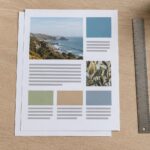
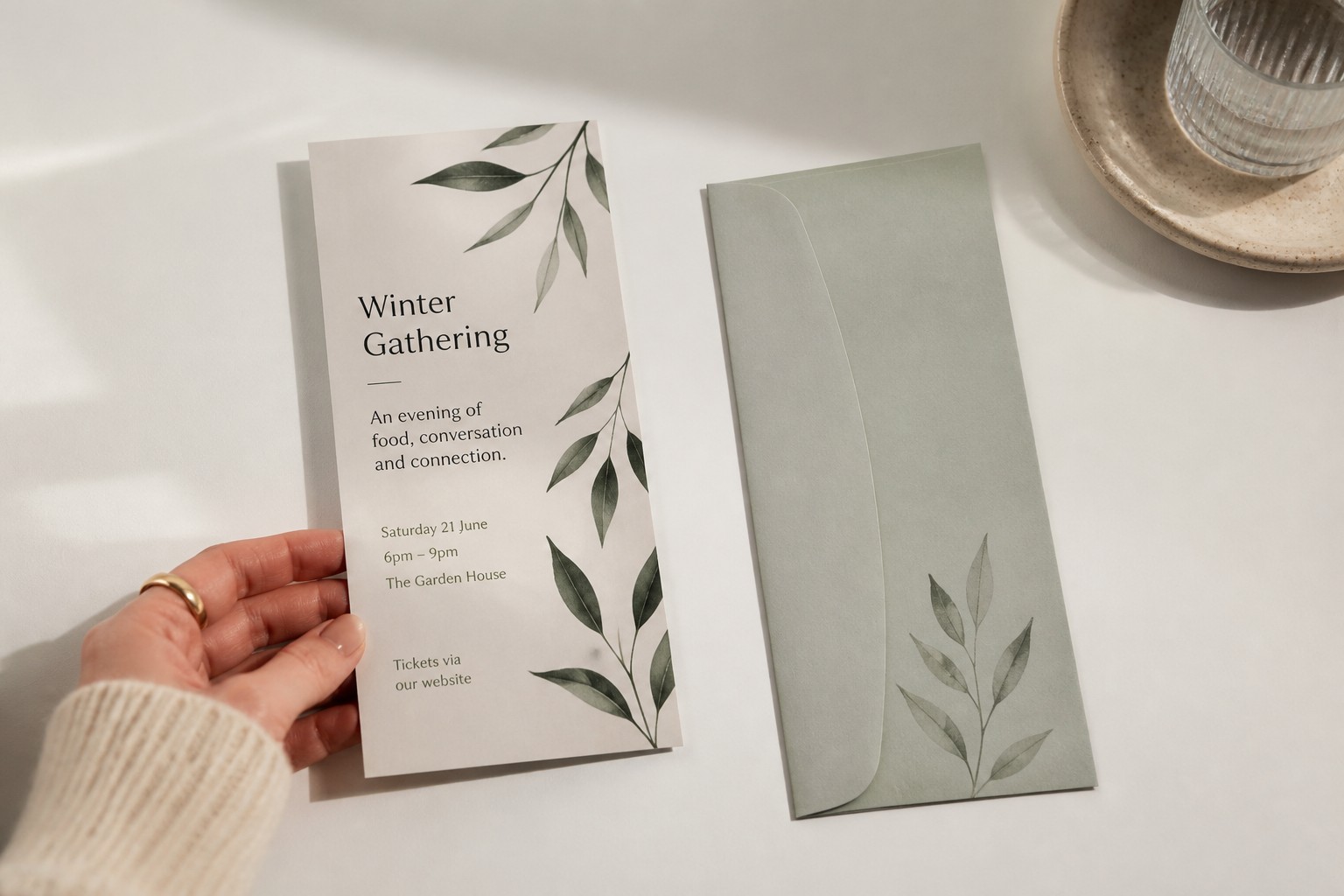
A DL flyer is 99mm x 210mm, equal to 9.9cm x 21cm or 3.9 x 8.3 inches. It is exactly one third of an A4 sheet, fits a 110mm x 220mm DL envelope unfolded, and slides into a standard brochure rack.
| Format | Millimetres | Centimetres | Inches |
|---|---|---|---|
| DL flyer | 99 x 210 mm | 9.9 x 21.0 cm | 3.9 x 8.3 in |
Paperlust Print Shop prints DL flyers across three paper stocks, front only or front and back, starting from $0.32 per flyer at 250 units and $0.04 per flyer at 5,000 units (inc. GST). The full pricing table and all options are at printshop.paperlust.co/products/flyers.
- Size: 99mm x 210mm
- Relationship to A4: one third of a 297mm x 210mm sheet
- Fits standard DL envelope: yes (110mm x 220mm envelope)
- Stocks: 150gsm Gloss, 170gsm Matte, 250gsm Gloss
- Sides: front only (default) or front and back
- Bleed: 3mm per side, bleed file 105mm x 216mm
- Safe zone: 93mm x 204mm (3mm inside trim on every side)
- Price: $0.32 per flyer at 250 / $0.04 per flyer at 5,000 (inc. GST)
Why DL Is One Third of A4
The A4 sheet measures 297mm tall by 210mm wide. Divide the tall dimension into three equal parts and each part is 99mm. That is exactly where the DL height comes from: 99mm x 210mm, with the 210mm running the full width of the parent A4 sheet.
This relationship matters for two practical reasons. First, a designer can lay out three DL panels side by side on a single A4 artboard to preview the whole run at once. Second, it is why the standard A4 trifold brochure folds to exactly DL size. The two fold lines fall at 99mm and 198mm across the 297mm height, producing three panels that each measure 99mm x 210mm.
If you have existing A4 artwork and want to adapt it to DL, the width of 210mm stays the same. You crop the 297mm height down to 99mm, which gives you one DL panel. Repeat three times and you have a trifold.
Three Paper Stocks and What Each Feels Like
Paperlust Print Shop offers three stocks for DL flyer printing. Choosing the right one comes down to how the piece needs to feel in the hand and how many you are ordering.
150gsm Gloss is the most popular choice. It is noticeably stiffer and holds its shape when placed in a rack or handed out at the door. The gloss surface reproduces photographs and vibrant colours well. For most promotional flyers, this is the default to start with.
170gsm Matte carries a substantial weight and a flat, non-reflective surface. Copy is easier to read under mixed lighting, fingerprints are less visible, and the overall look is quieter and more restrained. A good choice when there is a lot of text on the page or the brand skews understated.
250gsm Gloss is card weight. At this thickness, a DL flyer feels more like a business card than a traditional leaflet: firm, rigid, and premium to touch. This stock works well as a restaurant menu insert, a product spec card at a trade show, or an event pass at venues where the piece needs to survive a full day in a pocket.
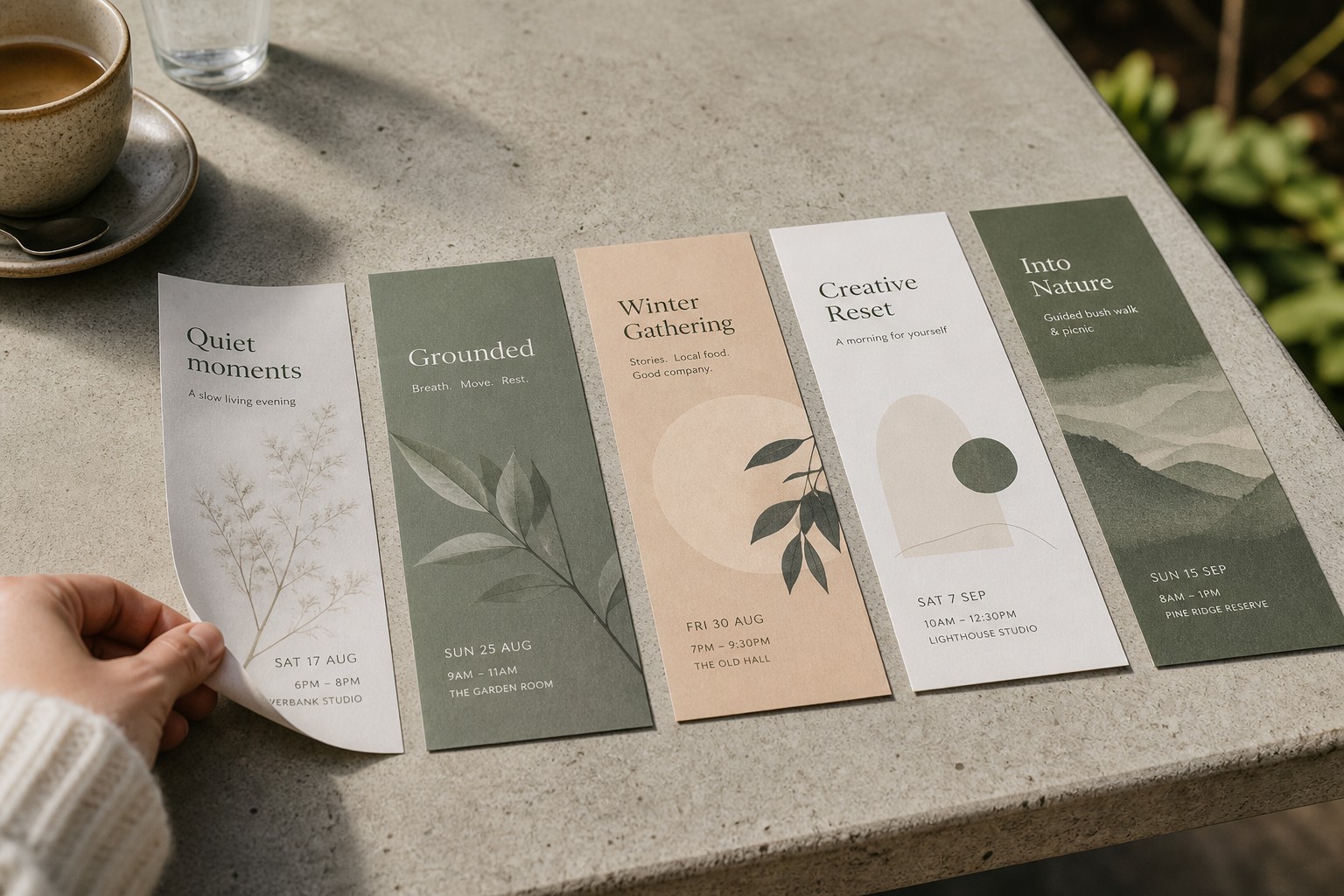
Where DL Flyers Work Best
The 99mm x 210mm format was built around two physical constraints: the standard DL envelope (110mm x 220mm, leaving around 5.5mm clearance on each side) and the standard brochure rack slot (typically 100mm to 105mm wide). DL is the only common flyer size that satisfies both without a holder insert.
Letterbox drops. A DL flyer fits a standard residential letterbox slot without jamming. The long, narrow shape also distinguishes it from an envelope, which increases the chance it gets read rather than recycled unopened.
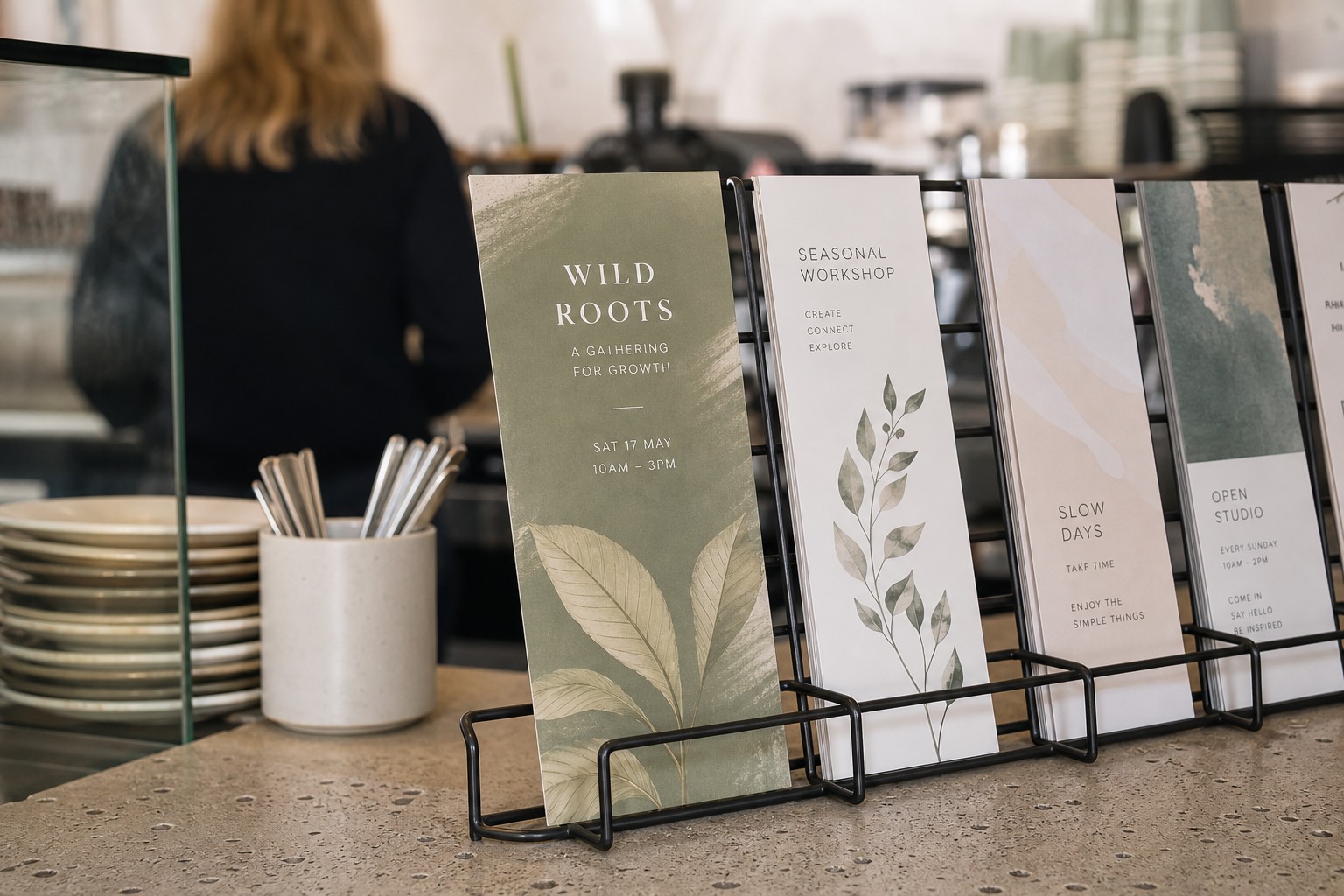
Rack cards. Cafes, hotel lobbies, real estate offices, and tourism visitor centres all use wire racks with DL-sized slots. DL is the format those racks were designed for. Placing an A5 or A4 piece in one of these racks requires a separate holder; a DL flyer drops straight in.
Menu inserts. On 250gsm stock, a DL flyer doubles as a firm menu insert. Placed inside a menu folder or slipped alongside the main menu, it carries specials, drinks lists, or seasonal updates without requiring a full reprint of the menu itself.
Event handouts. The narrow footprint means a DL flyer slips into a conference bag, slides into a goodie bag, or is carried in one hand while attendees move around. It is large enough to hold a schedule, map, or speaker list at a comfortable reading size.
Direct mail. Printed on 150gsm stock, a DL flyer fits a DL envelope for a direct mail campaign without folding. The flyer and envelope share the same DL footprint, which simplifies assembly.
Front Only or Front and Back
The default option is front only: your design covers one side and the reverse is left blank. This is the lower-cost choice and works well when the message is simple, such as a promotion, an event date, or a contact number.
Front and back printing gives you twice the space at the same physical size. Common uses include:
- Menus: food items on the front, drinks list or terms on the back
- Event programs: running order on one side, sponsor acknowledgements on the other
- Product sheets: key selling points on the front, technical specifications on the back
- Directions: an address and transport options on the front, a location map on the back
The cost difference between front-only and front-and-back is modest as quantities rise. If you have content for both sides, the back panel is rarely wasted.
Artwork Setup: 3mm Bleed
Set your document canvas to 99mm x 210mm. Extend any background colour, photograph, or pattern 3mm beyond the trim line on every side. This gives a bleed file of 105mm x 216mm.
Keep all critical content, meaning text, logos, and key imagery, at least 3mm inside the trim edge. The safe zone is 93mm x 204mm. Anything placed between the trim line and the safe zone edge may be cut during finishing, depending on the sheet position on the press.
Supply your file as a PDF with crop marks and bleed included, at a minimum of 300 DPI at the final print size.
DL Flyer Printing Cost
At Paperlust Print Shop, DL flyers are priced at $0.32 per flyer at 250 units and $0.04 per flyer at 5,000 units (all prices inc. GST). The full quantity ladder, including all quantities between those two points, is on the flyers product page.
The unit price varies with quantity and stock choice. Upgrading from 150gsm Gloss to 250gsm Gloss changes the price ladder. You pay a higher per-unit rate and receive a heavier, more premium stock.
How DL Compares to Other Flyer Sizes
DL (99mm x 210mm) is the tallest and narrowest of the five flyer sizes Paperlust prints. The table below shows how it sits alongside the others.
| Size | Dimensions | A-series relationship | Best for |
|---|---|---|---|
| DL | 99mm x 210mm | One third of A4 | Rack cards, letterbox drops, menus |
| A6 | 148mm x 105mm | One quarter of A4 | Postcard-style handouts, vouchers |
| A5 | 148mm x 210mm | Half of A4 | Image-heavy promotions, event posters |
| A4 | 210mm x 297mm | Standard A4 | Maximum information, detailed schedules |
| A3 | 297mm x 420mm | Double A4 | Large format, window displays |
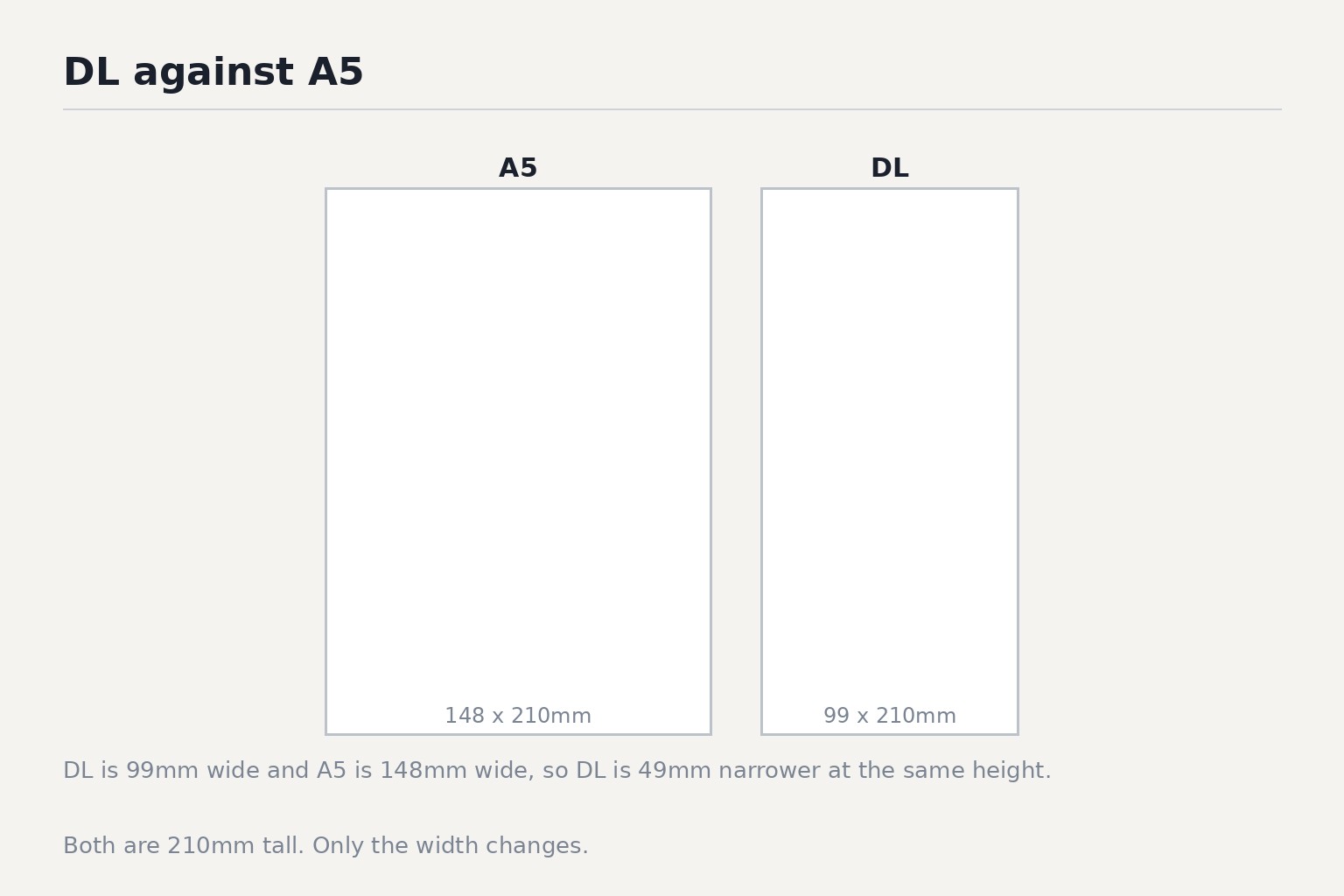
A5 (148mm x 210mm) shares the same 210mm height as DL but is 49mm wider. It suits layouts where an image needs more horizontal room, or where two columns of copy are more readable than one. For the full size selector and pricing across all five formats, see the flyers product page.
Frequently Asked Questions
What is the exact size of a DL flyer in mm?
A DL flyer is 99mm wide by 210mm tall. This is exactly one third of a standard A4 sheet and the same insert size as a standard DL envelope.
Does a DL flyer fit a standard DL envelope?
Yes. A standard DL envelope is 110mm x 220mm, which leaves approximately 5.5mm of clearance on each side when a 99mm x 210mm flyer is inserted. Lighter 150gsm stock slips in without resistance. The stiffer 250gsm Gloss may feel snug in some envelopes, so testing one piece before sealing a large mail run is recommended.
What bleed do I need for a DL flyer?
Set 3mm bleed on every side. Your artwork file should be 105mm x 216mm. Place crop marks at the 99mm x 210mm trim boundary and keep all critical content, such as text and logos, within the 93mm x 204mm safe zone (3mm inside the trim on each side).
Which paper stock is best for a DL flyer?
For most promotional flyers, 150gsm Gloss gives a good balance of stiffness, print quality, and cost. For high-volume letterbox drops, 150gsm Gloss keeps the per-unit cost as low as possible. For restaurant menus, premium event handouts, or trade show spec cards, 250gsm Gloss provides a card-weight feel that resists creasing. When you want that card-weight stock to feel even more premium, our foil menus add a foil-pressed finish for restaurants, cafes and venues.
How much does DL flyer printing cost in Australia?
At Paperlust Print Shop, DL flyers are priced at $0.32 per flyer at 250 units (inc. GST) and $0.04 per flyer at 5,000 units (inc. GST). The full pricing ladder is on the product page.
Can I print on both sides of a DL flyer?
Yes. Front and back printing is available on all three stocks. Front only is the default option. Double-sided printing is a practical choice for menus, event programs, and product sheets where both sides carry distinct content.
What is the difference between DL and A5 flyers?
DL is 99mm wide and 210mm tall. A5 is 148mm wide and 210mm tall. Both share the same 210mm height but DL is 49mm narrower. DL fits a DL envelope and a standard brochure rack slot; A5 does not. A5 gives more horizontal space for images or two-column layouts. If the piece will be racked or mailed in a DL envelope, DL is the correct choice.
Can I use a DL flyer as a restaurant menu insert?
Yes. The 99mm x 210mm format is a standard size for menu inserts in hospitality settings. For this use, 250gsm Gloss is the recommended stock: the card weight holds its shape inside a menu folder, resists spills better than lighter options, and has a premium feel that suits a table setting.