You have a photo or piece of artwork you want on display. The question is whether it becomes a gallery-wrapped canvas or a classic framed print. Both are part of our wall art prints range; the right format depends on where it is going, how big you want it, and the look you are after. Here is a direct, honest comparison to help you decide.
At a glance: canvas vs framed prints
| Feature | Canvas print | Framed print |
|---|---|---|
| Look/finish | Soft, textured; frameless gallery wrap, or framed in a floating or classic timber frame | Crisp, classic; matte paper in a timber frame |
| Surface | 400gsm artist-grade canvas | 170gsm matte fine-art paper |
| Glazing | None (low-glare, no glass) | Shatterproof plexiglass |
| Sizes | 30x30cm to 60x90cm (7 sizes) | A4, A3, A2 |
| Price from | From $79 (30x30cm gallery wrap) | From $79 (A4) |
| Display | Wall-hang only (hardware not included) | Hang on wall OR stand on shelf/desk |
| Best for | Large walls, contemporary interiors | Gallery walls, shelf display, all interior styles |
| Shipping | Flat $30 Australia-wide | Flat $15 Australia-wide |
| Made in | Australia | Australia |
Choose a canvas print if…
- You want a large-scale statement piece: canvas goes up to 60x90cm and can anchor an entire feature wall.
- Your room has a contemporary, coastal, Scandi, or minimalist feel and you want a clean, frameless look.
- The wall gets direct or strong side-lighting where glazing would create reflections.
- You want the image to wrap around all four edges for a three-dimensional, sculptural effect.
- You prefer the soft, warm texture of artist-grade canvas over the precise finish of paper under plexiglass.
Choose a framed print if…
- You want the option to stand the print on a shelf or desk as well as hang it on a wall: every framed print ships with a fold-out stand and wall-hanging hardware.
- You want a classic, gallery-style finish: matte fine-art paper inside a solid timber frame reads polished and refined in any interior.
- You are printing at A4 or A3, where a framed format suits the scale better than a stretched canvas.
- You want to build a gallery wall with consistent frame colours (Black, White, or Natural Oak).
- Your room is traditional, Hamptons-style, or eclectic and a defined frame suits the aesthetic better than a bare wrapped canvas edge.
The differences that matter
Look and finish
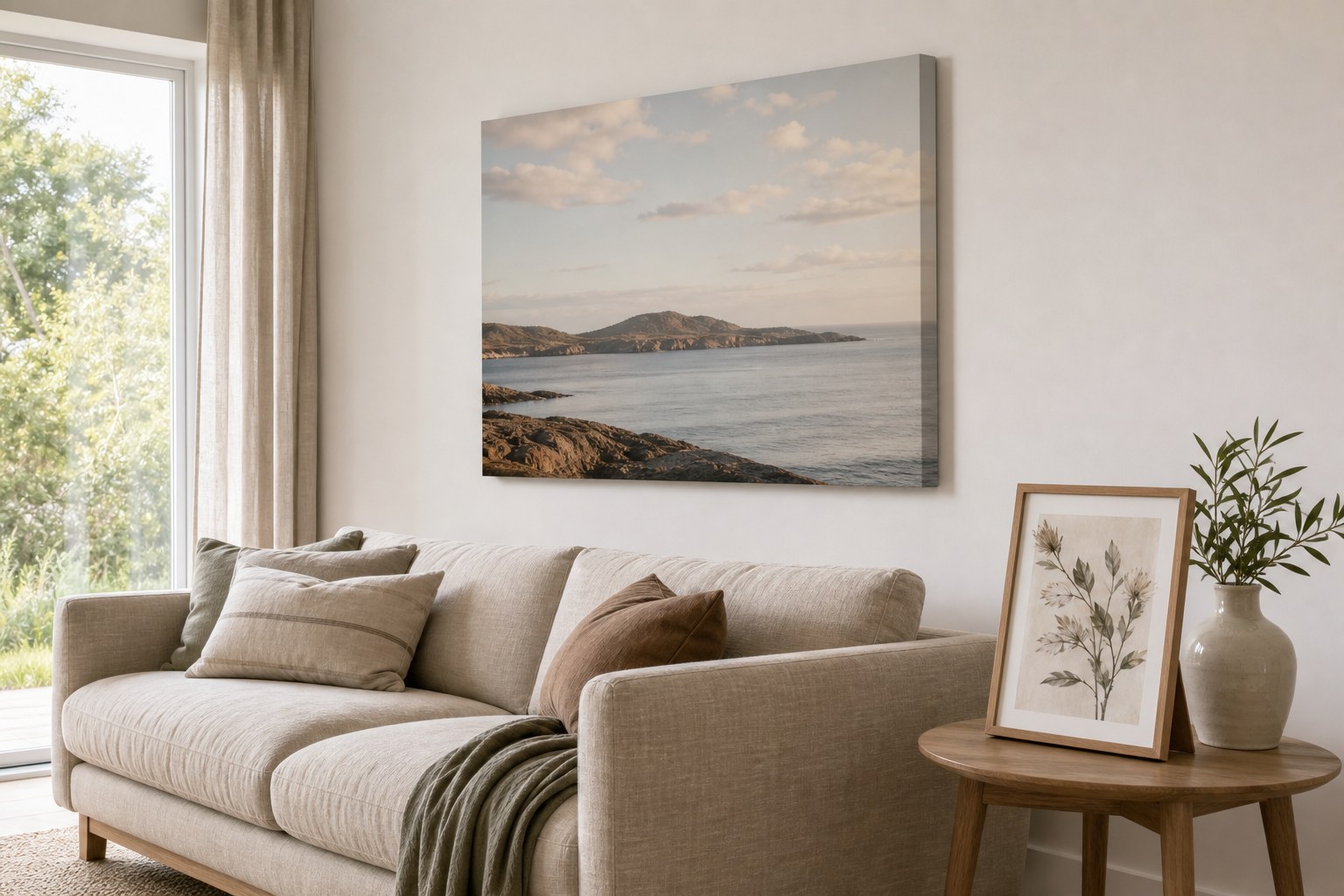
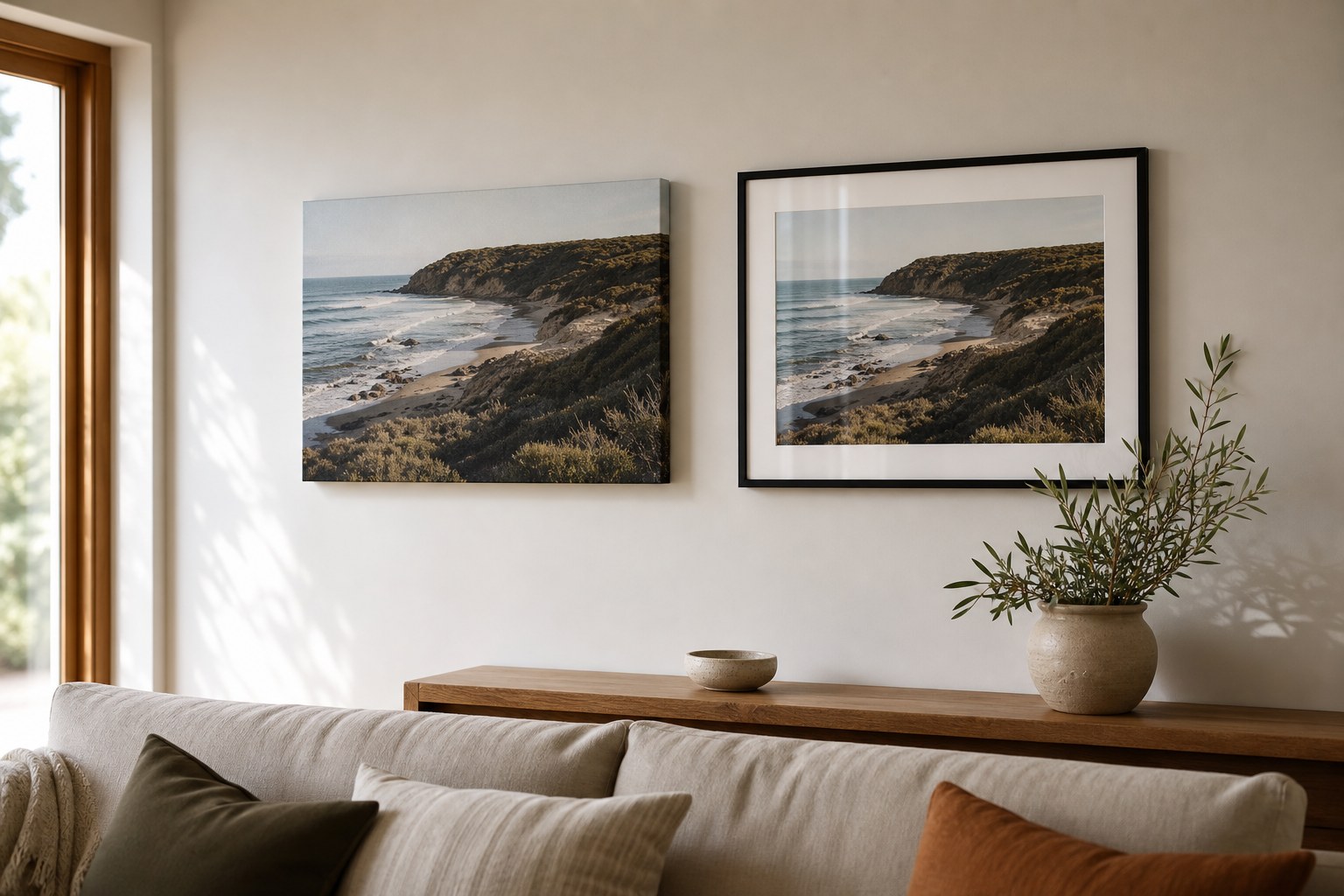
A canvas print has a soft, painterly quality. Your photo is printed directly onto 400gsm artist-grade canvas and stretched around a solid 38mm timber frame. The image wraps around all four sides, so when you look at it from an angle you see the picture continuing onto the edges rather than a plain border. There is no frame around the front face, no glass, and no mat board. Up close, the gentle weave of the canvas is visible beneath the ink, giving it a warm, tactile character that suits contemporary, relaxed, and nature-inspired interiors.
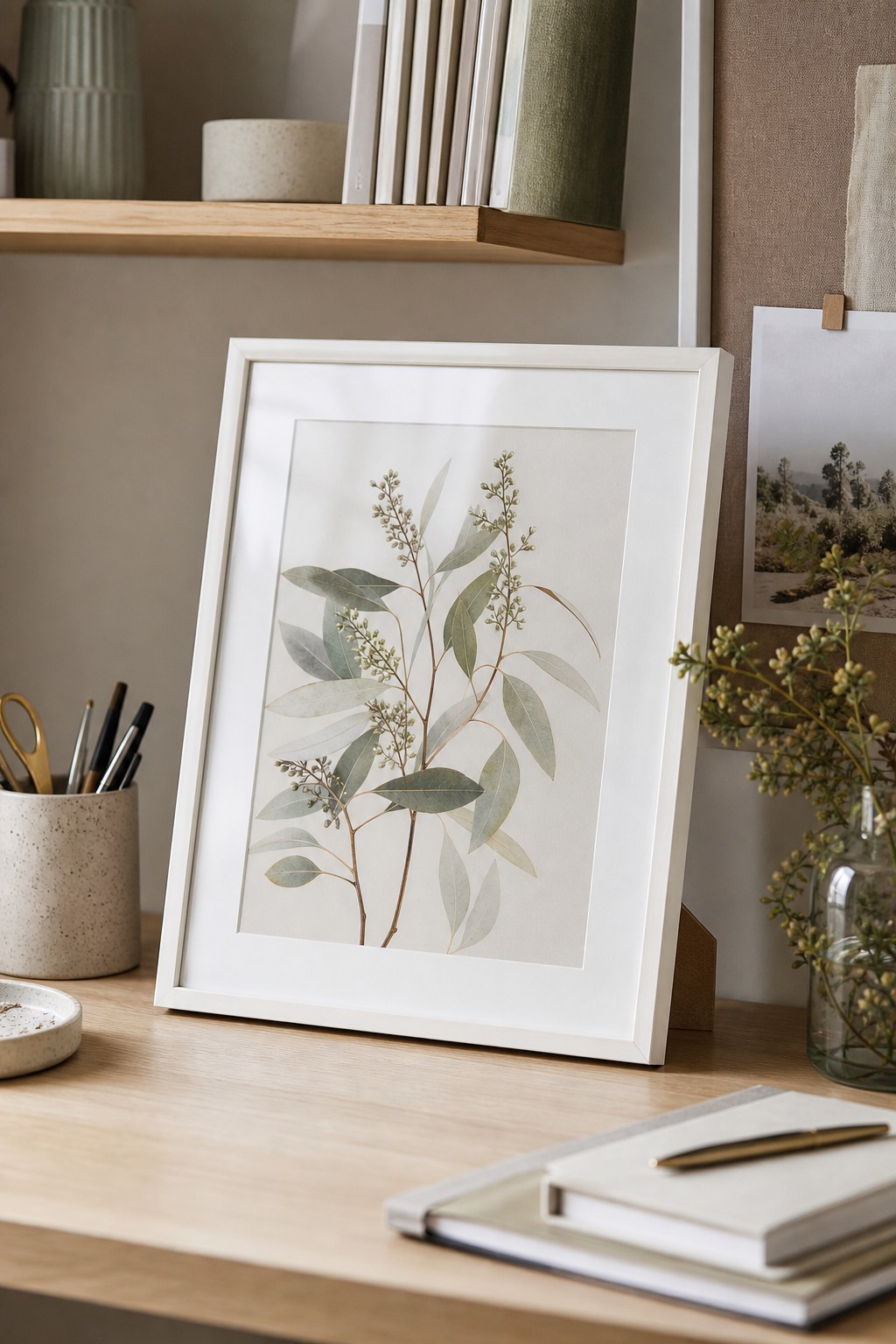
A framed print works differently. Your photo is printed on 170gsm matte fine-art paper and fitted inside a solid timber frame in Black, White, or Natural Oak, with a shatterproof plexiglass front. The result is sharp, precise, and gallery-ready. The matte paper brings out colour depth and fine detail without glare, and the frame gives the print a clean, defined edge that reads well across any interior style from modern to traditional.
Neither finish is objectively better. They are genuinely different products that suit different rooms and different tastes.
Glazing and glare
Canvas prints have no glazing at all. If the wall gets strong afternoon sun or you have directional spotlights overhead, canvas is the straightforward low-glare choice.
Framed prints use shatterproof plexiglass rather than standard glass: it is lighter, safer, and more resistant to shattering. Combined with the matte paper surface underneath, reflections are minimal in most residential lighting conditions. If you are placing a framed print directly below a downlight, angling it a few degrees forward on the wall resolves any residual glare.
Size, scale, and where it will live
Canvas is available in seven sizes from 30x30cm to 60x90cm, including square formats. It is the right choice when you need something large enough to carry a wide or tall wall on its own.
Framed prints come in three sizes: A4 (210x297mm), A3 (297x420mm), and A2 (420x594mm). They suit small-to-medium prints, gallery-wall clusters, and any situation where a defined frame matters more than raw scale. The fold-out stand that ships with every framed print makes them particularly practical for home offices, mantle shelves, or bookcases where you want to display a photo without mounting anything to a wall.
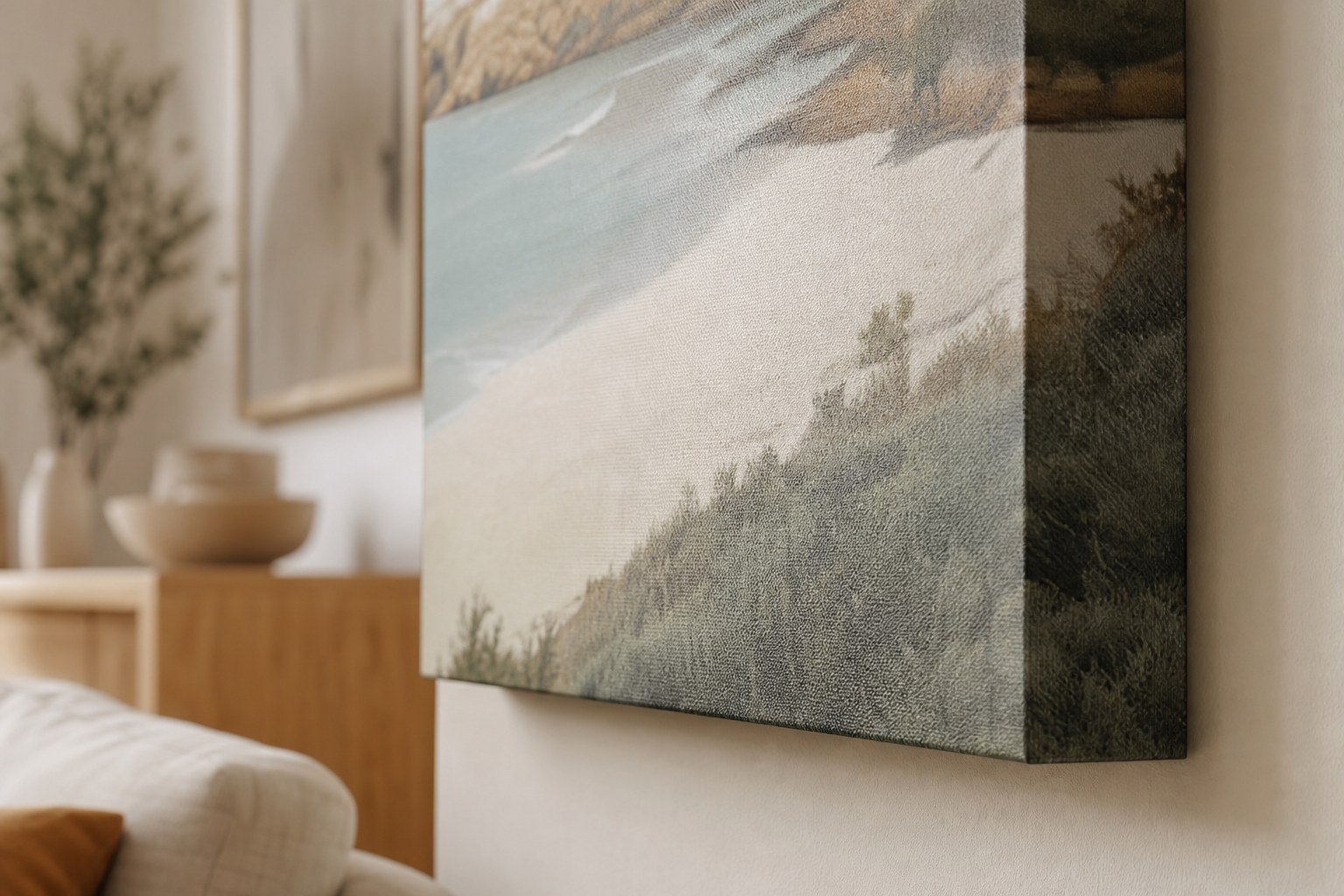
Can you add a frame to a canvas?
Yes, and there are two ways to do it. Any custom canvas print can be ordered with a floating frame (+$40 to $60 by size) or a classic frame (+$30 to $50), both in solid timber in Black, Natural Oak or White.
A floating frame sits around the outside edge of the stretched 38mm canvas with a deliberate gap visible between the timber and the image, adding visual weight and a sense of depth without covering the wrapped edges. A classic frame is the traditional framed canvas: the frame overlaps the canvas edge so the two sit flush, with no gap and no glass, on a slim 19mm canvas that sits closer to the wall. Because the frame covers the edge, a classic-framed canvas is finished with a plain white edge rather than a wrapped image.
Either way it is still a canvas on a stretcher rather than a paper print inside a frame. If you are drawn to the idea of a frame but prefer the look and scale of canvas, a framed canvas finish is a strong option.
Still not sure?
Either way, you are in good hands. Canvas prints and framed prints in every size are made to order in Australia, and every order goes through a file review before it goes to print. There is no wrong choice here; size usually settles it. For anything larger than A2, canvas is your format. For anything you want to prop on a shelf, choose a framed print.
Visit custom canvas prints or custom framed prints to see the full size range and pricing, or browse both formats on our wall art prints page.
FAQ
Is a canvas or framed print better?
Neither is universally better. Canvas is the stronger choice for large-scale, contemporary display where you want a frameless, textured look with no glazing. A framed print suits classic or gallery-style interiors, smaller sizes, and any situation where you want to stand the print on a shelf or desk as well as hang it.
Which lasts longer, a canvas or a framed print?
Both are built for longevity. Canvas prints use UV-resistant inks on 400gsm artist-grade canvas designed to hold colour over decades. Framed prints use 170gsm matte fine-art paper behind shatterproof plexiglass. For rooms with direct, unfiltered sunlight, the UV-resistant canvas inks have a practical edge. In a normal home environment with controlled light levels, either format will last a very long time.
Which is cheaper, a canvas or a framed print?
Framed prints start from $79 for an A4. Canvas prints run from $79 for a 30x30cm gallery wrap to $279 for a 60x90cm in a floating frame; see the custom canvas prints page for the full ladder. Keep in mind that the two formats use different sizing systems (canvas in centimetres, framed prints in standard A-sizes), so a direct size-for-size comparison is not always straightforward.
Can I stand a canvas on a shelf?
No. Canvas prints are designed for wall-hanging only, and hanging hardware is not included, so you can choose the hook or wall fitting that suits your wall. If you need a print that can also stand on a shelf or desk, choose a custom framed print: every framed print comes with a fold-out stand as standard.
Can I get a framed canvas?
Yes, in two ways. A floating frame (+$40 to $60 by size) sits around the outside of the 38mm canvas with a visible gap between the timber and the image, so the wrapped edge stays visible. A classic frame (+$30 to $50) overlaps the canvas edge with no gap, on a slim 19mm canvas, and is finished with a plain white edge instead of a wrapped image. Both come in Black, Natural Oak or White solid timber. Both are still canvas, which is different from a framed paper print on 170gsm matte fine-art paper.