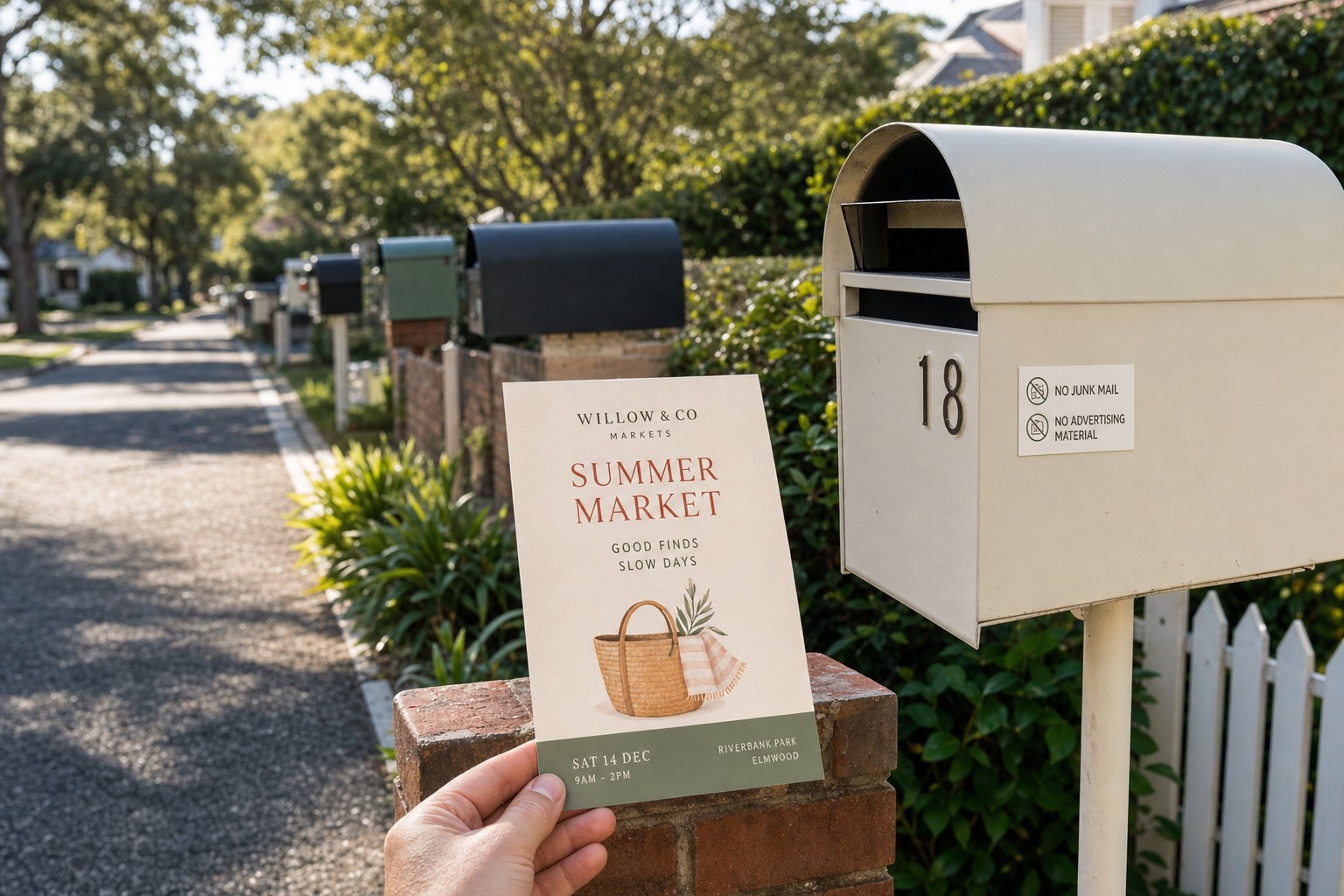
Every suburb has them: letterboxes plastered with “No Junk Mail” or “No Advertising Material” stickers. If you’re planning a flyer run to promote your business, those two small signs raise a surprisingly large question. Are you legally required to skip them? Does it depend on how you’re distributing? And what actually happens if you don’t?
The answer is more nuanced than most business owners expect. Here’s what actually applies to you.
- “No Junk Mail” and “No Advertising Material” stickers carry different obligations for different distributors.
- Australia Post’s Unaddressed Mail service automatically excludes opted-out letterboxes when you book a campaign.
- DSB-registered distributors (IVE Group, Adpost, Hi-Fliers, etc.) are contractually bound to skip “No Advertising Material” letterboxes.
- Independent distributors organising their own runs are not legally bound in most states.
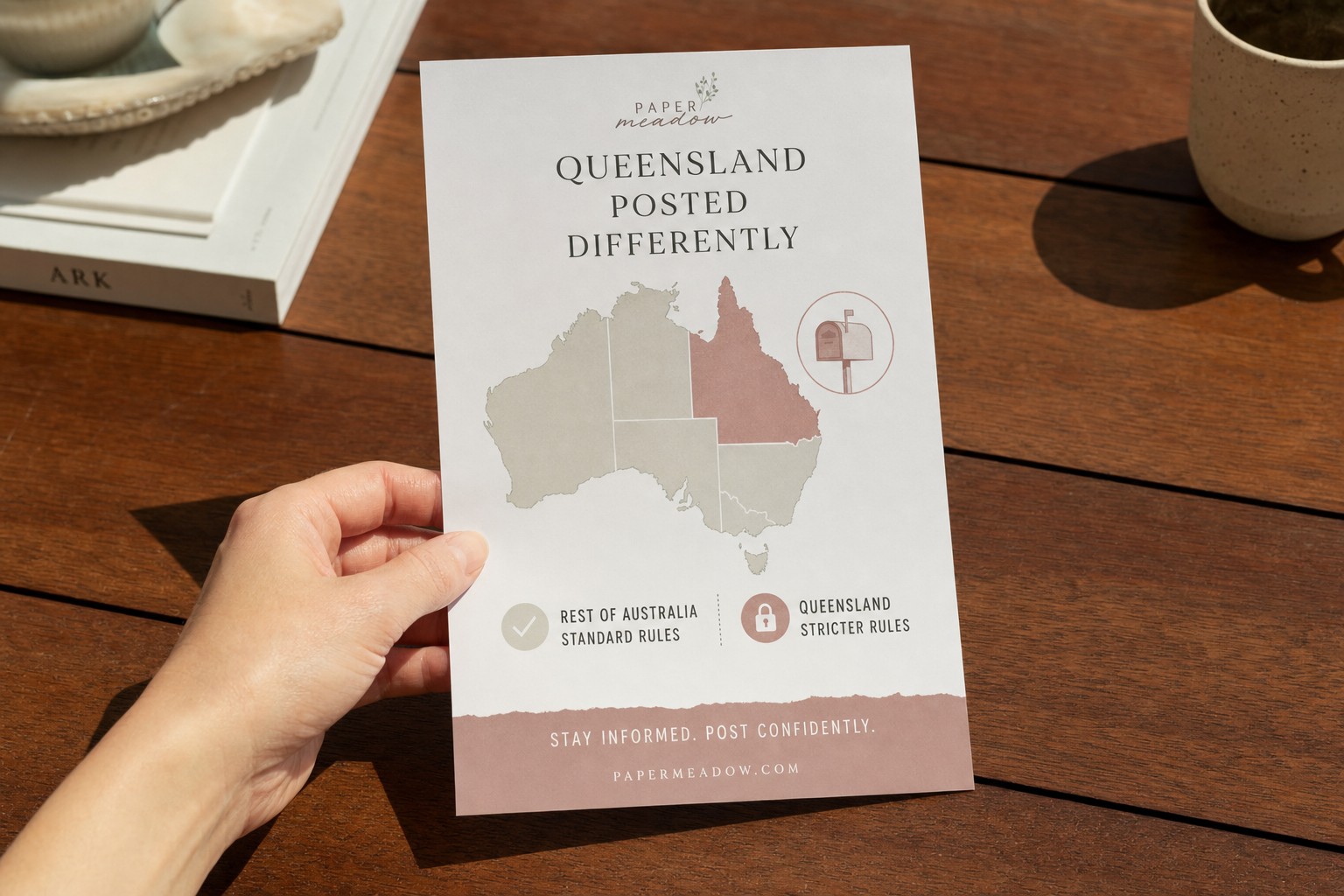
- Queensland is the exception: state law makes it an offence to deliver unsolicited commercial advertising to homes displaying appropriate signage.
- Always exempt from all signage: electoral material, registered charities, government communications, community newspapers (until written notice from the resident).
- Tucking flyers under car wipers or leaving materials on fences is illegal under litter laws nationwide.
“No Junk Mail” versus “No Advertising Material”: not the same sticker
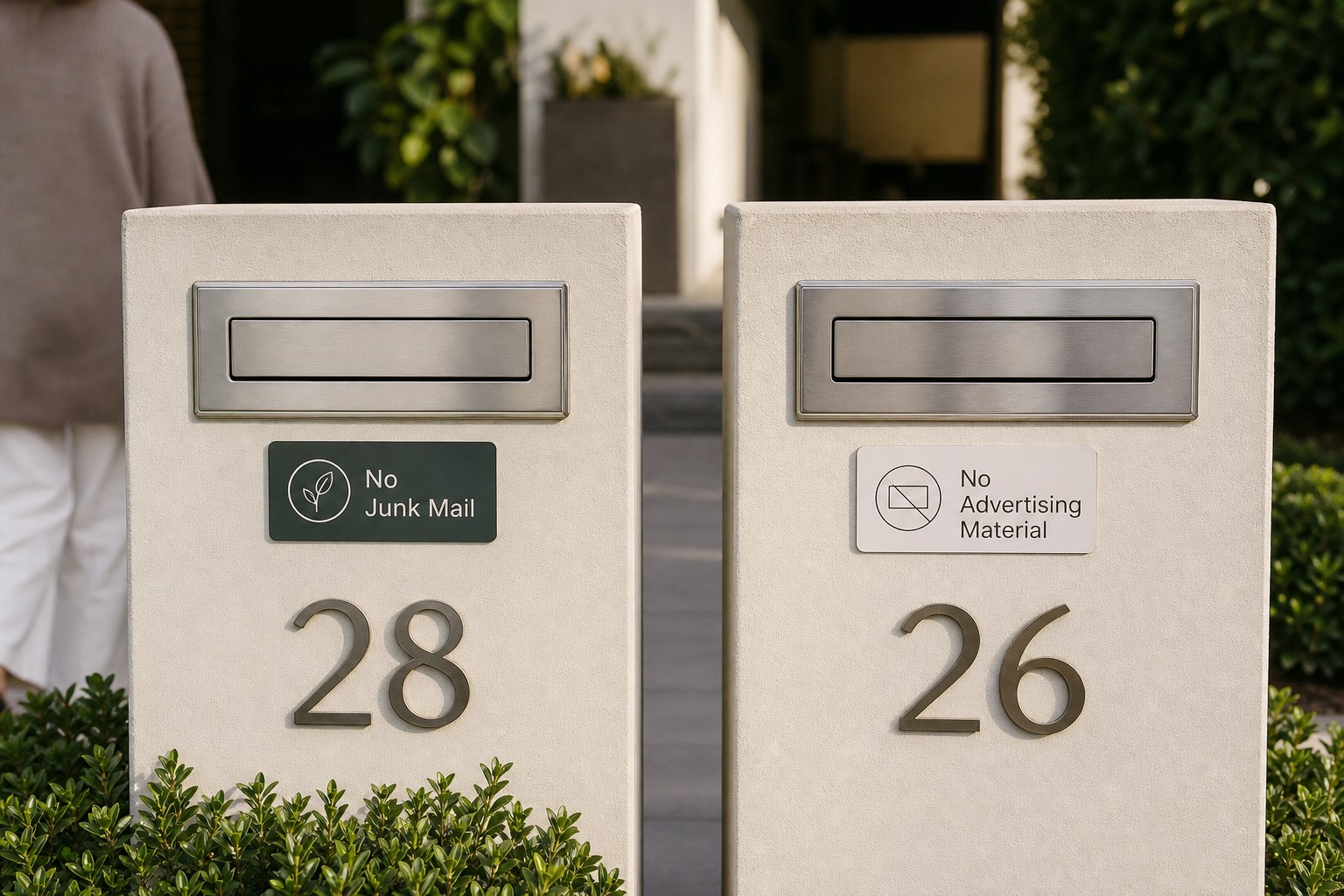
Both stickers communicate that the householder doesn’t want unsolicited material. But the coverage, enforcement, and legal weight differ significantly.
“No Junk Mail”
“No Junk Mail” is the everyday-language version. Australia Post’s delivery officers are instructed not to deliver unaddressed material to any letterbox displaying this message. For Australia Post’s Unaddressed Mail service, compliance is automatic: opted-out letterboxes are excluded from your delivery count before the run starts.
The limitation is scope. Australia Post delivers roughly 10 per cent of Australia’s unaddressed mail. For the other 90 per cent, handled by private distributors and independent operations, “No Junk Mail” carries no binding legal obligation outside of Queensland.
“No Advertising Material”
“No Advertising Material” is the industry-specific instruction. It maps directly to the Distribution Standards Board’s (DSB) Code of Practice. Any distributor that is a DSB member is contractually required to skip letterboxes displaying this sign.
The DSB Code does not cover real estate agents leafleting their own listings, a cafe owner organising their team to hand-deliver menus, or an individual running their own neighbourhood drop. These operations fall entirely outside the DSB’s jurisdiction.
| Sticker type | Australia Post Unaddressed Mail | DSB-member distributor | Independent distributor |
|---|---|---|---|
| No Junk Mail | Will not deliver | Typically honours | No binding obligation |
| No Advertising Material | Will not deliver | Bound by Code of Practice | No binding obligation |
| Addressed Mail Only | Will not deliver | Typically honours | No binding obligation |
Who’s distributing – and who’s bound by what
Your compliance obligations depend almost entirely on how you choose to distribute.
Australia Post’s Unaddressed Mail service
Australia Post’s Unaddressed Mail service gives businesses access to up to 12.7 million letterboxes for community notices, or up to 9.3 million letterboxes for commercial advertising. Material is delivered Monday to Friday during your nominated delivery week.
When you use this service, opt-out letterboxes are managed for you. Your campaign quantity reflects the actual deliverable letterboxes in your selected area, not a raw postcode total. Bookings require advance notice, particularly during election periods when capacity is reduced due to demand from political campaigns.
DSB-registered distributors
The Distribution Standards Board is the self-regulatory body for the letterbox distribution industry in Australia. Member companies include IVE Group (operating nationally), Adpost Online, GDR Marketing, Gold Coast Leaflet Distributors, Hi-Fliers and Fermax in Victoria, among others.
When you hire a DSB-registered company, their walkers operate from mapped routes that exclude opted-out letterboxes. Compliance is the distributor’s contractual obligation, which makes it their risk rather than yours.
Organising your own distribution
If you’re coordinating your own drop using staff, volunteers, or a casual crew, you’re operating entirely outside Australia Post and the DSB. In most states, there is no law requiring you to honour “No Junk Mail” or “No Advertising Material” signs. Queensland is the legal exception (see below).
The practical point is this: households with opt-out stickers have explicitly chosen not to receive promotional material. Your conversion rate from those letterboxes will almost certainly trail your campaign average. Skipping them is not only more respectful, it improves your campaign economics and reduces the print quantity you need to order.
State-by-state: is there a law?
There is no single national law governing physical unaddressed letterbox distribution. The Spam Act 2003 covers electronic communications and does not apply to print material. State and territory regulation is inconsistent.
| State / Territory | Law on opt-out signage | What it means in practice |
|---|---|---|
| Queensland | Yes – Waste Reduction and Recycling Act | Offence to deliver unsolicited commercial advertising to homes displaying appropriate opt-out signage |
| New South Wales | No specific law | Industry self-regulation (DSB Code of Practice) only |
| Victoria | No specific law | Industry self-regulation (DSB Code of Practice) only |
| South Australia | No specific law | Industry self-regulation (DSB Code of Practice) only |
| Western Australia | No specific law | Industry self-regulation (DSB Code of Practice) only |
| ACT, NT, Tasmania | No specific law | Industry self-regulation (DSB Code of Practice) only |
Queensland’s Waste Reduction and Recycling Act defines “unsolicited advertising material” as commercial advertising not addressed by name to the resident. When a resident displays “No Advertising Material,” “No Junk Mail,” or “Australia Post Mail Only” signage on their letterbox, delivering to that household is prohibited. Enforcement is complaint-driven rather than involving proactive inspection.
Outside Queensland, the DSB’s voluntary Code remains the main check on industry conduct. ADMA (the Association for Data-driven Marketing and Advertising) operates a Do Not Mail register for addressed promotional mail from member organisations, but this does not apply to unaddressed letterbox drops.
What’s always exempt from opt-out signage
Every sticker type has recognised exemptions. Material that can be delivered regardless of what the letterbox displays includes:
- Electoral and political campaign material
- Material from registered charities
- Religious and educational material
- Government and council communications
- Community newspapers, until the resident formally notifies the publisher in writing
- Statutory notices and infringement notices (parking fines, etc.)
- Lost animal notices
These exemptions apply across all states and within the DSB’s Code of Practice. If you’re distributing on behalf of a registered charity or running an electoral campaign, opt-out stickers do not restrict your delivery.
How to plan a compliant letterbox drop
A structured approach protects your brand, respects residents, and improves return on your print investment.
Choose your distribution method first
For large-scale or multi-suburb campaigns, book Australia Post’s Unaddressed Mail service: opt-outs are managed automatically and you get verified postcode-level targeting up to the national letterbox pool. For regional or suburb-level campaigns, hire a DSB-registered distributor. For hyper-local drops around a new shopfront or upcoming event, organise your own team – but honour every sticker you encounter.
Factor opt-outs into your quantity planning
Urban areas typically see 15 to 25 per cent of letterboxes displaying some form of opt-out signage. Inner-suburban and more affluent postcodes tend toward the upper end of that range. If you’re planning a 5,000-piece run for a 6,000-household catchment, budget for effective coverage of around 4,500 to 5,000 households after opt-outs. Australia Post’s Unaddressed Mail booking tools provide accurate deliverable-letterbox counts by postcode so you can calibrate your print order precisely.
Pick the right format for letterbox delivery
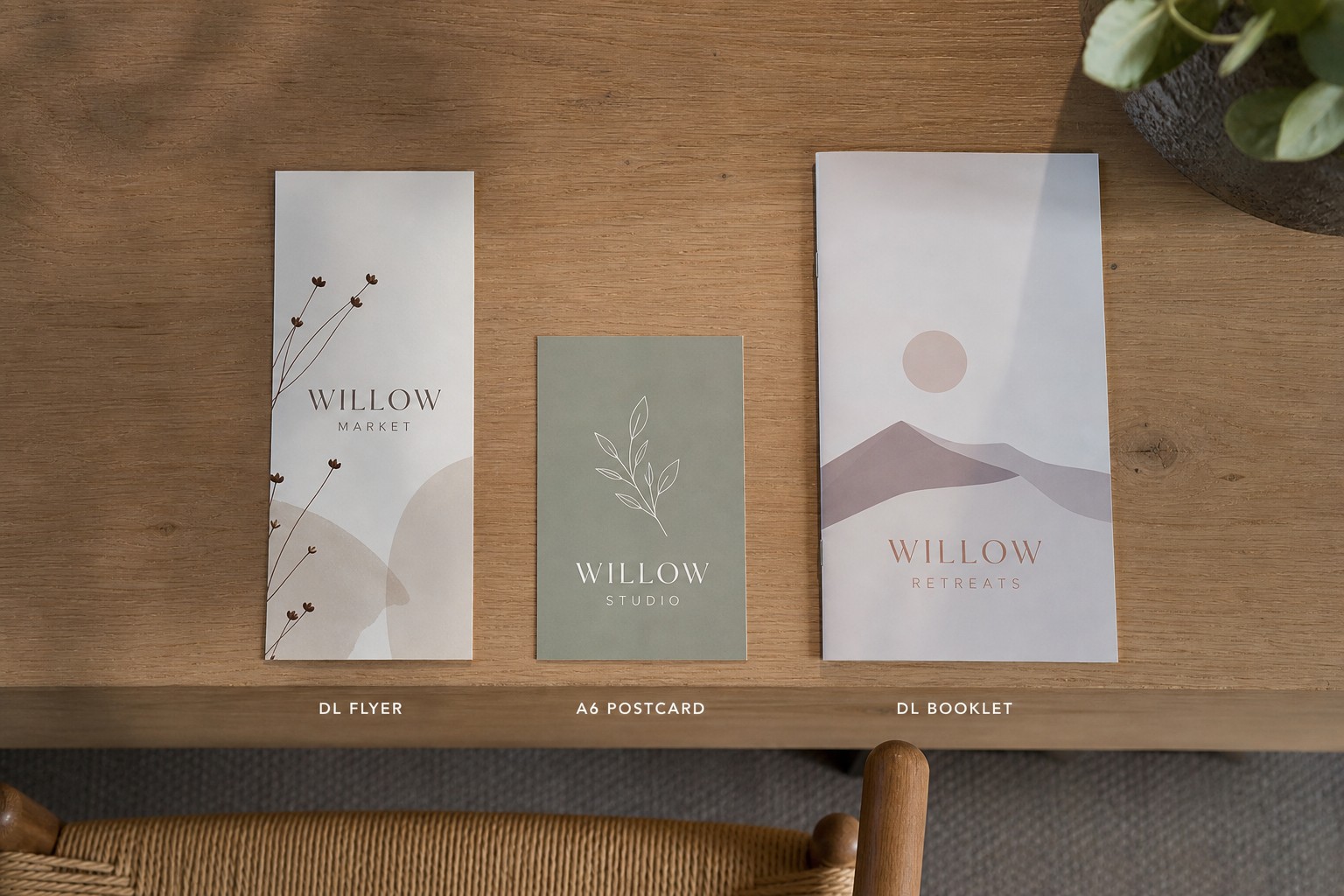
Not every print format suits unaddressed letterbox delivery. DL (99 x 210 mm) is the industry standard for a practical reason: it slots into almost every residential letterbox slot without folding or creasing on arrival. A5 (148 x 210 mm) and A6 (148 x 105 mm) also work well. A4 (210 x 297 mm) fits most letterboxes but shows handling marks more readily and can feel forced into narrower slots.
For campaigns that need more space than a single flyer allows, DL booklets give you multi-page content in the same letterbox-compatible format, well suited to service menus, seasonal catalogues, or multi-offer campaigns. For single-offer promotions where visual impact matters more than information density, custom-printed postcards on heavier stock stand out in the letterbox pile and tend to be kept rather than recycled immediately.
For the primary drop piece itself, professionally printed flyers across DL, A6, A5, A4, and A3 in stock weights from 115 gsm to 250 gsm give you the flexibility to match format to campaign scale. Production is 2 to 5 working days after proof approval, with flat-rate shipping of $10 AUD Australia-wide.
Target by audience profile, not just geography
Raw postcode coverage is the starting point for targeting, not the complete strategy. ABS demographic data is publicly available at the suburb level and covers income brackets, household composition, and age cohort. Mapping this against your ideal customer profile lets you prioritise postcodes before you print a single sheet, rather than blanketing an entire area and hoping for the best.
Quick reference: do’s and don’ts
| Do | Don’t |
|---|---|
| Skip letterboxes with any opt-out sticker displayed | Deliver to stickered letterboxes in Queensland (it’s a statutory offence) |
| Hire a DSB-registered distributor for suburb-scale or larger campaigns | Assume non-DSB distributors manage opt-outs on your behalf |
| Use Australia Post Unaddressed Mail for automatic opt-out exclusion | Tuck flyers under car windscreen wipers (illegal under litter laws) |
| Factor 15 to 25 per cent opt-out rate into your quantity calculation | Leave materials on fences, gates, or in public spaces where they could become litter |
| Choose letterbox-compatible formats: DL, A5, or A6 | Treat “No Junk Mail” and “No Advertising Material” as identical obligations for all distributors |
| Brief your distribution team on which stickers require skipping | Rely on non-DSB-member distributors without confirming their opt-out process in writing |
Frequently asked questions
Is it illegal to put flyers in letterboxes with “No Junk Mail” stickers?
In Queensland, yes. The Waste Reduction and Recycling Act makes it an offence to deliver unsolicited commercial advertising to homes displaying appropriate opt-out signage. In New South Wales, Victoria, South Australia, Western Australia, and the territories, there is no equivalent state law for physical distribution, but DSB-registered distributors are contractually required to skip opted-out letterboxes under their Code of Practice. If you’re organising your own distribution in those states, honouring the stickers is the right practice even without a legal mandate.
Does Australia Post skip letterboxes with “No Junk Mail” stickers?
Yes. Australia Post’s delivery officers are instructed not to deliver unaddressed mail to any letterbox displaying a “No Junk Mail” or “Addressed Mail Only” sign. When you book Australia Post’s Unaddressed Mail service, opted-out letterboxes are automatically excluded from your delivery quantity and are not counted in your campaign reach figures.
What’s the difference between “No Junk Mail” and “No Advertising Material” stickers?
“No Junk Mail” is everyday-language that Australia Post honours and many distributors respect by policy. “No Advertising Material” is the industry term codified in the DSB’s Code of Practice: member distributors are contractually required to skip those letterboxes. Both communicate the same preference to residents. “No Advertising Material” has stronger enforcement teeth within the commercial letterbox distribution industry because it maps directly to a contractual obligation on DSB members.
Can I deliver to opt-out letterboxes if I’m a charity or political campaign?
Yes. Electoral and political campaign material, registered charity notices, religious and educational material, government and council communications, and community newspapers are all exempt from opt-out signage requirements. These exemptions apply under Australia Post’s policy, the DSB’s Code of Practice, and Queensland’s legislation. If you’re unsure whether your specific material qualifies as exempt, confirm with the DSB (1300 083 241) or Australia Post’s Unaddressed Mail team before your run.
How many letterboxes will opt-outs affect in a typical suburb?
There is no single national figure, but urban and inner-suburban areas typically see 15 to 25 per cent of letterboxes displaying some form of opt-out signage. Affluent inner-suburb postcodes trend toward the upper end of that range. For campaign planning, budget for up to 20 per cent reduction from your raw household count when calculating your required print quantity.
What print formats work best for letterbox drops?
DL (99 x 210 mm) is the industry standard for letterbox delivery, fitting into almost every residential slot without creasing. A5 (148 x 210 mm) and A6 (148 x 105 mm) are also well-suited. A4 (210 x 297 mm) fits most letterboxes but can show handling marks more readily. For campaigns needing more than a single-page overview, DL booklets give you multi-page content in the same letterbox-friendly form factor. For single-offer promotions where visual impact is the priority, postcards on a heavier stock tend to be retained rather than recycled on arrival.