
Picking a canvas size should be the easy part of decorating a wall. In practice, most people order something too small and end up with a piece that looks lost, or they second-guess themselves until the wall stays blank for another six months. This guide cuts through the guesswork with a room-by-room breakdown of every size we offer, so you can order with confidence.
Canvas size quick guide
| Canvas size | Orientation | Best for | Wall or furniture width |
|---|---|---|---|
| 30x30cm | Square | Shelf, bathroom accent, gallery wall filler | Any nook or small accent space |
| 30x40cm | Portrait | Bedside accent, reading nook, small bathroom | Up to about 60cm |
| 40x50cm | Portrait | Home office, bedside table, gallery wall | 60-90cm |
| 50x50cm | Square | Bedroom feature, home office, one half of a matching pair | 80-120cm |
| 50x70cm | Portrait | Two-seater sofa wall, dining room, bedroom feature | 100-150cm |
| 70x70cm | Square | Three-seater sofa, queen or king bed, dining room feature | 120-180cm |
| 60x90cm | Portrait or landscape | Statement piece: wide sofa wall, entryway, open-plan living | 150cm and above |
The Two-Thirds Rule: Your Starting Point for Any Room
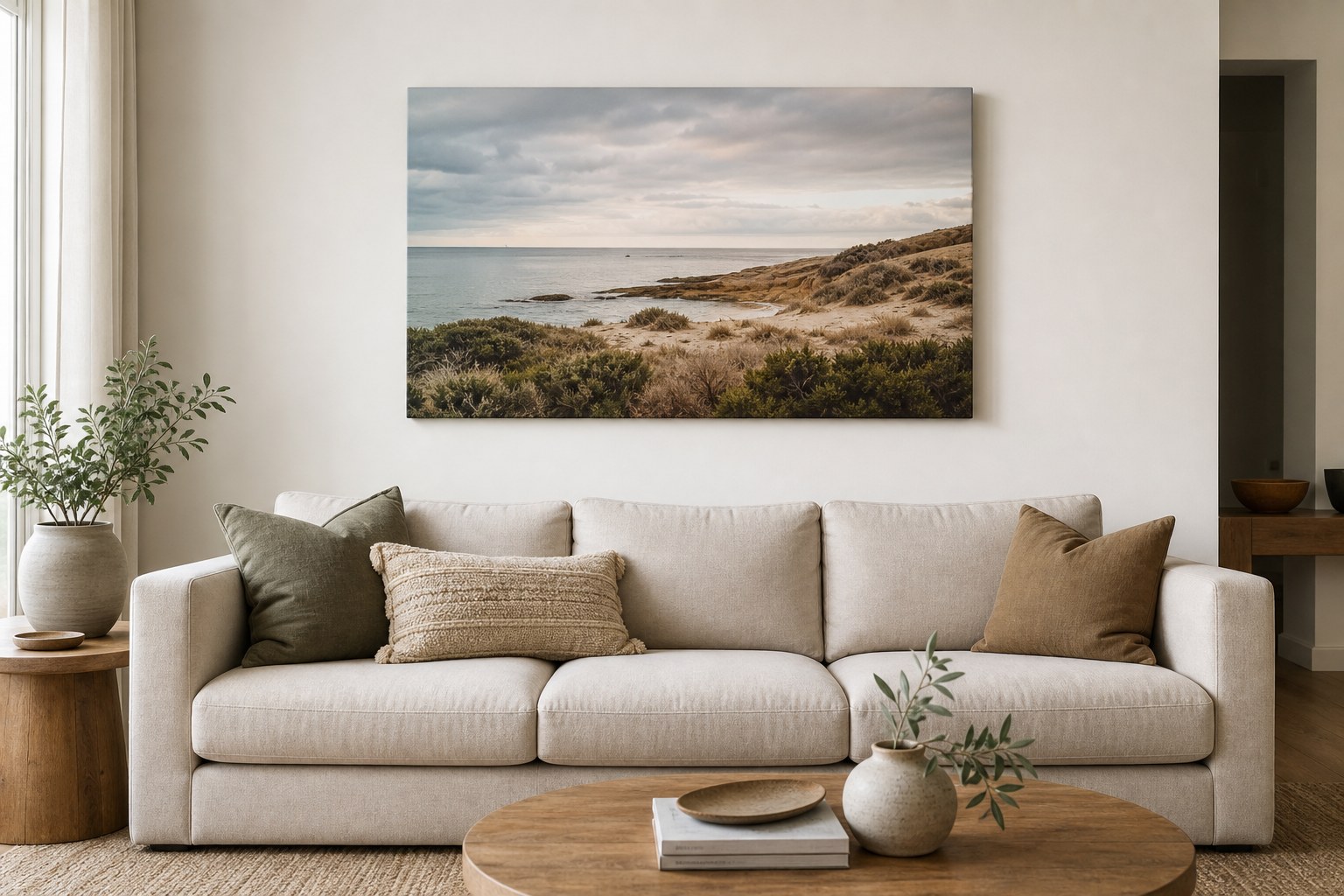
The most practical sizing principle in interior design is the two-thirds rule: a single canvas (or a group of canvases treated as one unit) should span roughly two-thirds to three-quarters of the width of the main piece of furniture below it.
If your sofa is 240cm wide, aim for a canvas or grouping that spans at least 160cm across. If your bed head is 150cm wide, a canvas around 100cm wide will sit comfortably above it without looking undersized or overwhelming. This is a guide rather than a rule. High ceilings, bold artwork, and gallery wall groupings can all push you toward a larger size than the formula suggests.
The sections below apply this principle room by room, using the seven sizes we print.
Living Room: Above the Sofa
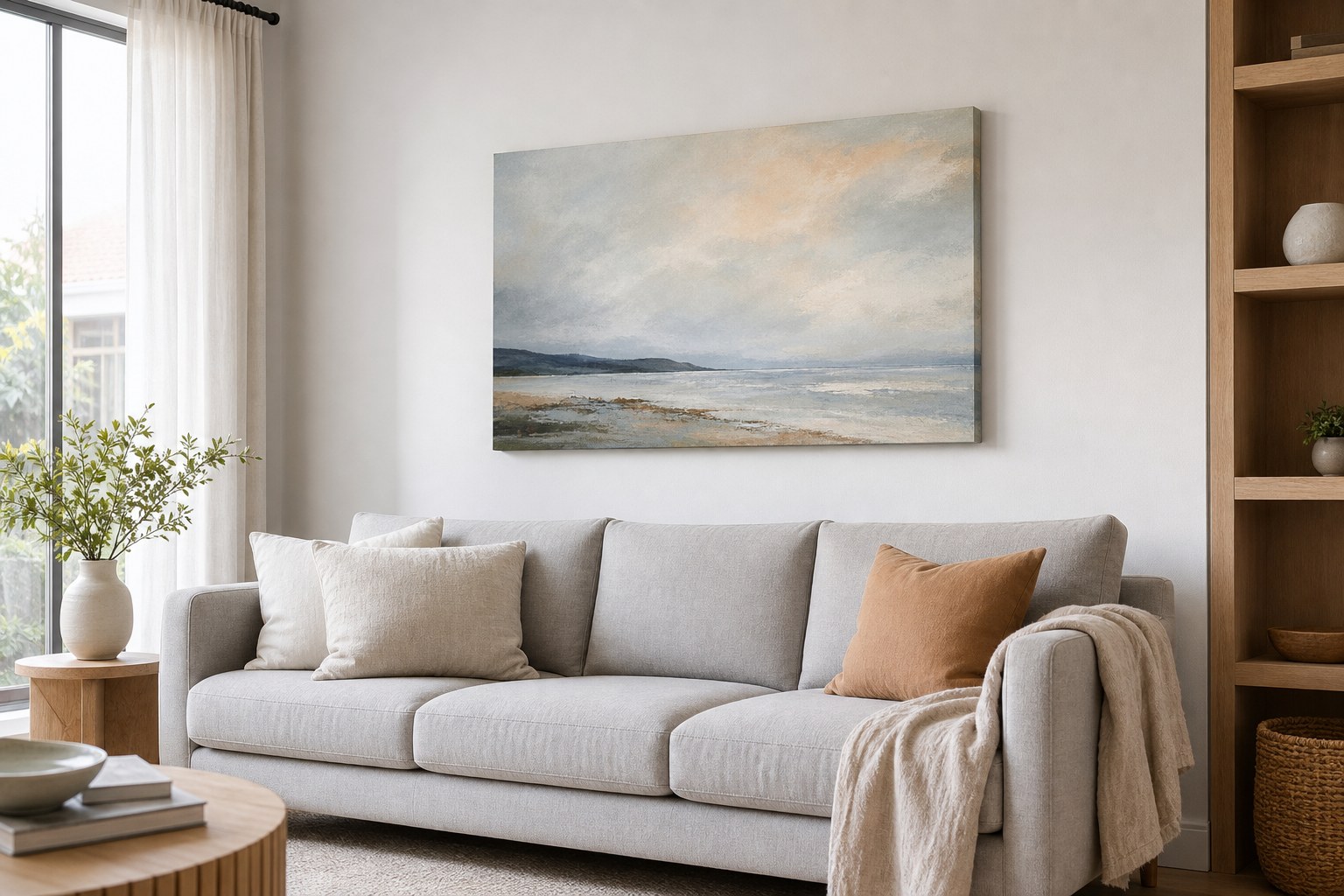
The sofa wall is the most common canvas placement and the one where sizing mistakes hurt most. A canvas that spans less than half the sofa width will look like an afterthought once you are sitting down and looking at it across the room.
For a two-seater sofa (roughly 150-180cm wide), our 50x70cm portrait canvas works well as a single piece. A pair of 40x50cm canvases hung side by side also reads as one cohesive unit and gives you more flexibility in layout. For a three-seater (200-240cm), step up to 70x70cm as a single square anchor piece. Our 60x90cm hung in landscape orientation (90cm wide, 60cm tall) is the strongest option for a wide sofa wall: at 90cm across, it spans roughly two-thirds of a standard 240cm sofa, sitting right in the proportional sweet spot.
Leave 15-25cm between the bottom of the canvas and the top of the sofa back. Any less and the two elements crowd each other; any more and the canvas floats off the furniture rather than relating to it.
Bedroom: Above the Bed and Bedside Table
The bedroom offers two distinct canvas moments: a feature piece centred above the bed head, and smaller accents on either side above the bedside tables.
For a feature piece above the bed, apply the two-thirds rule to the mattress width. A queen mattress (153cm wide) suits a canvas around 100cm wide, which you can achieve with our 70x70cm square or our 60x90cm in portrait (60cm wide) with generous side breathing room. For a king mattress (183cm wide), a 70x70cm reads confidently as a single feature. Two 50x50cm canvases hung symmetrically about 10cm apart give you a combined width of around 110cm and a softer, gallery-style look that works well in bedrooms with a relaxed aesthetic.
For bedside placements, our 30x40cm and 40x50cm sizes are the natural choice. At that scale they are proportionate to the table width without competing with the lamp or objects on the surface. A matching pair either side of a bed is a simple, considered look that takes about ten minutes to hang.
Home Office
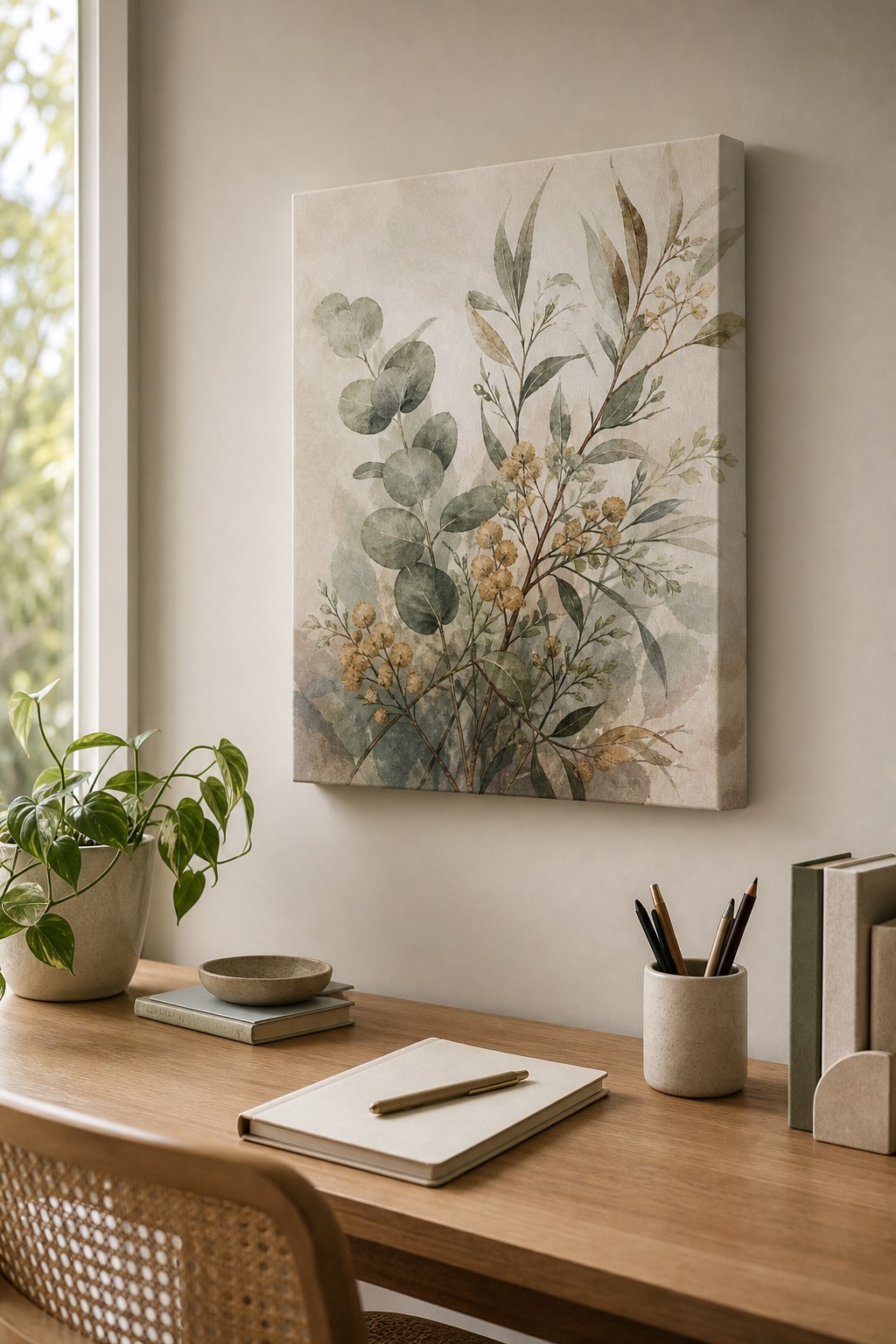
A home office canvas is doing two jobs at once: it decorates the space and it appears in the background of every video call you make from that room. That second job changes the sizing conversation.
A canvas that is too small disappears behind you on screen. A canvas that is oversized will become the focal point of the frame rather than you. Our 40x50cm or 50x50cm sizes hit the balance well for most desks: clearly visible on camera, proportionate to a standard wall section above a desk, and large enough to register as intentional. Centre the canvas at seated eye height or 10-15cm above it, so it reads naturally in frame without requiring you to point your camera upward.
Dining Room
In a dining room the canvas has to hold its own against a table that is often the largest piece of furniture in the house. The convention is to match the canvas width to roughly two-thirds of the table length rather than the full wall width, so the art and the table feel linked rather than competing.
A 180cm dining table suits a canvas or grouping around 120cm wide. Our 60x90cm in landscape orientation (90cm wide) is a practical single-piece option for a standard setting. For a longer table or a room with ceilings above 2.7 metres, two 50x70cm portraits hung side by side with a 10cm gap between them create 110cm of combined width and introduce a vertical rhythm that suits taller rooms. Hang the canvas so its base sits 40-50cm above the tabletop to keep the visual relationship clear.
Hallway and Entryway
Hallways reward taller, narrower formats because available wall space is narrow on both sides and the eye naturally travels toward the end of the corridor. Portrait orientation plays to that movement, drawing the eye upward and making the space feel longer and better proportioned.
Our 30x40cm, 40x50cm, and 50x70cm portrait canvases are all strong hallway choices. For a wider foyer or entryway, a single 60x90cm in portrait (60cm wide, 90cm tall) creates a proper arrival moment, particularly when the print is botanical, architectural, or features a place that matters to your household. For a long corridor with several wall sections, three 30x40cm portraits spaced evenly along one side at consistent height creates rhythm without requiring a feature wall.
Building a Gallery Wall
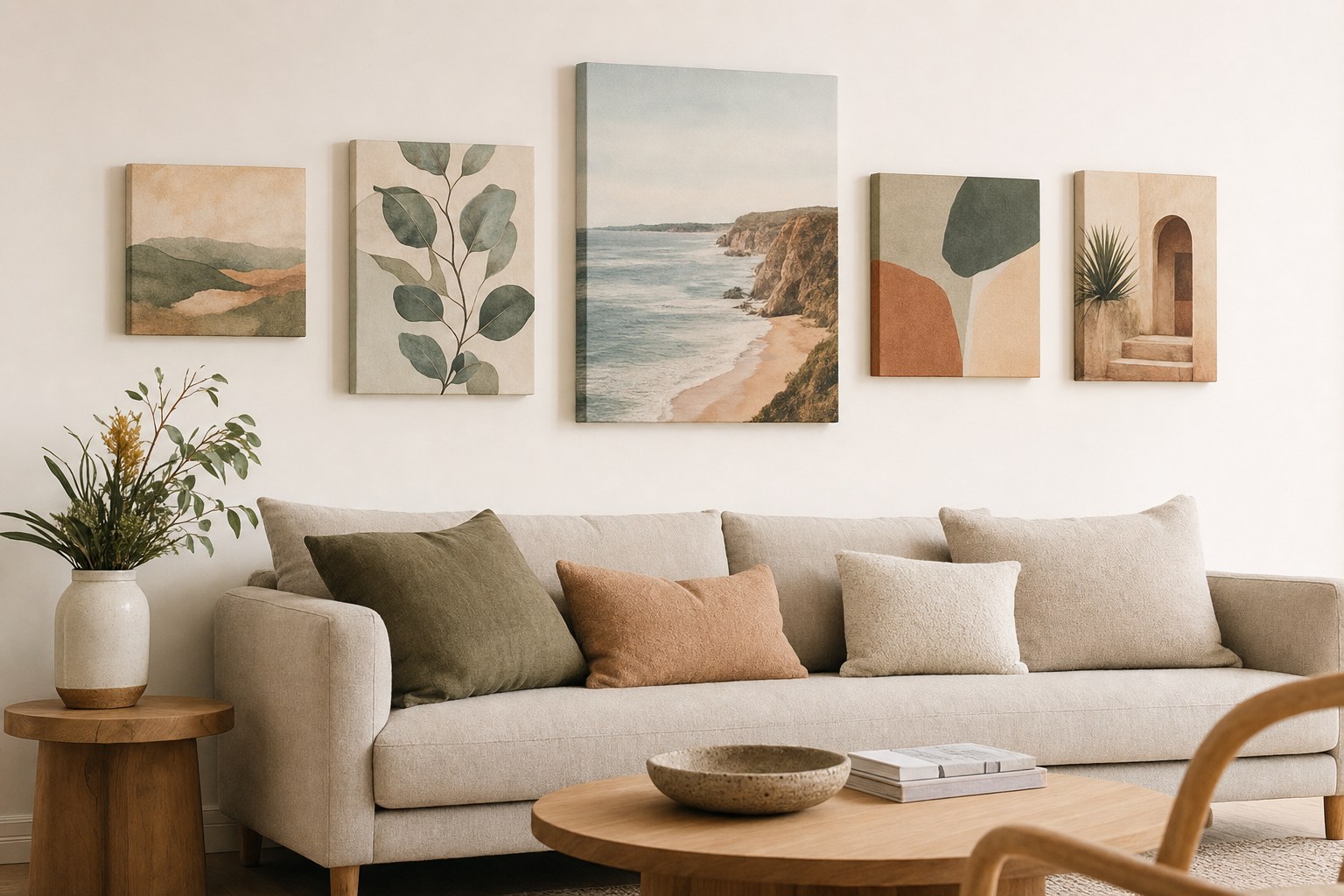
Gallery walls let you use multiple smaller canvases to fill a larger wall without relying on a single oversized piece. The easiest starting point is to anchor the arrangement with one mid-size canvas (50x50cm or 50x70cm) placed slightly left of centre, then build outward with smaller pieces, keeping 10-15cm of consistent gap between each frame.
Our 30x30cm and 30x40cm canvases are the natural building blocks here. Mix square and portrait orientations and hold the arrangement together with a consistent colour palette or subject matter rather than identical sizes. A set of five pieces covering roughly 120cm of wall gives you the same visual weight as a single large canvas, with more flexibility to rearrange as your taste evolves. Lay the arrangement out on the floor before committing to wall fixings to test the balance.
Always Do the Tape Test First
Before placing your order, cut sheets of newspaper or butcher paper to the exact dimensions of the canvas you are considering and tape them to the wall. Step back to the furthest point in the room from which you would normally view the wall, and live with the paper for at least a day.
The tape test
Cut newspaper or butcher paper to your chosen canvas dimensions. Tape it to the wall and step back to the furthest viewing point in the room. A size that looks right from there will look right as a finished print. If it looks small from across the room, go up one size before ordering.
A size that looks generous in your hand often reads as too small on a wall once it is framed and hung. The tape test is the single most reliable way to avoid ordering twice.
Sizing, Framing, and What to Know Before You Order
Our custom canvas prints are available in seven sizes from 30x30cm up to a maximum of 60x90cm. Every canvas is printed on 400gsm artist-grade material, gallery-wrapped on a 38mm deep timber frame, and arrives stretched and assembled. Hanging hardware is not included. Flat $30 shipping applies Australia-wide, and every canvas is made to order in Australia.
If you want a more finished look, both framed finishes come in the same three solid timber colours: Black, Natural Oak and White. A floating frame sits around the canvas with a small visible gap between the canvas edge and the frame, giving the piece a gallery-feel finish that suits contemporary and Scandi-style interiors particularly well, and adds $40 to $60 depending on size. A classic frame is the traditional framed canvas: the frame overlaps the canvas edge with no gap and no glass, on a slim 19mm canvas that sits closer to the wall, and it adds $30 to $50. Because the frame covers the edge, a classic-framed canvas is finished with a plain white edge rather than a wrapped image. You can compare all three finishes on the custom canvas prints product page.
For other wall art formats and print options, browse our full wall art prints collection.
FAQ
What is the most popular canvas print size?
For living rooms and bedrooms, 50x70cm and 70x70cm are the most frequently ordered sizes. They work well as a single feature piece above most standard sofas and bed heads without requiring the full statement commitment of a 60x90cm. Smaller sizes like 40x50cm are popular for home offices and gallery wall arrangements.
What size canvas fits above a sofa?
For a standard three-seater sofa (around 220-240cm wide), a 60x90cm canvas hung in landscape orientation (90cm wide, 60cm tall) or a 70x70cm square are the strongest single-piece choices. The guiding principle is to aim for a canvas or group of canvases that spans at least two-thirds of the sofa width. For a two-seater, 50x70cm or a pair of 40x50cm canvases hung side by side work well.
What is the largest canvas you print?
Our largest canvas size is 60x90cm, available in either portrait (60cm wide, 90cm tall) or landscape (90cm wide, 60cm tall) orientation. It is the recommended choice for wide sofa walls, open-plan living spaces, and entryways where you want the print to serve as the room’s visual anchor.
How do I know if a canvas is too big for my wall?
A canvas looks best with at least 20-30cm of visible wall on each side. If there is less clear wall than that, the piece will feel cramped against the edges. Leave 15-25cm between the bottom of the canvas and the top of the furniture below it (sofa, bed head, or console table) so the canvas relates to the furniture rather than floating away from it.
Can I hang a single canvas above a king bed?
Yes. Both 70x70cm and 60x90cm in portrait (60cm wide) work well as single-piece options above a king bed. If you prefer a softer, less formal look, two 50x50cm canvases hung symmetrically with about 10cm between them give you a combined width of around 110cm, which anchors a king bed head comfortably.