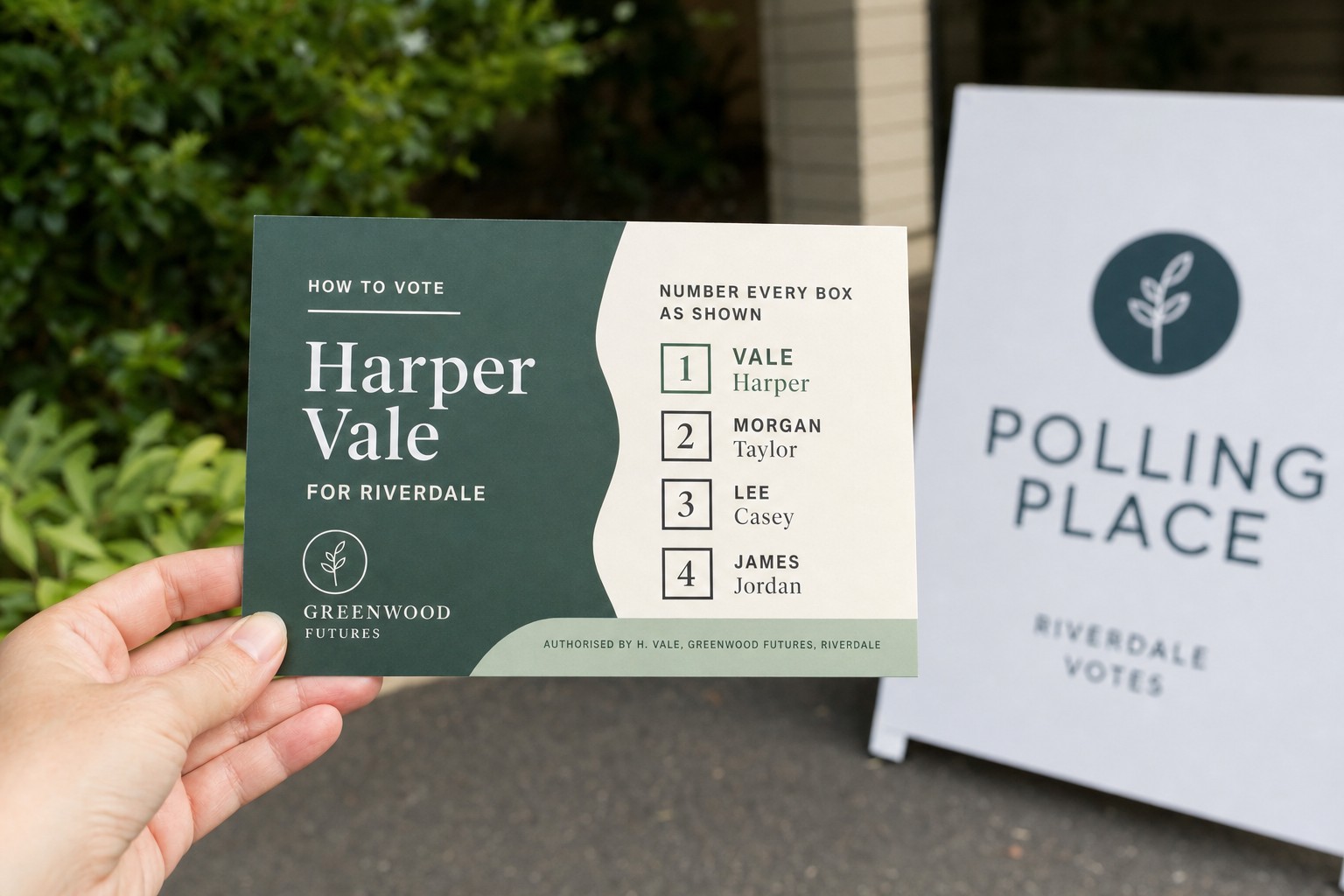
With compulsory voting and preferential ballots, how-to-vote cards are core campaign logistics for any Australian candidate or party. Mistakes discovered after print production – wrong authorisation wording, too few cards for a high-turnout booth, or a soft stock that wilts by midday – cost time and budget you do not have before election day. This guide covers format decisions, compliance requirements, quantity planning, and turnaround timing.
– DL (99 x 210mm) is the standard format for Australian how-to-vote cards: it fits polling-place card holders and is easy to hand out at booth entrances.
– Single-sided suits most campaigns; double-sided is worth it when you need to cover both houses or add a QR code or translated content on the reverse.
– Every HTV card must carry a printed authorisation statement. Confirm exact wording with the AEC (aec.gov.au) for federal elections, or your state/territory electoral commission for other elections.
– Quantity planning: look up booth-by-booth results from the previous comparable election, apply a 40-60% card acceptance rate, and add a 20-30% buffer.
– Lead time: allow at least 2 weeks from order to cards in hand; order 4 weeks before polling day if you are staffing pre-poll centres.
– Stock: 170gsm Matte handles outdoor distribution best.
What is a how-to-vote card?
A how-to-vote (HTV) card is a piece of authorised electoral material that shows voters how to number their ballot to direct preferences toward a specific candidate or party. Volunteers hand them out at polling-place entrances on election day and, in most jurisdictions, at pre-poll voting centres during the weeks beforehand.
HTV cards are used across all levels of Australian elections: federal, state, territory, and local government. They are regulated electoral material, which means they must carry a printed authorisation statement and comply with the relevant electoral commission’s advertising rules. The practical and compliance requirements are what this guide covers.
Why DL is the standard format
DL (99 x 210mm) has become the near-universal format for Australian how-to-vote cards for practical reasons. It slots neatly into the metal card holders placed at most polling-place entrance tables. It is easy for a volunteer to hold a working stack of 50-100 cards and hand them out one at a time. It fits a standard DL envelope if you need to courier batches to booth captains in other electorates. And it is one of the most cost-efficient sizes to print in bulk.
A4 sheets (210 x 297mm) do appear in lower-budget runs as a fold-to-DL workaround, but the print quality, feel, and booth-table compatibility fall short. For any campaign taking distribution seriously, purpose-printed DL on proper stock is the right starting point. Paperlust Print Shop’s flyer printing covers DL across three paper stocks with single or double-sided options.
Single vs double-sided
Most Australian HTV cards are printed single-sided. The front carries the candidate name and photo (or party branding), the preference numbering graphic, and the mandatory authorisation statement at the foot.
Double-sided printing adds minimal cost per card and is worth choosing if you need to:
- Show preferences for both houses of parliament on the one card (House of Representatives and Senate for federal elections)
- Include a policy summary, candidate statement, or QR code linking to the campaign website on the reverse
- Provide translated preference instructions in electorates with significant non-English-speaking populations
If there is any chance you will need a second panel, decide before briefing your designer. Retrofitting a double-sided layout after the front has been designed forces font-size compromises and can delay proof approval.
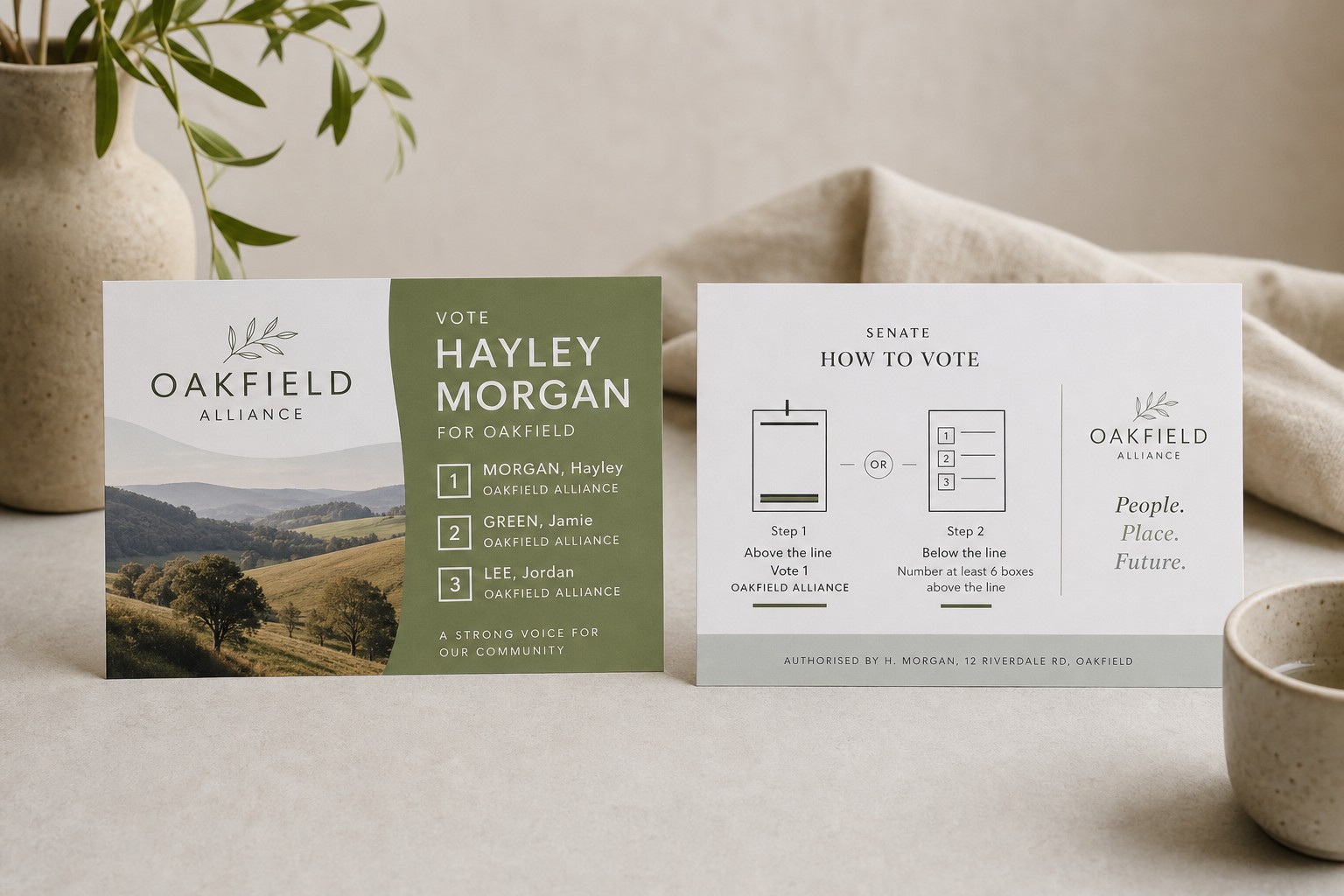
The authorisation line – what it must say
All electoral advertising material distributed in Australia, including how-to-vote cards, must carry a printed authorisation statement. This is a legal requirement at federal, state, territory, and local government levels. Cards distributed without a compliant statement risk enforcement action from the relevant electoral commission.
The AEC governs Commonwealth elections. For state and territory elections, requirements are set by the relevant body: the Victorian Electoral Commission (VEC), the NSW Electoral Commission, the Electoral Commission of Queensland (ECQ), and their counterparts elsewhere. Requirements differ between jurisdictions, so confirm exact wording with the relevant commission before locking artwork.
As a general reference for federal material, a compliant authorisation statement typically includes:
- “Authorised by” (or “Printed and authorised by”)
- The full name of the authoriser (usually the registered agent or candidate)
- A street address
- “On behalf of [Party Name]” where the material is issued through a party officer
A typical line reads:
The statement must be printed on the card itself – it cannot be added as a sticker after production. Checking this line during proof review is a compliance step, not a formality. If the authorisation wording needs correcting after cards are delivered, a full reprint will be needed before legal distribution can begin.
This article provides general guidance only. Confirm all requirements with the AEC at aec.gov.au or your relevant state, territory, or local government electoral commission before finalising artwork.
How many cards to order
Running short of cards mid-polling-day is one of the more avoidable campaign logistics failures. The method below produces a working per-booth estimate.
Per-booth planning method
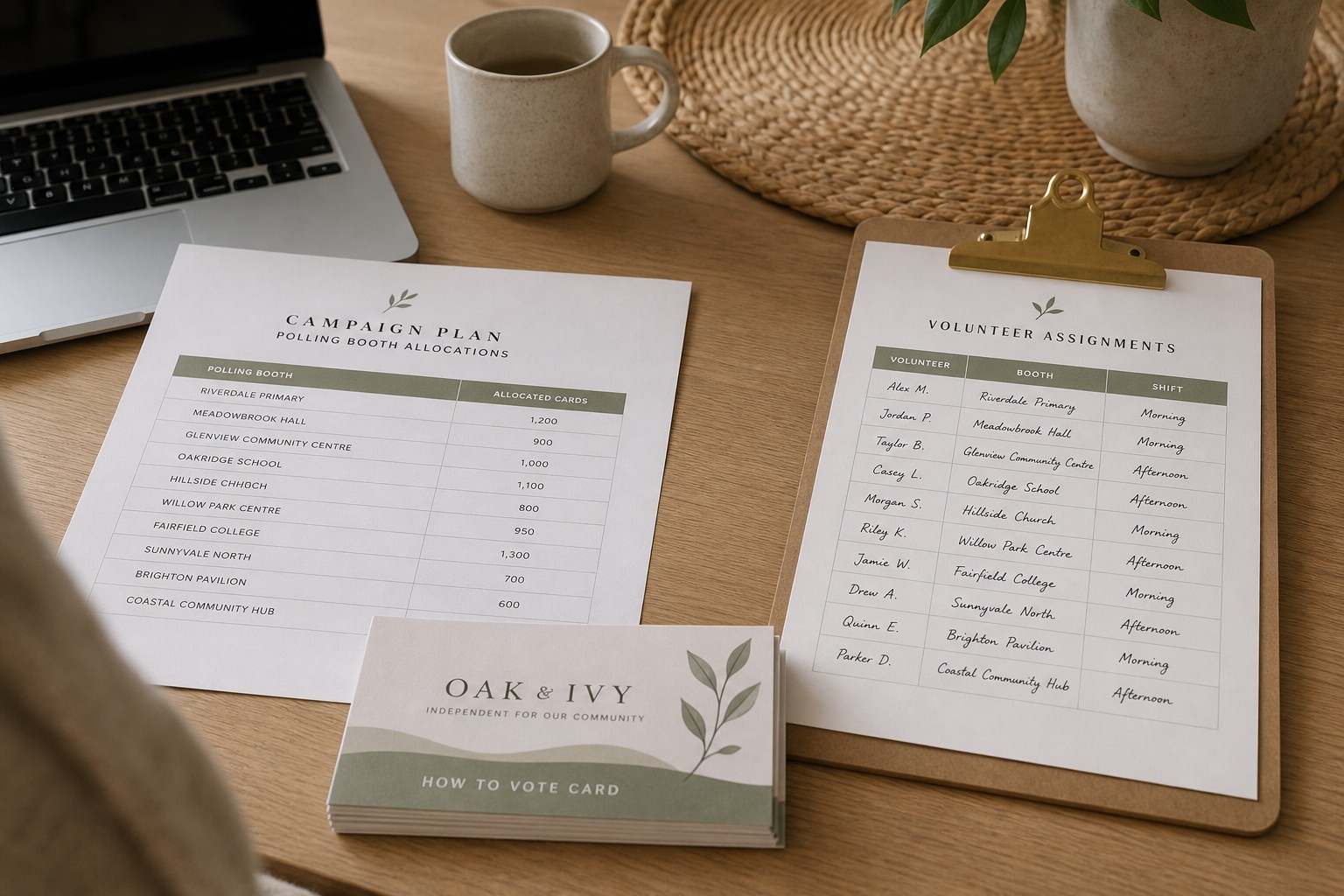
Use booth-by-booth results from the previous comparable election, available from the AEC Tally Room or your state commission’s equivalent. These give you votes cast at each specific polling place as a realistic baseline. Once those booth-level numbers are in hand, you can extend the same local focus to your polling place presence with matching election signs for fence lines and approach roads.
Apply a card acceptance rate of 40-60% (metropolitan booths with high foot traffic and experienced volunteers typically achieve the higher end). Add a 20-30% buffer for spoilage, additional volunteers, and any increase in enrolment since the last election.
| Planning step | Example (one booth) |
|---|---|
| Votes cast at this booth last election | 1,200 |
| Cards accepted (50% rate) | 600 |
| Buffer (+25%) | +150 |
| Allocate to this booth | 750 |
Repeat for each booth you intend to staff, then sum the totals. Add pre-poll separately: if you are placing volunteers at a pre-poll centre for the two weeks before election day, treat it as a separate line using pre-poll participation data from the last election.
Choosing the right paper stock
HTV cards get handled for hours in outdoor conditions. Paper selection affects how authoritative the card looks and feels at the end of a long polling day.
| Stock | Suited to | Notes |
|---|---|---|
| 170gsm Matte | Full-day outdoor distribution | No glare in sunlight; resists fingerprints; holds up to light moisture. Recommended default. |
| 250gsm Gloss | Leave-behind materials and counter displays | Unnecessary weight for a hand-out card; adds cost without distribution benefit. |
For most campaigns, 170gsm Matte is the practical default. If your design relies on vivid colour and conditions on the day are expected to be dry, 150gsm Gloss is a strong alternative.
Turnaround planning for campaign teams
Campaign printing runs to fixed dates. Building enough lead time before pre-poll opens is the main planning risk.
Working backwards from polling day
Paperlust Print Shop’s production and delivery timeline for flyers:
- Proof: delivered within 1-2 business days of artwork submission
- Corrections: allow time for at least one revision pass, particularly for the authorisation line
- Production: 2-5 working days after proof approval
- Delivery: $10 flat-rate Australia-wide; 1-2 business days metro, 2-4 business days regional
Practical lead time from order to cards in hand: 2 full weeks minimum. If pre-poll voting opens 2 weeks before polling day and you need cards available from day one of pre-poll, place your print order at least 4 weeks before polling day.
Coordinating campaign print in one order
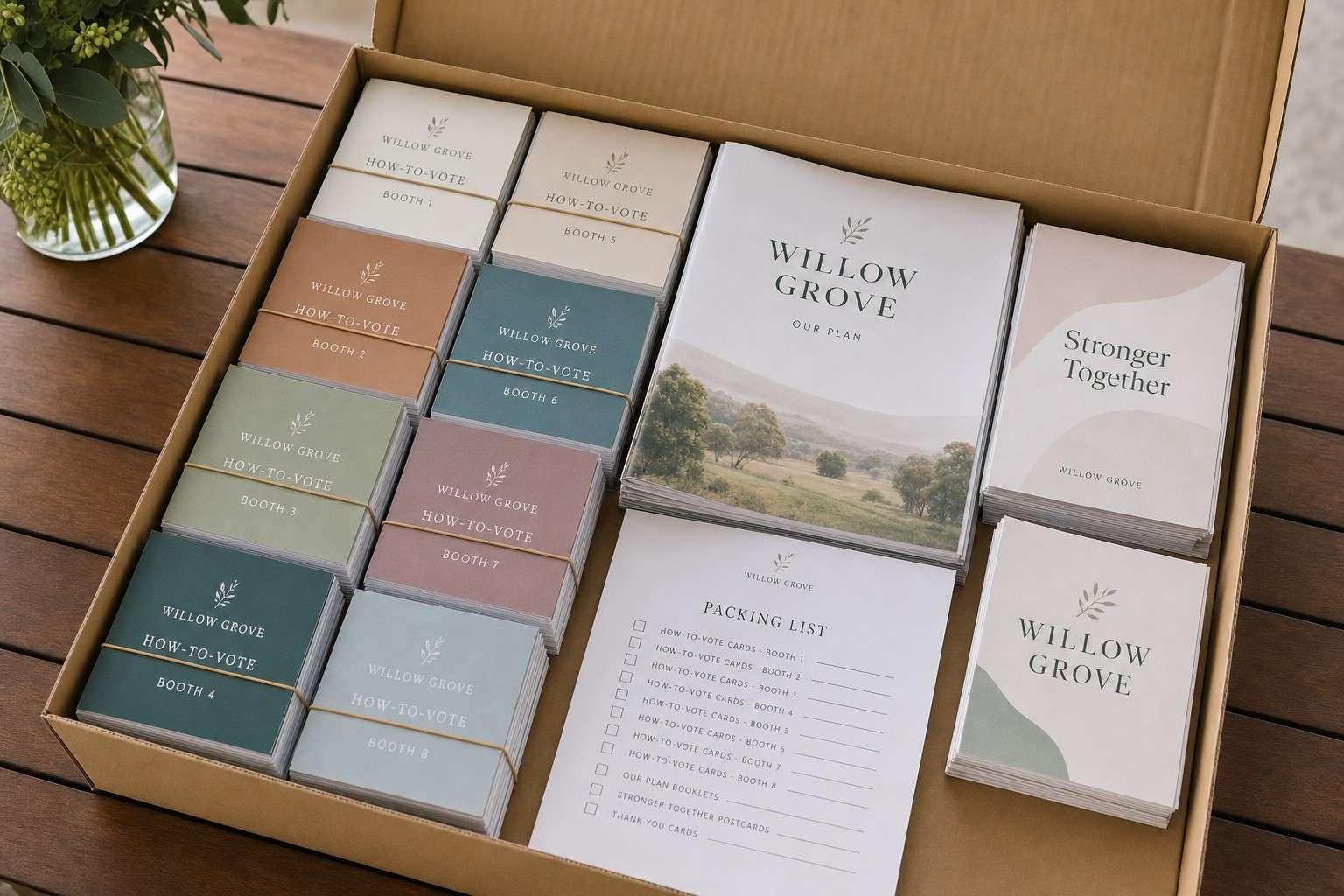
If your campaign is printing HTV cards alongside other materials – candidate policy summaries, direct mail, or corflute signage – placing all orders together simplifies delivery logistics. Paperlust Print Shop also prints DL booklets suited to candidate policy summaries and postcards for voter contact mail programs. A combined order means booth captains receive everything in one delivery rather than tracking multiple consignments.
Print your how-to-vote cards
Paperlust Print Shop’s flyer printing covers DL (99 x 210mm), single or double-sided, across three paper stocks from 150gsm to 250gsm. Production runs 2-5 working days after proof approval, with a free design proof included before print. Flat-rate shipping is $10 AUD Australia-wide, with metro delivery in 1-2 business days. The 100% Print Guarantee covers production defects with a free reprint.
Upload print-ready artwork at 300dpi with 3mm bleed and crop marks, confirm your authorisation statement is correct in the proof, and your cards are on their way to campaign HQ.
Frequently asked questions
What size are Australian how-to-vote cards?
DL (99 x 210mm) is the standard size. It fits the card holders at most polling-place entrance tables, is easy for volunteers to hold and hand out in bulk, and is the most cost-efficient format to print in high quantities. Some campaigns use A5 (148 x 210mm) when more design space is required, but DL is by far the most common format across federal, state, and local government elections.
Does a how-to-vote card need an authorisation statement?
Yes. All electoral material distributed in Australia must carry a printed authorisation statement. Exact wording requirements differ between federal, state, territory, and local government elections. Confirm the required format with the AEC (aec.gov.au) for Commonwealth elections, or with your state or territory electoral commission for all other elections.
Can how-to-vote cards be printed double-sided?
Yes, double-sided printing is available for DL and adds minimal cost per card. It is practical when you need to show preferences for both houses of parliament, include a candidate statement or QR code on the reverse, or provide translated content for multilingual electorates.
How many how-to-vote cards do I need per polling booth?
Start with votes cast at each booth in the previous comparable election, published by the AEC or your state commission. Apply a card acceptance rate of 40-60% and add a 20-30% buffer for spoilage and turnout variation. A booth that recorded 1,200 votes last election typically needs around 700-800 cards. Budget pre-poll centre quantities separately.
How far in advance should I order how-to-vote cards?
Allow at least 2 weeks from order placement to cards in hand: 2-5 working days production plus 1-2 business days metro delivery or 2-4 days regional delivery. If you need cards available from the opening of pre-poll voting, place your order at least 4 weeks before polling day.
What paper stock suits outdoor how-to-vote card distribution?
170gsm Matte is the recommended default. It handles extended outdoor handling, light moisture, and direct sunlight better than lighter stocks or gloss finishes. 150gsm Gloss is a good alternative if your design relies on vivid party colours and conditions on the day are expected to be dry.
Related reading: