

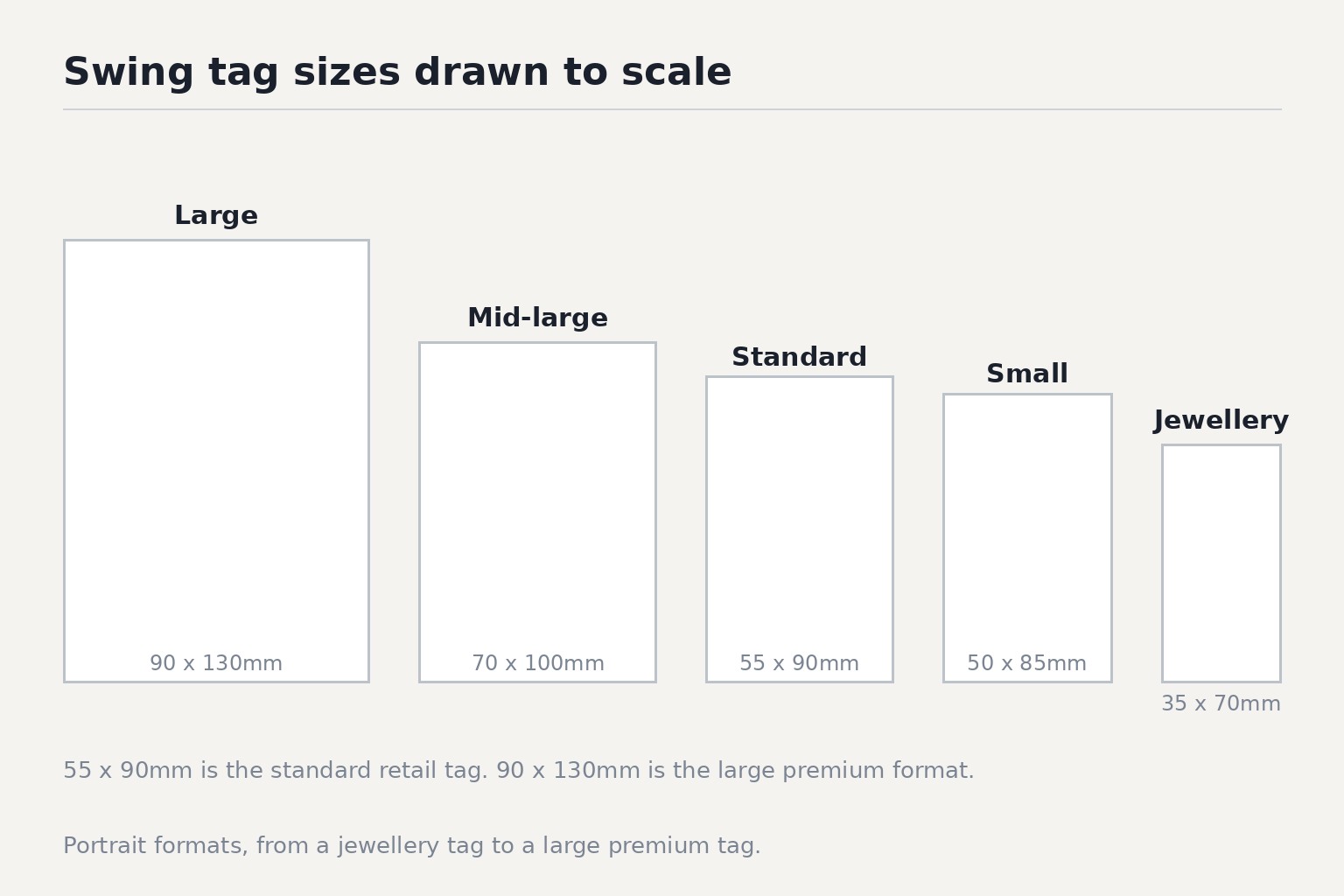
The most common swing tag sizes in Australia run from 50 x 85mm for small jewellery and accessories up to 90 x 130mm for premium apparel and homewares. The widely used mid-range is 55 x 90mm, close to a business card turned portrait.
There is no official Australian standard, but the sizes that appear most consistently across retail printing suppliers and industry use are well established. This guide covers dimensions by industry, portrait versus landscape orientation, where the hole should sit, and what board weight supports everyday handling.
- Small (jewellery, accessories): 50 x 85mm
- Standard (apparel, general retail): 55 x 90mm or 76 x 51mm portrait
- Mid-large (clothing, homewares): 70 x 100mm
- Large (premium or information-heavy): 90 x 130mm
- Narrow landscape (minimalist branding): 90 x 40mm or 100 x 40mm
- Hole clearance: hole centre 6 to 10mm from top trim edge
- Recommended board weight: 300 to 350 GSM for standard retail handling
Common Swing Tag Sizes by Industry
Swing tag and hang tag dimensions vary by product category because the information on the tag, the attachment method, and the shelf or rack context all differ.
Retail Apparel and Fashion
The credit-card proportions around 55 x 90mm (portrait) are the most common starting point for clothing tags. This fits comfortably on a garment without obscuring the product, accommodates a barcode, price, care reference, and brand logo, and attaches cleanly to a tagging gun or cotton string.
Slightly larger formats, 70 x 100mm and 80 x 120mm, suit mid-to-premium clothing where the tag carries more information, a seasonal story, or a designer note. Luxury brands often move to 90 x 130mm to signal quality through size and weight alone.
Jewellery and Small Accessories
Jewellery tags need to be small enough to avoid overwhelming a delicate piece. The common range is 35 x 55mm to 50 x 85mm. Some jewellers use a narrow format, 25 x 60mm, designed to fold around a chain or loop through a clasp. Round tags at 40 to 50mm diameter are a popular alternative for minimalist branding.
Homewares and Ceramics
Homewares retailers generally use 70 x 100mm or 80 x 120mm because the tag often carries care instructions, material origin, or a brand story alongside the price. A heavier board weight is common here because the tag may sit on a display stand rather than hanging from a garment, so it needs to remain rigid without drooping.
Food and Specialty Grocery
Artisan food producers and specialty grocers typically use smaller, near-square formats, 50 x 70mm to 60 x 80mm, often in a landscape or near-square orientation. These are attached to jars, gift hampers, or bottleneck ties, and usually carry only a product name, ingredients note, and brand mark, so smaller formats are sufficient.
Industrial and Numbered Tags
The numbered size series used across Australian retail and industrial settings follows a consistent progression:
| Size number | Approximate dimensions | Typical use |
|---|---|---|
| Size 1 | 35 x 70mm | Jewellery, small items |
| Size 2 | 41 x 83mm | Children’s clothing |
| Size 3 | 48 x 95mm | Medium products, general clothing |
| Size 4 | 54 x 108mm | Standard retail (widely cited as the default) |
| Size 5 | 60 x 121mm | Versatile, general use |
| Size 8 | 79 x 159mm | Luggage tags, heavy-duty |
Portrait vs Landscape: Which Orientation to Choose
Portrait (taller than wide) is the dominant format for swing tags for practical reasons. Portrait orientation gives more vertical reading space when the tag hangs from a garment or display hook. It keeps the hole at the top of the narrow edge, where the string or cord attaches cleanly without the tag twisting during handling.
Landscape (wider than tall) works well for narrow formats such as 90 x 40mm or 100 x 40mm, which are common for minimalist or luxury brands wanting a slim, ribbon-like tag. Landscape tags often attach through a left-edge hole rather than at the top centre.
Square formats at 60 x 60mm or 70 x 70mm appear frequently in jewellery, craft goods, and small accessories. They suit designs that are centred and symmetrical.
For most first-time applications, portrait at 55 x 90mm is the lowest-risk starting point. It is well-supported by print finishers, tagging guns fit a standard 3mm hole at the top, and the proportions are similar to a business card so artwork is straightforward to set up.
Where the Hole Should Sit
The hole position affects both the appearance of the tag when hanging and the structural strength at the attachment point.
Top centre is the standard position for portrait tags. It keeps the tag balanced when hanging and makes it compatible with tagging guns, which drive a plastic barb through the hole and into the garment. Landscape tags typically use a left-centre or left-edge hole.
Hole clearance from the top edge matters more than most designers expect. If the hole centre sits too close to the trim line, the thin strip of board above the hole will split under repeated handling or when a cord pulls at an angle.
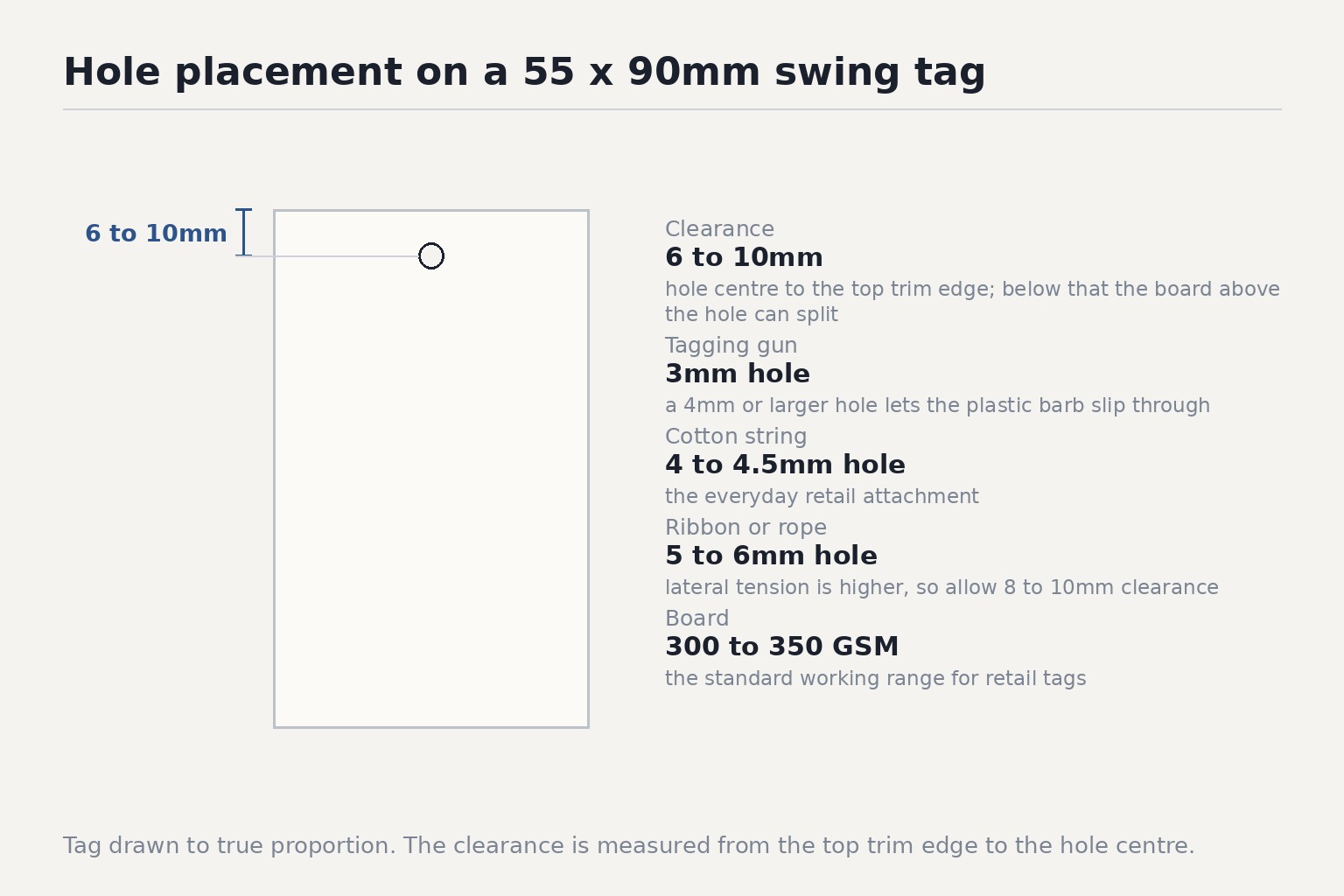
The practical specification for everyday retail use is to place the hole centre 6 to 10mm from the top trim edge. This gives the material above the hole enough depth to resist tearing, leaves room for a metal eyelet without splitting the board, and provides visual breathing space so the hole does not look crowded at the top of the tag.
At the lower end, 6mm clearance is the working minimum for an eyeleted tag on 300 to 350 GSM board. At 3 to 4mm clearance, tearing risk increases sharply with repeated in-store handling or cord tension. For cotton string on 300 GSM card, a 6mm minimum is a safe spec. For ribbon, heavier cord, or split-ring attachments, 8 to 10mm clearance is more appropriate because lateral tension is higher.
Hole diameter depends on the attachment method. A tagging gun needs a 3mm hole so the plastic barb catches cleanly. A 4mm or larger hole will allow the barb to slip through. Cotton string or a thin cord works with a 4 to 4.5mm hole. Ribbon or rope requires 5 to 6mm.
Stock Weight and Why It Matters for Handling
Swing tags are handled more than almost any other printed piece. They pass through production, hang on a garment through transport, are touched by customers repeatedly, and need to stay intact through returns and re-tagging.
250 to 300 GSM is the minimum range for functional retail use. At 250 GSM, a tag can feel lightweight and flimsy, particularly in a portrait format taller than 85mm. The hole edge may also deform under repeated handling. For basic price tags and short-term use, 250 GSM can be acceptable with a 3mm hole and a tagging gun attachment.
300 to 350 GSM is the standard working range for most clothing and homewares tags. At 300 GSM matte board, the tag has enough rigidity to hang correctly without rolling or curling in humidity, and the hole edge holds up with cotton string at 5 to 6mm clearance. 350 GSM board is preferred where the tag carries metal eyelets or will be handled frequently across a retail floor.
Above 350 GSM is used for premium or luxury applications. At 400 GSM and above, the tag feels substantial, resists damage, and can carry more complex finishing such as foiling or embossing without warping.
Lamination adds durability and protects against surface scuffing in high-contact retail environments. Matt laminate keeps the texture clean. Gloss laminate adds sheen and slightly more resistance to moisture.
What Paperlust Prints
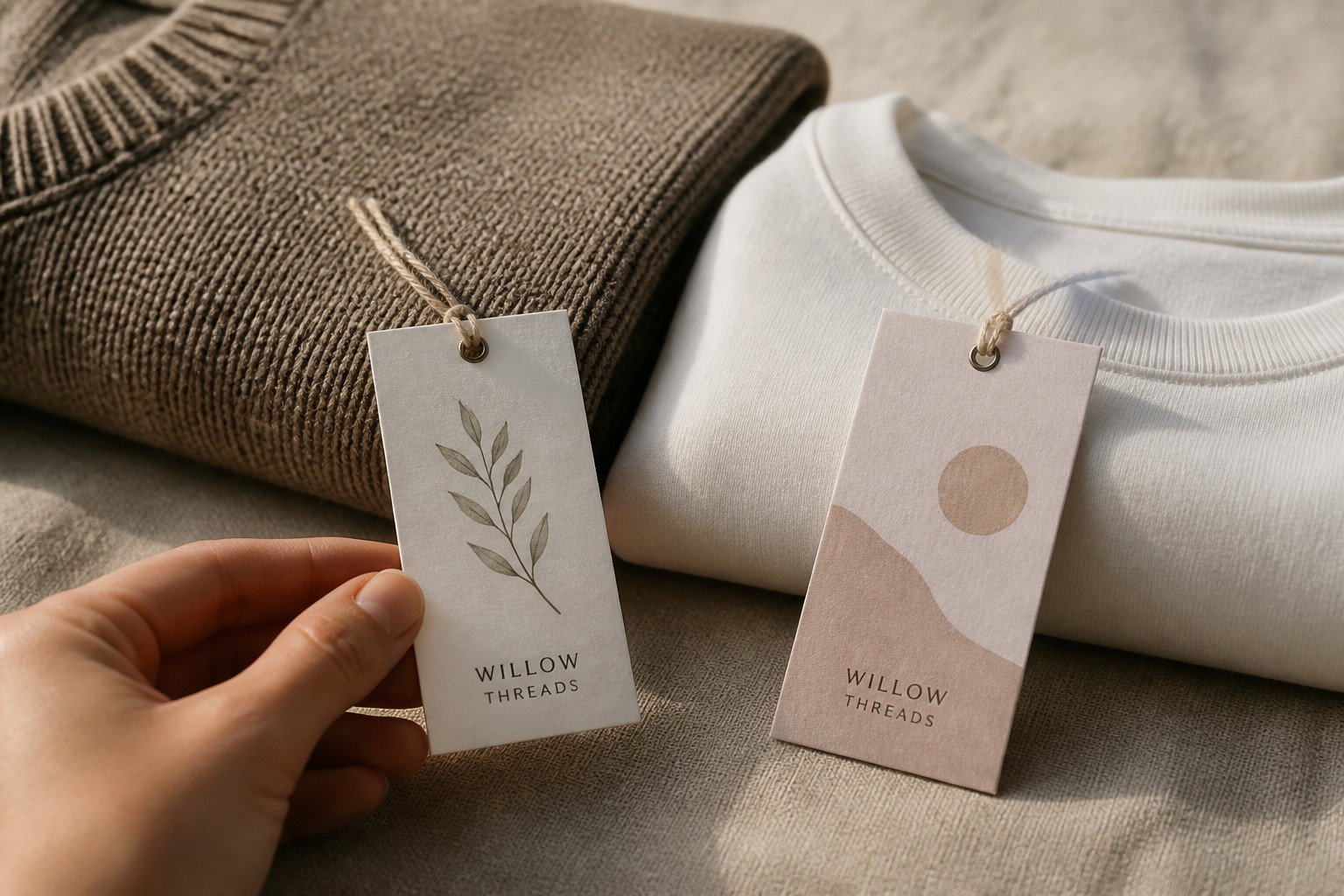
Paperlust Print Shop sells swing tags online, with full colour printing on both sides and a hole punched at the top centre for your own string or ribbon. The paper options are 300 GSM Matte, a smooth white card, and 290 GSM Kraft, an uncoated natural brown card. For a heavier premium tag, Duplex Swing Tags bond two card sheets together into one tag of 540 to 600 GSM, with the front face and back face able to carry different stocks.
Because 300 GSM Matte is also the card used for standard business cards, a tag and card pair can be ordered in the same stock.
Frequently Asked Questions
Can I order swing tags from Paperlust?
Yes, swing tags can be bought through the product page with a minimum order of 50 tags. You choose the shape, paper and artwork from one of six ready layouts, your own print file, or a custom design, and a PDF proof is emailed for approval before production starts.
What is the standard swing tag size in Australia?
There is no single national standard, but the most widely used size across Australian retail is approximately 55 x 90mm in portrait orientation. This sits within the credit-card proportion range and is well supported by print finishers and tagging gun attachments.
What is the difference between a swing tag and a hang tag?
The two terms are used interchangeably in Australia. Some suppliers use “swing tag” specifically for garment tags attached with a tagging gun and “hang tag” for tags attached with a cord, string, or split ring, but this distinction is not consistent across the industry.
What GSM board should I use for swing tags?
300 to 350 GSM is the standard working range for most retail swing tags. 300 GSM suits cotton string and standard tagging guns. 350 GSM is preferred for eyeleted tags or frequent handling. Below 250 GSM, the hole edge is prone to tearing under load.
How far from the top edge should the hole be?
Place the hole centre at least 6mm from the top trim edge for standard retail use. For eyeleted tags or heavier cord, 8 to 10mm clearance reduces the risk of tearing under lateral string tension. At 3 to 4mm clearance, the narrow strip of board above the hole can split with repeated handling.
What hole size do I need for a tagging gun?
A tagging gun uses a 3mm hole so the plastic barb (kimble) catches correctly. A larger hole, 4mm or above, may allow the barb to pull through. For cotton string or a thin cord, a 4 to 4.5mm hole is appropriate. For ribbon or rope, use 5 to 6mm.
Can I use a printed business card as a swing tag?
Yes, with third-party hole punching. A standard Australian business card is 90 x 55mm, which at portrait orientation is 55 x 90mm and sits within the most common swing tag range. 300 GSM matte card is within the recommended board weight for retail use. The card would need a finisher to punch and eyelet before stringing.
What sizes do luxury or premium swing tags come in?
Luxury swing tags typically run from 90 x 130mm to 100 x 150mm in portrait for premium apparel and homewares. Some applications use 120 x 170mm or larger to communicate exclusivity through physical weight and print area.
Are landscape swing tags common?
Landscape formats are less common than portrait for clothing and accessories. Narrow landscape formats, 90 x 40mm or 100 x 40mm, appear in luxury fashion and minimalist branding where the tag is intended to look like a ribbon strip rather than a conventional card.