
Free pens get lost. Tote bags pile up. Lanyards are discarded by end of day. A well-designed branded sticker gets kept, placed somewhere visible, and seen by hundreds more people than the one person who received it.
The event giveaway market is crowded. Stickers stand out when they’re done right — and fail the same way as everything else when they’re not.
Print event stickers people actually keep
Custom die-cut shapes in vinyl or laminated paper, designed to survive a tote bag and a year on a laptop lid.
At a Glance
Event stickers earn their cost when guests apply them within 30 days.
The best event stickers are kept and shared, not pocketed and forgotten. Three design choices drive that outcome: shape (die-cut beats rectangle), finish (matte or holographic beats gloss), and call-to-action (visual + URL beats logo-only).
- Best format for keep-rate: Die-cut single piece — reads premium, intentional
- Best finish for share-rate: Holographic or foil — visually distinct, photographs well
- Quantity rule: 60–70% of expected attendance + 10% buffer
- Distribution rule: Active hand-off > passive table — doubles uptake
- Attribution layer: Add a unique URL or QR if you want to measure post-event engagement
Why Stickers Work as Event Giveaways
The economics are compelling. A high-quality die-cut sticker costs cents per unit at volume. The impression value — people keeping it, displaying it, and showing it to others — extends well past the event itself.
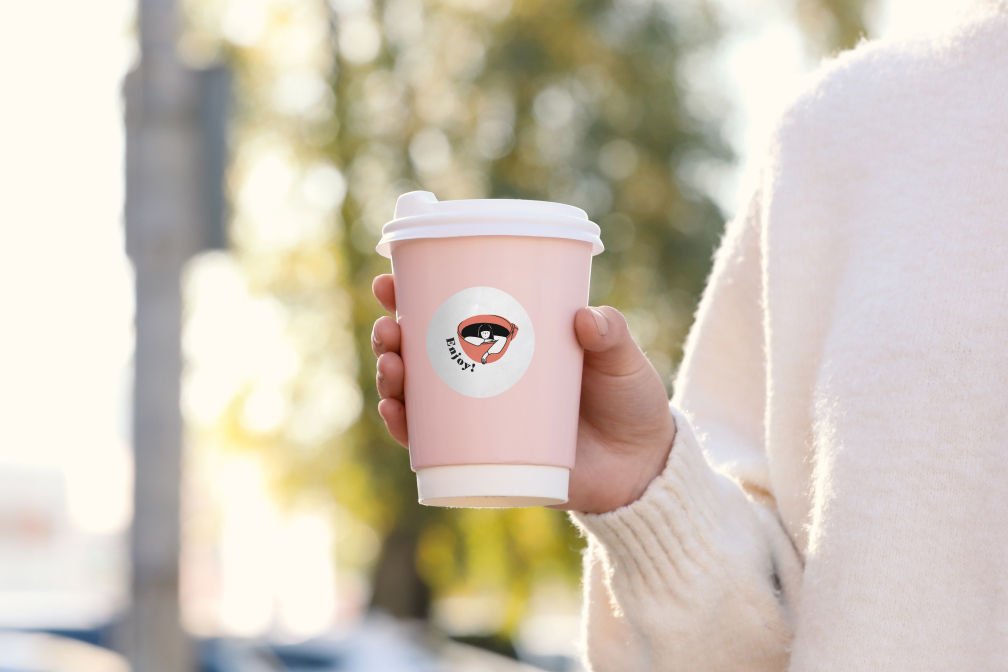
But cost alone isn’t the argument. The better argument is selectivity. People choose stickers. Someone who picks up your sticker at an event made a micro-decision: “I want this.” That opt-in is fundamentally different from someone accepting a branded pen because it was on the table.
When someone puts your sticker on their laptop, notebook, or water bottle, they’re endorsing your brand to everyone who sees it. That’s advocacy, not advertising.
What Makes a Sticker Worth Keeping
The gap between stickers people keep and stickers that end up in the bin comes down to design.
Independent visual value. The sticker should be worth looking at on its own merits — not just because it has your logo on it. Illustration-forward designs, typographic stickers with a strong message, or character stickers all perform better than a logo on a rectangle.
Appropriate size. For events, 70-100mm wide is the sweet spot — large enough to hold its own visually, small enough to go on a laptop lid or water bottle without dominating it.
Quality finish. Matte finish reads as premium in almost all contexts. Gloss works well for bold, colour-heavy designs. Avoid budget gloss on professional event stickers — it looks cheap next to well-made alternatives.
Distribution Tactics That Work
The display table method
Set out a small display of 4-6 sticker designs at your booth. Let people browse and choose what resonates. Choice creates engagement. Engagement creates conversation. Conversation creates leads.
The pack-and-hand approach
Put 2-3 stickers in a small envelope with your card or a QR code. Present it as a “sticker pack” rather than a single item. The packaging signals value. People take better care of things that feel considered.
The welcome bag inclusion
Talk to event organisers about including stickers in conference welcome bags or packs. Most organisers welcome swag donations — it reduces their costs, and your sticker gets into every attendee’s hands without staffing a booth.
The post-event follow-up
Send branded stickers as part of a follow-up to people you met at the event. Combined with a personalised note, it’s a memorable touchpoint that most competitors won’t match.
Need multi-design giveaway packs?
Sticker sheets bundle 4-12 designs into one piece — ideal for activations, brand kits, and conference swag bags.
Format Options for Events
| Use case | Recommended format | Adhesive | Quantity vs attendance |
|---|---|---|---|
| Conference giveaway | Die-cut holographic | Permanent | 60–70% |
| Trade show handout | Kiss-cut sheet (3–5 designs) | Permanent | 300% (passive table) |
| Wedding favour | Foil die-cut | Permanent | 120% of guest count |
| Pop-up packaging seal | Vinyl die-cut, brand-front | Permanent | 120% of expected sales |
| Conference badge / lanyard | Matte vinyl | Removable | 120% of registrations |
| Exhibit booth giveaway | Die-cut single piece | Permanent | 100% of expected stops |
- Die-cut stickers: Custom shape, most visual impact, best for hero brand stickers
- Circle stickers: Versatile, clean, fast to produce, works for most brand styles
- Sticker sheets: High perceived value, great for brands with multiple characters or design elements — premium giveaway format
- Kiss-cut stickers: Easy to peel, clean look on white backing
Measuring the Return
Event sticker campaigns are difficult to track directly, but a few proxies help:
- Ask on lead forms: “How did you hear about us?” and include “sticker/event” as an option
- QR codes on the sticker: A unique QR code links to a specific landing page, giving you direct attribution
- Social monitoring: A distinctive die-cut design will appear in social posts from event attendees. Search your brand name after any event
Scale and Quantities
Event quantities depend on expected attendance. For a 500-person conference, 300-500 stickers is realistic if you’re distributing actively. For a 50-person event, 100 is plenty with some left for follow-up.
Higher quantities push unit cost down significantly. If you’re attending multiple events across the year, calculate annual usage and order once rather than in small runs.
Get a quote on branded stickers for your next event — from small conference runs to large-scale festival quantities.
Planning Your Event Sticker Order
Most event sticker orders that go wrong do so because of timing, not design. Production takes 2-5 business days for standard formats. Rush production (24-hour turnaround) is available for die-cuts, but costs more and leaves no margin for a design revision.
Rule: brief your sticker order 3 weeks before the event. One week for design, one week for production, one week buffer for delays, corrections, or shipping variance. Arriving at a trade show with “we ordered but they haven’t arrived” is an avoidable situation.
How many to order
For passive distribution (stickers on a table, free to take): expect 40-50% uptake from event attendees if the design is genuinely good, 15-25% if it’s average. For active distribution (staff handing stickers directly to people): uptake is much higher, often 70-80% of engaged attendees.
Calculate your expected reach, apply the relevant uptake rate, and add 20% buffer. Running out means missed impressions. Having 20% leftover means you have stock for the next event.
Event Type Playbook
Tech conferences and industry events
This audience has high laptop sticker engagement. Die-cuts at 70-90mm with a strong visual or clever copy perform best. Logo-only stickers are taken less frequently – the design needs independent value beyond brand recognition. Offer two options if budget allows: a brand mark variant and an illustration or concept-driven design that people want for its own sake.
Food and beverage festivals
Packaging seals, jar labels, and product labels get heavy use from food and drink brands at markets and festivals. For giveaways, sticker sheets work well – they feel like a collected item rather than just a handout. Die-cut character stickers tied to a product mascot or ingredient illustration are the format that gets pinned to market stalls and van windows by customers.
Trade shows and expos
Trade show stickers serve a dual role: giveaway for visitors and booth branding. Clear stickers on acrylic panels or glass booth dividers reinforce the brand environment. For giveaways, the competitive dynamic of a trade show floor means your sticker is competing visually with dozens of others. Design for the person who sees it on a laptop two weeks after the show.
Corporate conferences and seminars
Welcome kit stickers, name badge decorations, and session markers are common applications. For corporate events, a subdued, professional design typically outperforms bold or whimsical approaches. If attendees are wearing the sticker on a lanyard or badge holder, keep the scale appropriate – a sticker that fits naturally without dominating the badge shows restraint.
After the Event: Extending the Life of Event Stickers
Event stickers don’t stop working when the event ends. The impressions continue wherever the sticker is placed – and the placement decisions happen after the event, not during it.
Design for the post-event context first. Where will this sticker realistically end up? A laptop lid, a water bottle, a notebook, a car bumper? The placement context determines optimal size, shape, and durability requirements. A sticker designed for laptop use should be sized for a laptop lid even if it’s being distributed at a conference.
Consider adding a URL or QR code to the design for a small percentage of the run – these can be distributed separately or mixed in as a trackable variant. This creates an attribution signal for the post-event period.
Measuring Return on Your Event Sticker Investment
Attribution for physical marketing is hard. There’s no clean pixel that fires when someone sees your sticker on a train. But there are useful proxies.
Track branded search volume and direct traffic in the weeks after major events. Compare against baseline. If you distributed 1,000 stickers at a tech conference and branded search increases 15% the following week, that’s not proof but it’s signal.
Social media is more direct: branded hashtag use, tagged posts featuring the sticker, and “where’d you get that sticker” DMs or comments are all qualitative evidence of active brand endorsement. Track these manually or via social listening tools for the 2-3 weeks following each event.
Building a Reusable Event Sticker System
The businesses that get the most from event stickers aren’t designing a new sticker for each event. They’re building a small system of formats that work across different contexts, ordered at quantities that span multiple appearances.
The core giveaway sticker
One strong, evergreen design that represents the brand at its best. This sticker doesn’t reference any specific event – no dates, no venue, no campaign. It’s a design people would display regardless of which event they got it at. Ordered at 500-1,000 units, it services multiple events from the same stock without reprinting.
A die-cut sticker at 70-90mm with original illustration or bold typography is the most versatile format. It holds its own on a laptop, water bottle, or journal without looking like a conference badge.
The event-specific variant
A secondary design that references the event, the date, or the occasion. Produced in smaller quantities (100-250 units) specifically for the appearance. The event-specific sticker becomes a collectible for people who attend; the core giveaway sticker travels beyond the event.
Use the same brand palette and visual language for both – they should feel like part of the same family even when they’re different designs. Consistency builds recognition across multiple interactions with the same audience.
The packaging insert crossover
Event giveaway stickers that also work as order inserts create economies of scale. If your core giveaway sticker is also something you include in outgoing e-commerce orders, you can order a single large run that services both channels. The per-unit cost drops, and the design gets more distribution across more touchpoints without additional investment.
This only works when the design is genuinely versatile – not event-specific and not dependent on context for its value. If the sticker is worth displaying, it’s worth including in a package. If it only makes sense at a specific event, keep the two formats separate.
How to Choose and Spec Event Stickers for Maximum Return
Event sticker ROI fails for predictable reasons: too many produced (waste), wrong format for context (rectangles in a creative event read cheap), or no path from sticker to the brand surface online. The checklist below catches the failures before the print run.
Before you order event stickers
- Audience match — Match finish to audience — corporate matte, creative holographic, premium foil
- Format match — Die-cut single for keepsake, kiss-cut sheet for shareables
- Attribution layer — Unique short URL or QR for post-event measurement
- Distribution plan — Active hand-off vs passive table — double the order if passive
- Quantity discipline — 60–70% of expected attendance + 10% buffer — over-ordering wastes budget
- Lead time — 10–14 days for foil/holographic; 24h on standard die-cut
Order event stickers in 24h
Die-cut, foil, holographic, kiss-cut sheet. Print runs from 50 stickers; bulk tiers from 500.
Frequently Asked Questions
How far in advance should I order stickers for an event?
Order at least 3 weeks before the event. This allows a week for design finalization, a week for standard production, and a week of buffer for shipping and any unexpected corrections. If you’re ordering closer to the event, 24-hour rush production is available for standard die-cut formats, but this adds cost and leaves no room for design revisions. The cheapest route is always planning far enough ahead that standard production timelines are sufficient.
What sticker format works best for event giveaways?
Die-cut stickers consistently outperform rectangular stickers at events because the custom shape creates visual interest and removes the “generic label” association. For events targeting a younger, creative, or tech-savvy audience, a strong illustration or concept-driven design outperforms a logo-only sticker. For professional or corporate events, a clean brand mark with strong typography is the right balance. Size: 70-90mm wide for event giveaways – visible enough to matter, small enough to fit any surface.
How many event stickers should I order?
Estimate your expected reach, then apply an uptake rate. For passive distribution (stickers available to take), expect 20-50% uptake depending on design quality. For active distribution (staff handing directly to attendees), expect 70-80%. Add 20% to your calculated quantity as buffer – running out creates missed impressions you can’t recover. Leftover stock can be used at the next event or in outgoing orders. It’s also worth noting that per-unit costs drop meaningfully at 500+ units.
Should event stickers be gloss or matte finish?
Matte is the stronger choice for most professional events – it reads as premium and handles the handling stress of being carried in bags, passed between people, and stored. Gloss works well for bold, color-heavy designs targeting consumer events (food festivals, markets, pop-ups) where visual vibrancy is the priority. If unsure, matte is the safer default – it looks good in almost every context and ages better than gloss on surfaces that see regular contact.
Can I add a QR code to event stickers?
Yes, and it’s worth doing if campaign measurement matters. A QR code linked to a UTM-tagged landing page turns a physical brand impression into trackable web traffic. For events where the primary goal is awareness, keep the QR code secondary in the design – large enough to scan cleanly (minimum 20mm square) but not the visual focus. The sticker should be worth displaying without the QR code; the code is an added layer for the subset of people who are curious enough to scan it.
Planning your next event?
Tell us your quantity, distribution date, and we’ll quote a print-ready run. Most event orders ship within 5 business days.