If you are weighing up canvas against paper for your next print run, the decision comes down to one question: is this piece going on a wall to stay, or is it going up for a season, an event, or a campaign? Canvas and paper each have genuine strengths, but they are optimised for very different jobs. This guide explains the real differences in materials, durability, and cost, then tells you which format suits commercial, retail, and event use, and when canvas is genuinely the better call.
CHEAT SHEET
- Canvas is ideal for long-term decorative art prints and home decor that need a frameless, gallery look.
- Paper and synthetic poster stock handles high-volume commercial runs better: lower cost per unit, faster turnaround, easy to swap out seasonally.
- Paperlust Print Shop prints posters on 200gsm synthetic stock, which is moisture-resistant and more durable than standard coated paper, suited to hospitality, retail, and event display.
- If you need one art piece for a lounge room, canvas wins on aesthetics. If you need 20 posters for a pop-up, a venue, or a campaign, paper/synthetic wins on every practical measure.
What Is Canvas Printing?
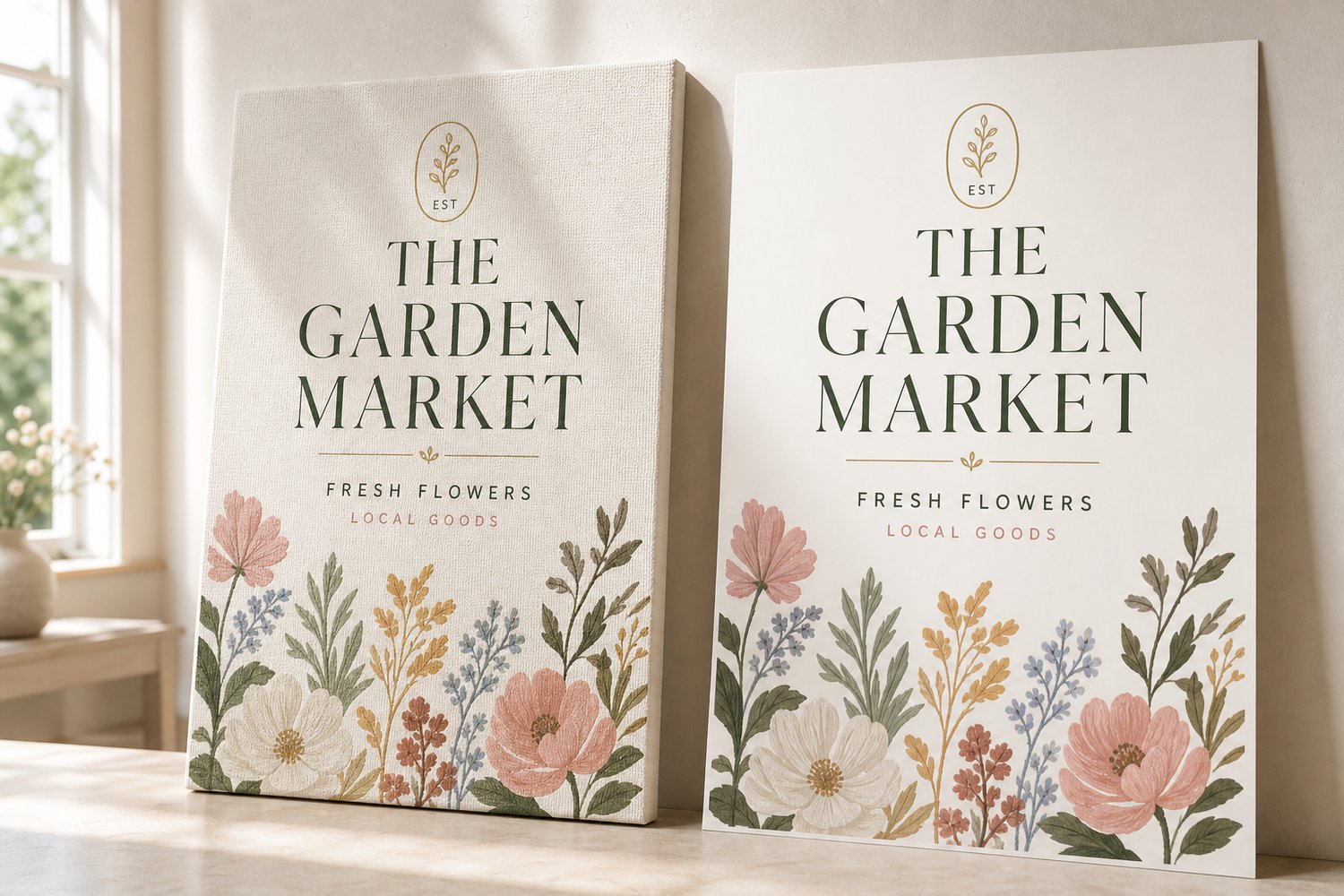
Canvas printing transfers an image onto a woven fabric substrate, typically a cotton-polyester blend or pure cotton weighing 380 to 450gsm, using latex or UV-cured inks. The canvas is then stretched over a timber frame (called a stretcher bar or chassis) and the edges are wrapped, stapled, and finished on the back. The result is a frameless piece that hangs directly on the wall and presents a subtle woven texture across the surface of the image. Our own canvas prints follow that construction on 400gsm artist-grade canvas over solid timber, 38mm deep on the gallery wrap and floating frame finishes and 19mm on the classic frame.
Canvas has been the standard substrate for fine-art reproductions for decades. It reads as an object, not just a print, which is part of its appeal for residential and gallery contexts. It does not require glazing (glass or acrylic), which eliminates glare and keeps the piece lightweight.
What canvas is NOT well suited for: short-run commercial work, seasonal campaign printing, or any application where you need to swap artwork regularly. Canvas is printed individually or in very small quantities because each piece requires hand-finishing on the stretcher. Per-unit cost is significantly higher than paper, and turnaround times are longer. Canvas also cannot be rolled or folded for storage without risk of cracking the ink layer once stretched.
What Is Paper (and Synthetic) Poster Printing?
Paper poster printing covers a wide range of substrates: standard coated art paper (typically 130 to 200gsm gloss or matte), heavyweight fine-art cotton rag paper (200 to 350gsm), and synthetic stocks.
Synthetic poster stock is worth understanding separately. It is made from a polymer-based sheet rather than wood-pulp paper fibres. This gives it properties that standard paper cannot match: it resists moisture, holds up to handling, and will not warp or soften if exposed to humidity. It is still a flat, rollable, printable surface, so it behaves like paper for display and mounting purposes, but it performs far closer to a rigid substrate for durability.
Paperlust Print Shop uses a 200gsm synthetic stock for its poster range. The PDP describes it as “moisture-resistant” and notes it “outperforms standard coated paper” in durability, making it a practical choice for hospitality venues, retail displays, trade events, and any environment where standard paper would deteriorate quickly.
Available sizes are A1 (594 x 841mm), A2 (420 x 594mm), and A3 (297 x 420mm).
Canvas vs Paper: Side-by-Side Comparison
The table below covers the most common decision criteria for buyers choosing between canvas art prints and paper or synthetic posters for commercial and display use.
| Criterion | Stretched Canvas | Standard Coated Paper | 200gsm Synthetic (Paperlust) |
|---|---|---|---|
| Substrate | Cotton-poly blend, 380-450gsm | Wood-pulp coated paper, 130-200gsm | Polymer sheet, 200gsm |
| Texture | Woven textile texture on surface | Smooth (matte or gloss finish) | Smooth, consistent finish |
| Moisture resistance | High (once varnished) | Low (warps, softens when wet) | High (moisture-resistant by material) |
| Durability (unframed, indoor) | 75 to 100+ years (art-grade pigment inks) | 5 to 15 years | Superior to standard paper; suited to commercial use |
| Frame required | No (self-supporting stretcher) | No (pinned or mounted) | No (pinned, mounted, or framed) |
| Glass/glazing required | No | Optional (recommended for longevity) | Not required |
| Rollable/storable | Not once stretched | Yes | Yes |
| Per-unit cost | High (hand-finished per piece) | Low-moderate | Low-moderate |
| Minimum quantities | Very low (often 1) | Low | Low |
| Typical turnaround | 5 to 10 business days | 2 to 5 business days | 3 to 4 working days after proof approval |
| Best for | Fine art, home decor, gallery display | Budget campaigns, short-run events | Hospitality, retail, trade shows, events |

When Canvas Makes Sense
Canvas is the right choice when the primary purpose is long-term decorative display and the print will stay in one spot for years. Specific situations where canvas wins:
Residential and Home Decor
A single statement piece above a sofa or in a bedroom benefits from canvas’s tactile quality and frameless presentation. The woven texture adds depth to the image, and the absence of glass eliminates glare from ambient lighting. For a piece that will live on a wall for a decade, canvas’s longevity justifies the higher cost.
Fine Art and Photography Reproduction
Photographers and artists selling reproductions often prefer canvas because it signals value and permanence to buyers. The surface texture is also forgiving with certain image types, adding a painterly quality to photographs.
Coastal and Humid Environments (Residential)
Australian homes in coastal areas (Queensland and northern NSW especially) experience high humidity. A well-varnished canvas on a stretcher is dimensionally stable in these conditions in ways that unprotected paper is not. If the print is going into a non-climate-controlled space near the coast and you want it to last, canvas is worth the premium for residential decor. Our wall art range prices each canvas size with and without a frame, so the difference is easy to weigh up before you order.
When Paper and Synthetic Posters Make More Sense
For the majority of commercial, retail, hospitality, and event use cases, paper and synthetic poster stock is the more practical choice.
High-Volume Commercial Runs
If you need 10, 20, or 50 posters for a venue fit-out, a campaign, or a series of retail locations, canvas becomes prohibitively expensive. Paper and synthetic stock is priced to scale, the cost-per-unit drops significantly at higher quantities, making large runs feasible.
Seasonal and Campaign Printing
Any artwork that will be replaced in 3 to 12 months should not be printed on canvas. Menu boards, seasonal promotional posters, event signage, and campaign artwork all fall into this category. Synthetic poster stock is robust enough to last the run, and cost-effective enough to replace without hesitation.
Hospitality and Retail Display
Venues and retailers need posters that can handle real-world conditions: a staff member rolling one up to move it, condensation near a bar fridge, or foot traffic in a corridor. The 200gsm synthetic used by Paperlust Print Shop is moisture-resistant and more durable than standard coated paper, which is exactly why it suits these environments. A standard paper poster would soften or warp in a kitchen pass or near a cool room; synthetic holds up.
Events and Trade Shows
Pop-up events, trade show stands, and market stalls need printed materials that travel well, set up quickly, and do not show wear after a weekend of handling. Rolled synthetic posters are easy to transport and mount, and if one gets damaged during transit, reprinting is affordable.

File Setup for Poster Printing
Whether you are printing on canvas or paper, high-resolution artwork is essential. For Paperlust Print Shop’s poster range, the technical requirements are:
Resolution
- A1 and A2: minimum 100 dpi at final print size
- A3: 150 to 300 dpi at final print size
Lower-resolution files will appear soft or pixelated at large sizes. If you are scaling up a logo or graphic, work with a vector source (AI, EPS, or PDF) wherever possible.
Colour Mode
Submit artwork in CMYK colour mode. RGB files (the default for screen) will be converted to CMYK during prepress, and colours can shift noticeably, particularly vivid blues, greens, and neon tones. Design in CMYK from the start or review a proof carefully before approving.
Bleed and Crop Marks
Add 3mm of bleed on all sides beyond your trim edge. Any background colour or imagery that extends to the edge of the poster must extend into the bleed area to avoid white slivers on the finished piece.
Accepted file formats are PDF, AI, EPS, and high-resolution PNG.
Pricing and Turnaround
Canvas prints from specialist suppliers in Australia typically start from $40 to $80 for small sizes (20 x 30cm) and scale to $150 to $300 or more for A1-equivalent sizes, excluding framing.
For Paperlust Print Shop’s synthetic poster range, pricing starts from $6.53 inc. GST for an A3. A1 and A2 pricing scales with size, use the product page for a live quote based on your quantity and size. Production time is 3 to 4 working days after proof approval. Flat-rate shipping is $15 AUD Australia-wide.
If you need to explore other large-format print options alongside posters, the Poster Printing Australia: Sizes, Paper Stocks and Costs Explained covers the full range of stock options and size guidance in detail.
Frequently Asked Questions
Is canvas or paper better for a commercial venue?
For most commercial venues, synthetic or paper poster stock is the better choice. Canvas is hand-finished per piece and priced accordingly, which makes it impractical for multi-location rollouts or seasonal updates. Synthetic poster stock is moisture-resistant, durable, and cost-effective at the quantities hospitality and retail businesses typically need.
Does Paperlust Print Shop offer canvas poster printing?
Yes. Paperlust Print Shop prints canvas wall art on 400gsm artist-grade canvas stretched over solid timber, in gallery wrap, floating frame, and classic frame finishes. For commercial, retail, and event posters where the artwork is replaced within 3 to 12 months, our synthetic poster stock is the better call on cost and turnaround.
What sizes are available for poster printing?
Paperlust Print Shop offers A1 (594 x 841mm), A2 (420 x 594mm), and A3 (297 x 420mm). These are the three most common display sizes in Australian commercial settings.
Can I hang synthetic posters without framing them?
Yes. Synthetic poster stock is stiff enough to mount with poster strips, pins, or standoffs, and does not require framing. Framing is an option if you want a more permanent display, but it is not necessary for the poster to stay flat on the wall.
Will synthetic posters work in outdoor or semi-outdoor settings?
The 200gsm synthetic used in Paperlust’s poster range is moisture-resistant and the PDP describes it as “suitable for outdoor-adjacent display.” For fully exposed outdoor use (direct sun and rain), a more robust substrate such as a vinyl banner is a better choice. For covered outdoor areas like alfresco dining or a market stall awning, synthetic posters hold up well.
How quickly can I get poster proofs?
After you submit your artwork, a design proof is sent for your approval before printing begins. Production then takes 3 to 4 working days. If you need advice on artwork setup before submitting, the How to Design a Poster That Prints Crisp: Resolution, Bleed and Colour covers the full file-prep process.