Every sticker decision starts with shape. And the most common decision is the one most people underestimate: circle or custom die-cut.
Both can work brilliantly. Both can underperform. The difference is understanding when each earns its keep.
Order circle stickers — fastest path to a branded sticker
Standard-size round stickers in our most popular materials, with the lowest setup cost and quickest turnaround.
At a Glance
Circle stickers vs custom die-cut shapes in 30 seconds: circle stickers win on speed, lowest setup cost, and clean symmetry for round logos; custom die-cut shapes win on standout, brand recognition, and packaging that looks designed-not-stuck-on.
How to choose: pick circles when your logo is round or budget is tight; pick die-cut when shape is part of the brand asset (mascot, wordmark, irregular icon).
- Cheapest small-quantity option: circle stickers — no custom dieline cost
- Best for brand recognition: custom die-cut — silhouette becomes part of the asset
- Fastest turnaround: circle (standard sizes ship faster than custom dies)
- Best for packaging seals: circle 35–50mm — fits most box flaps and mailer closures
The Case for Circle Stickers
Circle stickers are the reliable choice. They work for almost every brand, almost every surface, and almost every use case. That universality is the point.
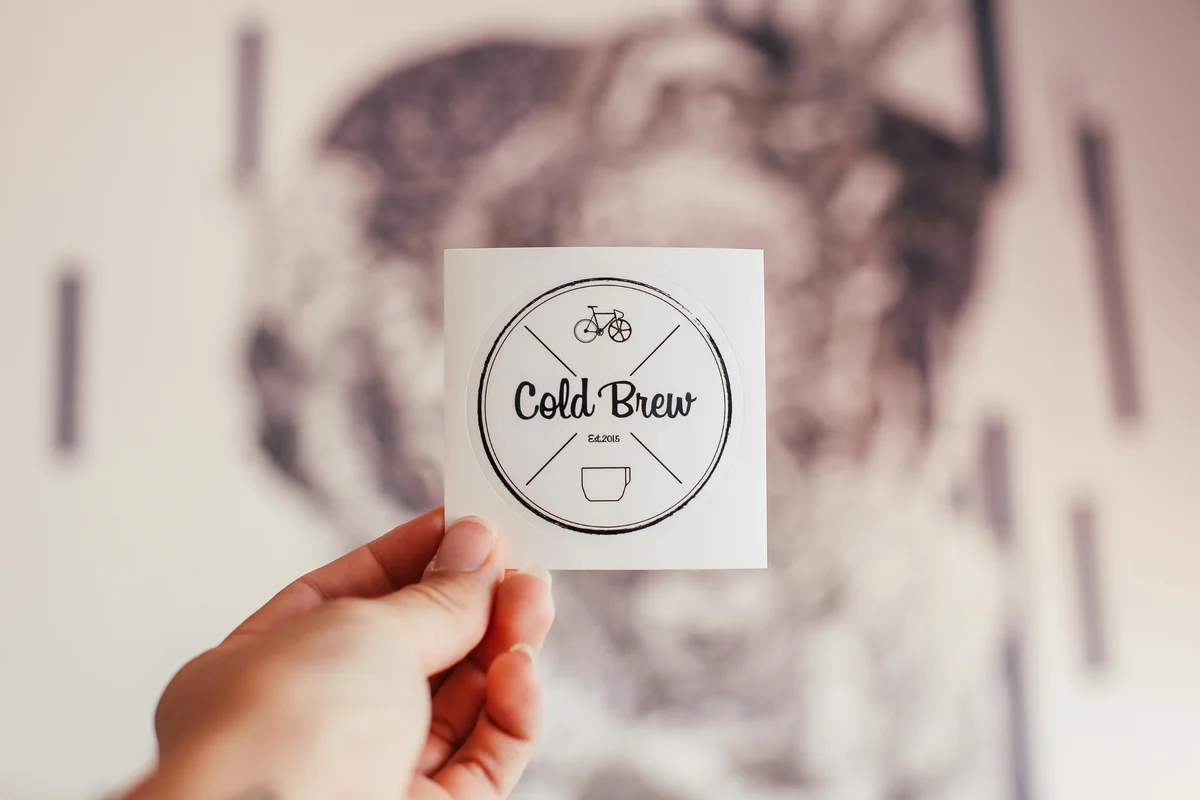
A circle doesn’t have a “right way up.” It looks the same from any orientation on a laptop, bottle, or notebook. That removes a placement decision from the person applying it — one fewer reason to put it off.
Circles also carry strong cultural associations: wax seals, stamps, official certifications, award medallions. A well-designed circular sticker with a centred logo reads as confident and intentional without requiring any explanation.
When circles are the right choice
Packaging seals. The circular format is the standard for box and mailer seals. It centres naturally on the flap, looks balanced, and seals cleanly. There’s a reason wax seals are circular.
Consistency across a product range. If you’re labelling multiple products with different dimensions, a circle adapts to any surface without modification. One design, infinitely flexible application.
High-volume campaigns. Circle stickers are faster to produce and more cost-efficient at volume than complex die-cuts. For events or large-scale distribution, the economics favour circles strongly.
Brand marks that are centred or symmetrical. Logos that work well in a circle — monograms, crests, simple icons, circular wordmarks — don’t benefit from a custom shape. The circle IS the right shape for these.

Need a custom die-cut shape instead?
Die-cut stickers cut to your exact artwork outline — lettering, logos, mascots, illustrations — for the ownable look that circles can’t match.
The Case for Custom Die-Cut Stickers
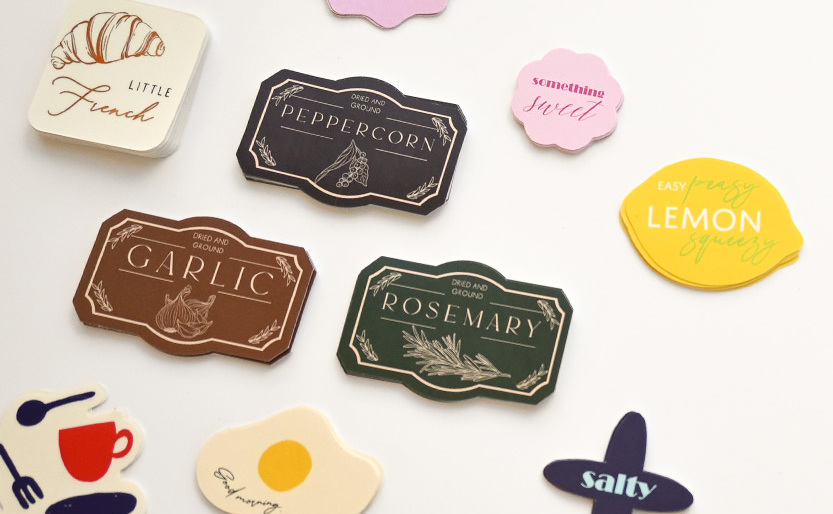
Die-cut stickers are cut to the exact outline of your design. The sticker shape matches the art. No white background, no rectangle, no arbitrary container around the design.
The result: the sticker has more visual energy. It looks intentional. It looks different from every other sticker. And when people are choosing which sticker to put on their laptop — and they have 10 to choose from — the one with the interesting shape tends to get placed first.
When die-cuts are the right choice
Illustrated designs. A character, animal, plant, or object illustration gains enormous impact from a custom die-cut. The shape IS the art. An illustration of a cactus with the cactus silhouette die-cut is fundamentally different from the same illustration in a circle.
Brand mascots and characters. If you have a character or mascot, die-cutting its silhouette transforms the sticker from a logo placement into a miniature figure. It becomes something to display rather than just a brand mark.
Collectible and merch stickers. Sticker sets, event merch, and fan-oriented stickers perform far better as die-cuts. The visual interest drives collection behaviour. A sticker sheet of custom-shaped characters is a product. A sheet of circles with logos is swag. Either way, a custom sticker sheet lets you arrange multiple shapes and sizes on one kiss-cut backing.
Designs with strong silhouettes. Logos or marks with a distinctive outline — a leaf, a wave, an arch, a lightning bolt — translate directly into die-cut shape and gain presence as a result. The outline amplifies the mark.
Design Considerations
For circle stickers
Design to the circle. Elements that bleed to the edge should extend to the trim line. Centred compositions work best. Avoid designs with strong horizontal emphasis — a wide horizontal logo in a circle will have a lot of unused space at top and bottom, which can look awkward.
For die-cut stickers
Simplify your silhouette. Complex outlines with many indentations and fine points are fragile — the vinyl at narrow points can tear during application. Smooth, clear outlines are more durable and more legible as a shape.
Keep a safe zone of at least 3mm between design elements and the cut line. Fine detail right at the edge gets lost in the cutting process.
Cost and Practical Comparison
Die-cut stickers cost more per unit than circle stickers for the same quantity and size. The cutting is more complex and requires a custom die. That premium is worth paying when the shape is integral to the design. It’s not worth paying when the design would work equally well in a circle.
| Factor | Circle stickers | Die-cut stickers |
|---|---|---|
| Unit cost (comparable qty) | Lower | Higher |
| Production speed | Faster | Standard |
| Best for volume campaigns | Yes | Less so |
| Best for collectible/fan use | Less so | Yes |
| Packaging seal use | Ideal | Overkill |
| Design flexibility | Limited by circle | High |
How to Choose Between Circles and Custom Shapes
Rounded corner stickers occupy the space between circle and full die-cut — a rectangle or square with softened edges that avoids the peeling-corner problem of sharp-cornered stickers while retaining a defined rectangular format. Good for typographic designs, label-style stickers, and designs that need a defined text area.
Browse circle stickers, die-cut stickers, and rounded corner stickers to compare formats. Configure your shape, size, and finish to get an instant quote.
Cost Comparison at Different Quantities
Shape complexity affects price. Circle stickers use a standard die, which is already set up and shared across all orders. There’s no die creation cost. Custom die-cut stickers require either a custom die or a digital cut path – the setup is absorbed differently depending on the print process, but at low quantities (under 100), circles have a clear cost advantage.
At higher quantities (250, 500, 1,000+), the per-unit cost difference between circles and custom die-cuts narrows. The die setup cost is amortized across more units. By 500 units, a well-specified die-cut is often within 15-20% of the circle equivalent – close enough that the decision should be made on design merit, not cost alone.
The exception is very complex die-cut shapes with narrow cut points, acute angles, or very fine details. These require more precise production and may have a cost premium that persists at volume. Simple custom shapes – a rounded rectangle, a leaf, a shield – are cost-comparable to circles at reasonable quantities.
Need fast, affordable circle stickers?
Order custom circle stickers in standard sizes (25mm–100mm) — full-colour printing, gloss or matte finish, 24–48hr turnaround.
Brand Application by Industry
Food and beverage
Food brands split clearly by positioning. Mass market and casual brands: circles work naturally for jar lids, bottle caps, and packaging seals – the format is familiar and trusted. Artisan, craft, and premium brands: die-cut shapes that echo product ingredients, regional imagery, or brand characters create differentiation on crowded market shelves where every label looks the same from three steps away.
Beauty and skincare
Beauty packaging rewards the considered choice. Circles read as clean, clinical, and professional – the right frame for brands with a medical or science-forward positioning. Custom die-cuts (organic shapes, botanical silhouettes, decorative crests) are better for brands selling on aesthetic appeal and the luxury of craft. The shape of the sticker becomes part of the brand visual language.
Tech and software
Tech stickers at events and in welcome kits almost universally perform better as die-cuts. The audience is design-literate and accustomed to seeing hundreds of laptop stickers. A circle with a logo reads as generic in that context. A well-executed custom die-cut – an icon shape, a character, a distinctive mark – reads as intentional. This audience notices the effort.
Retail and fashion
Retail packaging seals and hang tags favor circles for their function (closing, centering, framing) and their universality. For brand expression beyond the functional seal, fashion brands benefit from die-cuts that have clear design rationale – not just “a different shape” but a shape that’s recognizably theirs. The shape becomes part of the signature.
How to Brief Your Sticker Order
The brief you give when ordering a sticker is as important as the design file. Unclear briefs produce mediocre results even from good print partners. A clear brief covers:
- Use case: Packaging seal, event giveaway, product label, laptop sticker. This determines the size range, adhesive strength, and material requirements.
- Surface: What is the sticker going on? Paper packaging, glass, metal, fabric, laptop aluminum. Different surfaces require different adhesives – specify the surface if you know it.
- Quantity: How many do you need initially? Are there future reorder requirements? Establishing reorder intent at ordering time is useful context.
- Shape: Circle, standard size (specify mm). Or custom die-cut (supply a cut file, or describe the shape clearly). If uncertain, ask for a recommendation based on the design.
- Finish: Gloss, matte, or clear. If unsure, matte is the safe default for most professional applications.
- Timeline: When do you need them? If the answer is “in two weeks” versus “in three days,” the production path and cost differ.
Using Both Shapes in a Single Campaign
There’s a strong argument for using both shapes for different roles in the same campaign – not choosing, but designing a system where each format does its best job.
A practical example: a product brand uses 50mm circle stickers as packaging seals on every order (consistent, cost-efficient, functional). They also produce a run of custom die-cut character stickers for their seasonal campaign (limited edition, conversation-starting, designed to be kept). The circle seal is the workhorse. The die-cut is the collectible. Both serve the brand without competing with each other.
This approach works especially well for direct-to-consumer brands with an active social following – the die-cut character sticker becomes the shareable item, while the circle seal maintains brand presence on every outgoing order regardless of season or campaign.
Before You Order Circle or Die-Cut Stickers
- Confirm logo shape — circular logos do best on circle stickers
- Decide on quantity — die-cut becomes cost-competitive at 500+ units
- Specify cut type (die-cut for individual, kiss-cut for sheets)
- Choose surface application (smooth glass / curved bottle / matte packaging)
- Supply vector artwork with cut path on a separate layer
Want a custom shape that stands out?
Our die-cut stickers are cut to the exact silhouette of your design — perfect for mascots, wordmarks, or irregular brand icons. Free dieline review.
Frequently Asked Questions
Are circle stickers or die-cut stickers better for packaging seals?
Circle stickers are the standard choice for packaging seals, and for good reason: they center naturally on folds and flaps, seal reliably from any orientation, and carry the visual heritage of wax seals that signals care and quality. Custom die-cut shapes are worth specifying if the shape has clear brand rationale – a logo element, a product icon – rather than just being different. For most packaging seal applications, the circle is the right answer.
At what quantity does a custom die-cut sticker become cost-competitive with a circle?
By 250-500 units, the per-unit cost difference between a well-specified custom die-cut sticker and a circle is typically within 15-20%. At 1,000+ units, the difference narrows further. For quantities under 100, circles have a clear cost advantage. The decision at higher quantities should be made on design merit – which shape best serves the brand and use case – rather than pure cost, since the financial difference becomes relatively minor at scale.
Do die-cut stickers work on all surfaces?
Yes – the shape is determined by the cut, not the material. Die-cut stickers can be produced in paper stock, vinyl, clear vinyl, or specialty materials, and applied to the same range of surfaces as any other sticker format. For curved surfaces (bottles, tubes, bumpers), vinyl is more durable than paper stock because it flexes with the curve rather than resisting it. For flat packaging surfaces, both paper and vinyl work well. Specify the application surface when ordering – it informs the adhesive and material recommendation.
Can I have a logo-only sticker as a die-cut?
Yes, and it often works better than a circle if the logo has distinctive external geometry – a shield, a leaf, a distinctive icon shape. The sticker becomes the logo shape exactly, which creates a stronger impression than the same logo floating in a circle. The trade-off is that very complex logos with fine lines, negative space, or narrow cut points can be difficult to cut cleanly at small sizes. If the logo has these characteristics, a circle background often gives the logo more stability and visual presence than a complex die-cut.
What’s the difference between a die-cut and a kiss-cut sticker?
A die-cut sticker is cut through both the sticker material and the backing – the sticker is fully separated from the backing and comes as individual shapes. A kiss-cut sticker is cut only through the sticker layer, leaving the backing intact. Kiss-cut stickers stay on the backing until peeled, making them easier to handle and display individually. Die-cut shapes are the standard for most individual stickers. Kiss-cut is the format used for sticker sheets, where multiple designs sit on one backing card and are peeled individually.
Not sure which shape fits your brand?
Talk to our team or browse the full sticker range — we’ll help you match the shape to your distribution and budget.