
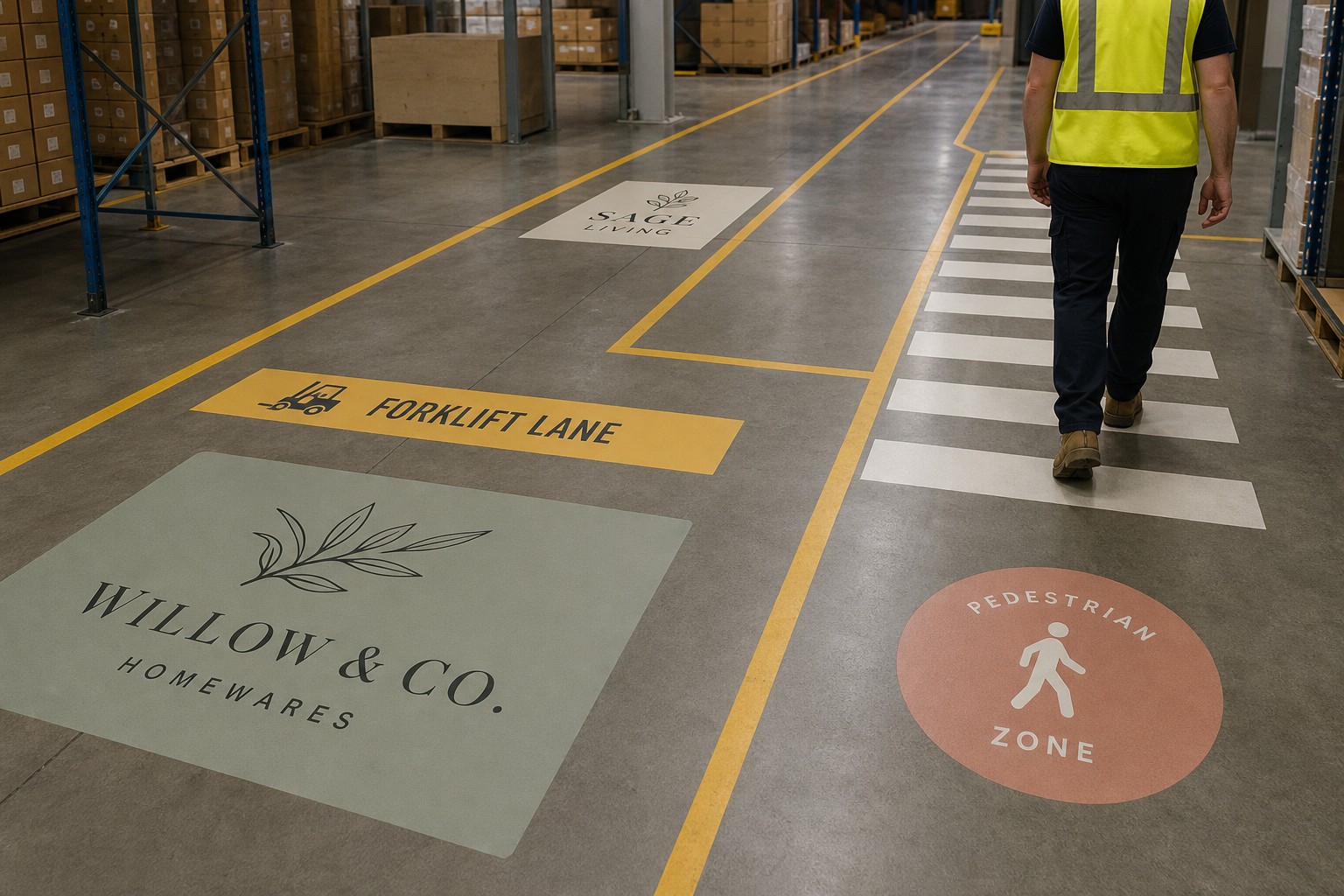
Floor marking in a warehouse is not just about organisation. It is a legal obligation under Australian Work Health and Safety (WHS) legislation. Colour-coded zones protect workers, keep forklifts separated from foot traffic, and help auditors confirm your facility meets its duty of care. This guide covers the colour conventions you need to know, the AS 1319 safety-sign framework, and how anti-slip floor decals perform under real warehouse conditions.
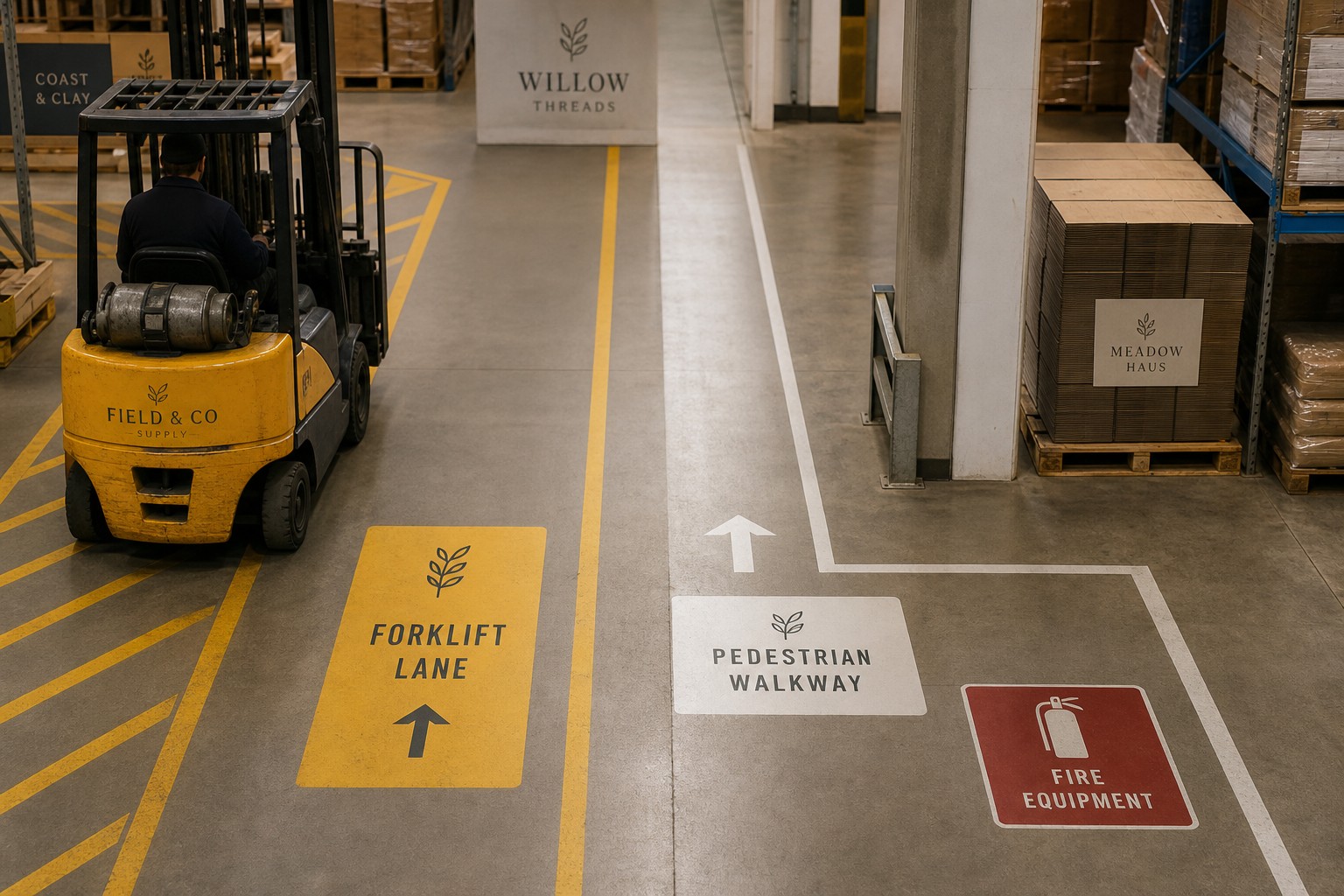
- Yellow = forklift lanes, vehicle traffic routes, caution areas (AS 1318)
- White = pedestrian walkways, bay delineation, general demarcation
- Red = fire equipment locations, no-go zones, emergency stops
- Green = emergency exits, first aid stations, safety equipment locations
- Blue = mandatory action zones (PPE required, hard-hat areas)
- Yellow/black diagonal hatching = exclusion zones not to be stood in or obstructed
- Anti-slip floor decals suit sealed concrete and tile; not unsealed concrete or wet areas
- Confirm current obligations against the published AS 1319 and your state WHS regulations
Why floor marking is a legal obligation, not a suggestion
Work Health and Safety (WHS) legislation requires all persons conducting a business or undertaking (PCBUs) to eliminate or minimise risks to workers. In a warehouse or industrial facility, separating vehicle and pedestrian traffic is one of the highest-priority controls, and floor marking is the baseline mechanism for achieving it.
Safe Work Australia’s Traffic Management Guide for Warehousing provides specific guidance on pedestrian and vehicle separation. Australian Standards, particularly AS 1318 (industrial safety colour codes) and AS 1319 (safety signs for the occupational environment), underpin the colour system used in practice across Australian facilities. State WorkSafe authorities enforce compliance, and faded, damaged, or absent floor markings can constitute a WHS breach.
The key principle is consistency. Workers learn colour conventions quickly when they are applied reliably. An ambiguous or unmarked pedestrian corridor is more dangerous than no marking at all, because it creates a false sense of safety.
The colour system: what each zone signals
The table below summarises the colour conventions used across Australian warehouses, following the AS 1318 and AS 1319 framework. Some facilities introduce additional colours such as orange for specific hazard types or purple for racking-protection zones. If you use non-standard colours, document their meaning in your site safety plan so workers, contractors, and auditors all understand the system.
| Colour | What it signals | Typical warehouse use |
|---|---|---|
| Yellow | Caution, physical hazard, vehicle traffic | Forklift lanes, aisle edges, turning bays, loading dock boundaries |
| White | Pedestrian route, general delineation | Walkways, bay markings, column guards, directional arrows |
| Red | Danger, fire equipment, prohibited zone | Fire extinguisher floor surrounds, emergency stop areas, no-entry zones |
| Green | Safety, emergency, first aid | Emergency exit routes, first aid station markers, muster points |
| Blue | Mandatory action required | PPE required zones, hard-hat areas, eye-protection reminders |
| Yellow/black hatching | Keep clear, exclusion zone | Column bases, machinery exclusion zones, loading dock edges, do-not-obstruct areas |
AS 1319 and the WHS compliance framework
AS 1319 (Safety Signs for the Occupational Environment) sets out colour-coded conventions for workplace safety signage, including floor-level applications. It defines which colours convey which meanings and specifies how safety symbols are to be presented. AS 1318 specifically addresses industrial safety colour coding for plant and floor marking. Together these standards underpin the colour system applied across Australian warehouses.
A few things facilities managers commonly get wrong:
Assuming the standards answer every detail
AS 1319 establishes the colour framework and principles. It does not prescribe minimum line widths or exact marking dimensions for every scenario. Your WHS management system, site risk assessments, and Safe Work Australia guidance fill those gaps. Check you are referencing the current published version of the relevant standard, as Australian Standards are reviewed periodically.
Treating painted lines and floor stickers as interchangeable
They are complementary tools, not substitutes. Painted epoxy or thermoplastic line marking is typically more durable in very high-traffic vehicle zones, particularly where forklifts make sharp turns. The lateral tyre-scrub force during a tight turn puts significant stress on any surface-applied material. Floor decals fill a different role: faster to install, fully customisable with logos, icons, or multilingual text, and easy to reposition as your floor plan evolves. The most effective warehouse marking systems use both: painted lines for permanent traffic lanes, decals for supplementary signage, zone identifiers, warnings, and areas that change configuration regularly.
Not maintaining markings
WHS legislation requires you to keep safety controls effective. A correct marking system that has faded or peeled is a liability. Assign a review frequency (quarterly is common) and replace worn decals before they become unreadable.
Anti-slip floor decals: materials and surface compatibility
For a floor decal to be appropriate in a warehouse setting, anti-slip lamination is essential. Floor stickers from Paperlust Print Shop include anti-slip lamination as standard. The textured surface reduces slip risk underfoot, which matters most in pedestrian crossing zones, mandatory-action areas, and first aid markers where workers are likely to be looking at the signage rather than watching their footing ahead.
Compatible surfaces
Floor decals adhere reliably to:
- Sealed ceramic and porcelain tiles
- Polished and sealed concrete
- Sealed timber and laminate
- Commercial vinyl flooring
- Smooth painted hard floors
What floor decals are not suited to
- Unsealed or porous concrete
- Wet areas or drainage zones
- Prolonged outdoor exposure
- Carpet or textured rubber flooring
The unsealed-concrete point is the most critical for warehouse managers. A significant proportion of older Australian warehouse and logistics facilities have unsealed or partially sealed concrete floors. If your floor is porous, decals will not adhere reliably and will lift prematurely. Options in this situation include applying an epoxy sealer first, using painted line marking, or supplementing the system with rigid PVC safety signs mounted to racking, walls, or columns at eye level.

Durability expectations under warehouse traffic
Floor stickers are rated for 1-3 months in normal foot traffic conditions. In a high-use warehouse environment with multiple forklift passes daily and heavy pedestrian traffic, expect performance toward the shorter end of that range, particularly near turning bays or loading zones. Standard floor stickers start at 150 x 150mm and can be produced in custom sizes to suit aisle widths and zone boundaries.
Applying decals in pedestrian zones, first aid areas, mandatory-action markers, and supplementary directional signage rather than directly in forklift lanes will extend service life and reduce replacement frequency.
Applying floor decals to warehouse concrete floors
Correct surface preparation is the single biggest factor in how long a floor decal lasts. A rushed application on a dusty, damp, or inadequately sealed floor will fail within days.
Surface preparation
1. Clean thoroughly. Sweep, then mop with a degreasing cleaner. Oil residue, wax, or cleaning-product buildup will prevent adhesion. Allow the floor to dry completely: minimum 24 hours after mopping. 2. Test for sealing. Place a drop of water on the surface. If it beads, the concrete is sealed. If it soaks in, the surface is porous and is not suitable for decals without sealing first. 3. Check for cracks and damage. Decals will bridge minor imperfections but will lift along the edges of larger cracks over time.
Application steps
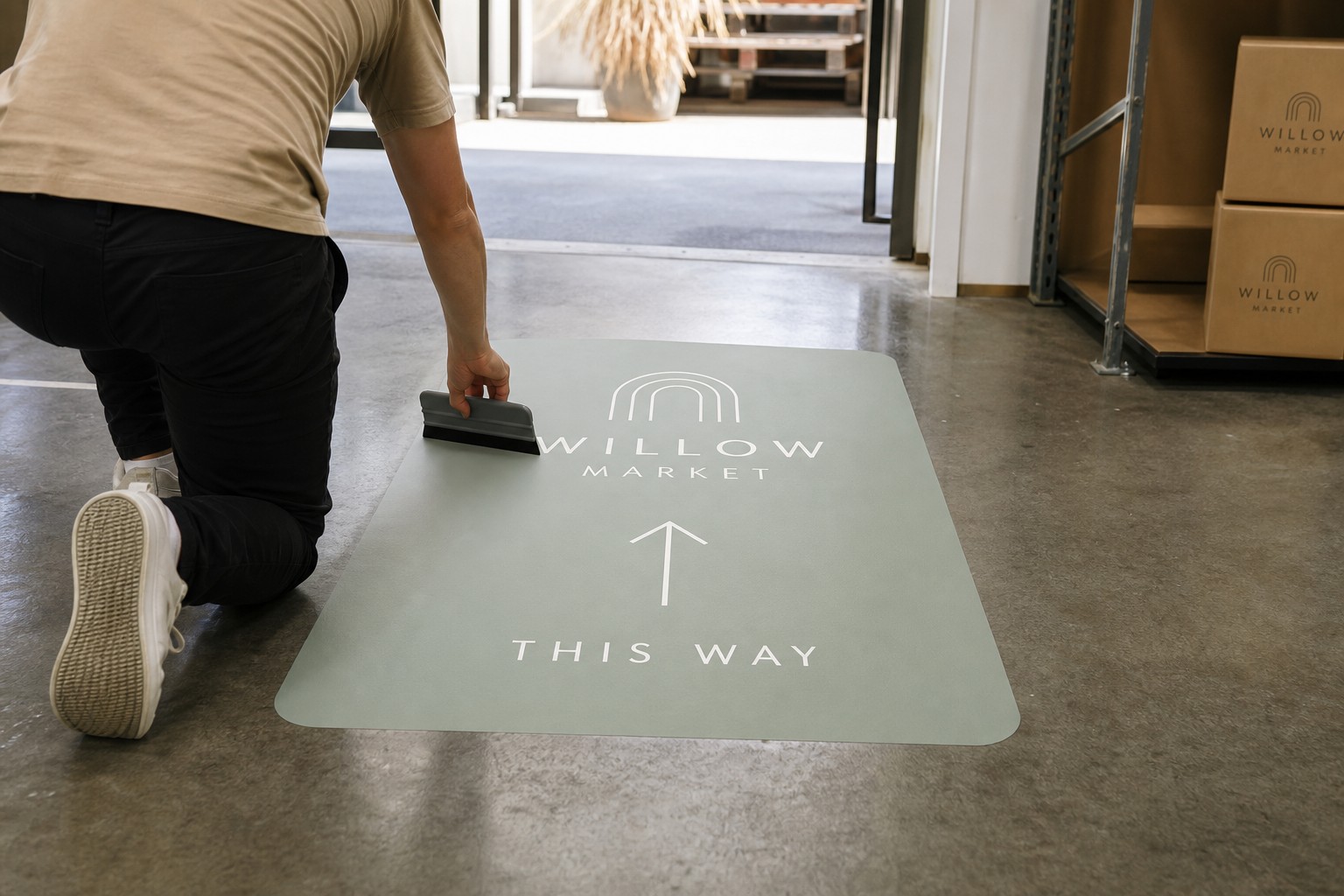
1. Position the decal face-up and confirm placement before removing the backing. 2. Peel the backing from one corner, align the decal, then smooth outward from the centre to push out air bubbles. 3. Press firmly along all edges and corners using a squeegee or smooth-edged card to ensure full adhesion. 4. Leave the area foot-traffic-free for 24 hours. Avoid mopping for 48 hours.
Ongoing maintenance
- Clean with a damp mop and a neutral pH cleaner. Solvent-based floor cleaners can attack the laminate and cause premature lifting.
- Inspect decals monthly. Replace any with lifted edges immediately; a partial lift will propagate quickly under traffic.
- In high-use areas, keep a small stock of replacement decals on-site so turnaround is fast.
Complementing floor marking with safety signage
Floor marking and wall-mounted signage operate as a system. A yellow forklift lane boundary tells a driver where to travel. A sign at eye level on the adjacent racking reinforces speed limits or horn-at-intersection requirements. PVC safety signs printed on 3mm or 5mm TekPVC are a practical complement: rigid, lightweight, UV-resistant, and printable in full colour with custom safety messaging specific to your site. Available in A1 (594 x 841mm), A2 (420 x 594mm), and A3 (297 x 420mm), or up to 2,440 x 1,220mm for large-format safety boards.
For facilities with public-facing areas, trade counters, or showroom floors adjacent to the warehouse, explore the full window and floor graphics range for broader options including digitally printed window graphics and directional graphics for visitor spaces.
Frequently asked questions
What colour should forklift lanes be in an Australian warehouse?
Yellow is the standard colour for forklift and vehicle traffic lanes in Australian warehouses, consistent with AS 1318 industrial safety colour codes. Yellow signals caution and physical hazard. Workers and contractors recognise it as a vehicle-priority zone. Where pedestrian bollards sit alongside these marked lanes, printed bollard signs help make the same safety message visible at eye level.
Do floor decals satisfy WHS requirements for warehouse floor marking?
Floor decals can form part of a compliant WHS marking system when they use correct colours, remain legible, and are kept in good condition. They work best alongside painted line marking: painted lanes for permanent vehicle routes, decals for supplementary and frequently updated signage. Confirm your specific WHS obligations with your safety consultant or state WorkSafe authority.
Can floor decals be applied to unsealed concrete in a warehouse?
No. Reliable adhesion requires a sealed surface. Unsealed or porous concrete causes premature lifting. Options include sealing the floor with an epoxy coating, using painted floor marking instead, or supplementing with rigid wall-mounted safety signs on racking and columns.
How long do warehouse floor decals last?
In normal foot traffic conditions, floor decals typically last 1-3 months. In a heavy industrial environment with regular forklift traffic, expect the shorter end of that range, particularly near turning zones. Placement in pedestrian zones and supplementary marking areas rather than directly in forklift lanes will extend service life.
What minimum text size works for floor decals in a warehouse?
A minimum text height of 50mm is recommended for directional copy. In a warehouse where workers move quickly or operate machinery, larger text at 80-100mm or above improves readability at walking or driving pace and reduces the chance a marking is missed.
What is AS 1319 and how does it apply to floor markings?
AS 1319 (Safety Signs for the Occupational Environment) is the Australian Standard that establishes colour conventions for workplace safety signage including floor-level applications. AS 1318 covers industrial safety colour coding for plant and floor marking. Together they underpin the colour system used in Australian warehouses. Always confirm you are working to the current published version and seek guidance on your specific WHS obligations from a qualified consultant.