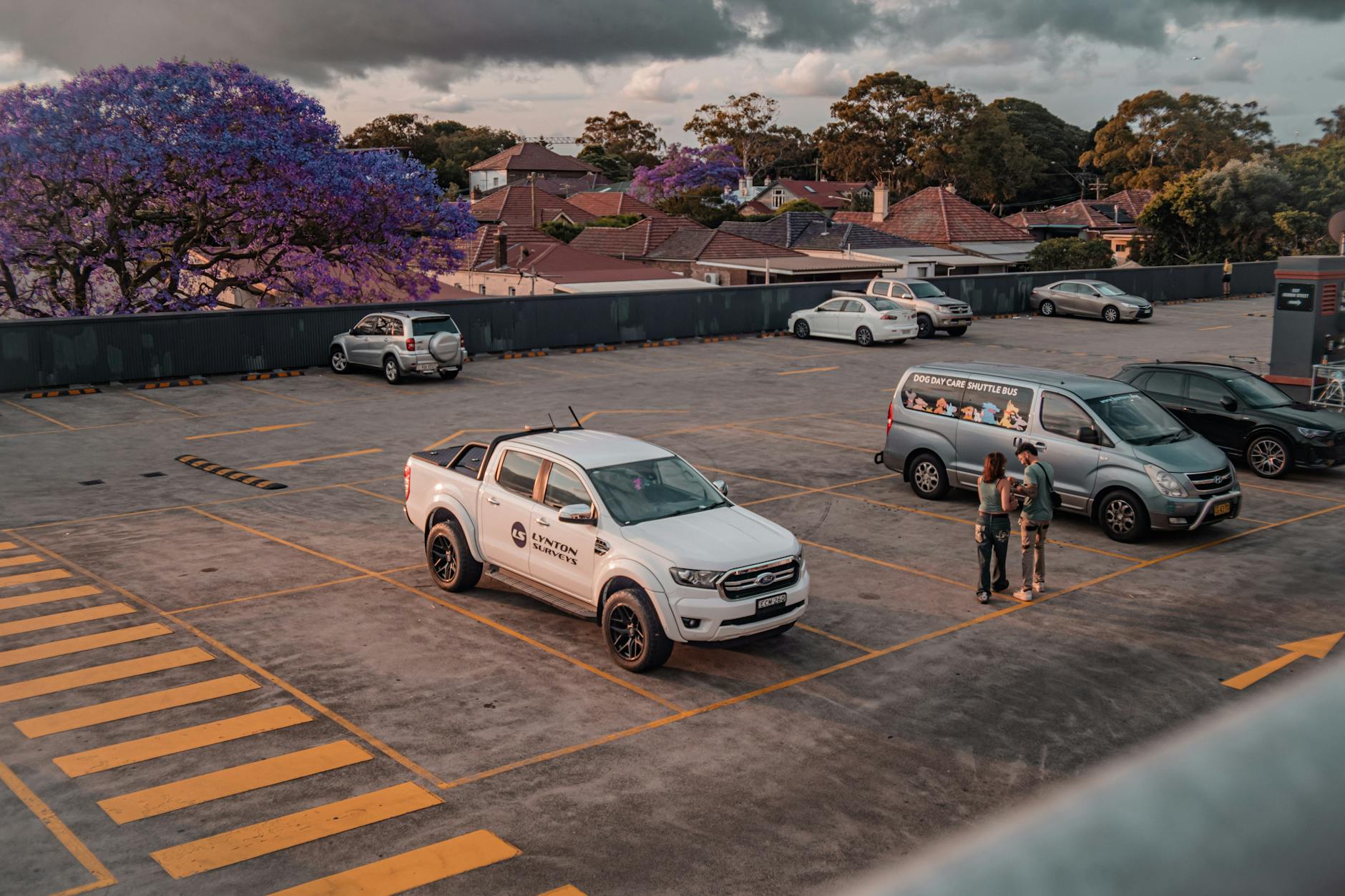
You are on the road every day. You work in people’s homes, on building sites, and around the same suburbs job after job. That visibility is a marketing asset most small businesses would pay a lot for, and you already have it.
The problem is most tradies don’t convert that visibility into leads. A van with no signage, a crumpled business card fished from a workpants pocket, and a site left spotless with zero trace of who did the work: that’s money left on the table. This guide breaks down the five core prints that turn your daily presence into a consistent lead-generation system, what each piece does for your business, where it gets seen, and how to put it together without blowing the budget.
At a glance: the 5 prints every tradie needs
- Car magnets – removable door signage for your ute or van; no wrap commitment needed
- Corflute site signs – weatherproof job-site boards that brand every active job
- Business cards – the close: something physical to hand to every potential client and referrer
- A-frames – sandwich boards for street-facing jobs with passing foot or vehicle traffic
- Flyers and door hangers – local area drops around every job to capture nearby demand
1. Car Magnets: Your Ute Is a Moving Billboard
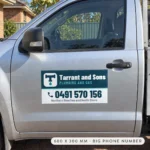
Every kilometre you drive is an impression in your service area. Car magnets turn that into deliberate advertising without the permanence or cost of a full wrap.
Where they get seen: school drop-off runs, hardware store carparks, traffic on the way to jobs, outside the job itself. In a tradie’s average week, that adds up to a lot of eyeballs in exactly the right suburbs.
Why magnets instead of a wrap? A wrap is a serious commitment, typically in the thousands of dollars, and means your personal car doubles as a work billboard even when you’d prefer it didn’t. Magnets give you a professional setup you can put on and take off. They work on any steel door panel, transfer between vehicles, and store flat in the boot when you don’t need them.
A quality pair of magnets at 600 x 300mm covers both front doors cleanly. That’s the standard size that fills the door panel without looking undersized. For a ute or van, you may want to add a third panel for the rear tailgate.
What to put on your magnets:
- Business name and logo (large, clear, visible from 10 metres)
- Your trade in plain language: “Licensed Electrician”, “Emergency Plumbing”, “Landscape and Turf”
- Mobile number (the single most important element, readable from a moving car)
- Website or booking link
- Licence number if your state or trade regulations require it
Keep it to four or five elements maximum. A magnet read in two seconds from a passing car needs big type and strong contrast. Save the fine print for your business cards.
Paperlust car magnets are printed on commercial-grade, weatherproof magnetic sheet designed to stay flat at highway speeds, and remove cleanly without adhesive residue or paint damage. See current sizing and pricing at the car magnets product page.
2. Corflute Site Signs: Brand Every Job You Do

A finished job with no sign is a missed opportunity. Every active worksite is a micro-billboard in a neighbourhood where other homeowners are watching and wondering who is doing the work next door.
Corflute signs (corrugated plastic boards) are the standard for tradie site signage in Australia. They are lightweight, weatherproof, cheap enough to leave at multiple sites simultaneously, and built to handle months outdoors.
Where they get seen: front fences at residential jobs, temporary fencing on commercial sites, council nature strips, display home entries, scaffolding clamps. Anywhere you are working, a corflute sign visible from the street is working for you.
Standard sizes for tradies:
| Size | Best use |
|---|---|
| A3 (297 x 420mm) | Compact: fence panels, small site entry points |
| A2 (420 x 594mm) | Medium: visible from the footpath on smaller jobs |
| A1 (594 x 841mm) | Recommended for most residential sites |
| 600 x 900mm | Most popular: readable from across the street, standard A-frame size |
| 900 x 1200mm | High-impact: large renovation sites, prominent road frontage |
For most residential jobs, 600 x 900mm hits the sweet spot between visibility and cost. Buy in small batches so you can have four or five live at the same time across different jobs.
Paperlust corflute signs are available in 3mm (short-term, lighter) or 5mm (more rigid, better for extended outdoor use in windy conditions). They are full-colour printed and ready for fence installation with eyelets. See the full size range and pricing at the corflute signs product page.
What to put on a site sign:
- Your logo and business name (consistent with your vehicle branding)
- A headline that frames what you do: “Kitchen Renovation by [Brand]”, “Roof Restoration in Progress”, “New Deck by [Brand]”
- Phone number and website
- Licence number if required
Leave a sign at every job for the duration of the work. If the client is happy for it to stay up for a few weeks after completion, even better.
3. Business Cards: The Close

A quote conversation ends with a handshake and a card. A neighbour asks who is doing the work next door: you hand them a card. A referral from a satisfied client carries further when there is something physical to pass on.
Business cards are the cheapest entry point in this kit and the one piece every tradie should have on them at all times. For the customer who needs the number in an emergency, business card magnets at 90 x 55mm sit on the fridge door with a full magnet back. The contact details are printed in full colour on one side, so the client who kept the card can find the name and number when they need it.
Where they get seen: at the quote, at completion, in the hands of referrers, on noticeboards at hardware stores and real estate offices, tucked under door wipers at the end of a local area drop.
What goes on a tradie’s business card:
| Element | Notes |
|---|---|
| Business name and logo | Front, prominent |
| Your name and title | “Director”, “Master Plumber”, “Licensed Electrician” |
| Mobile number | Largest text element after the business name |
| Professional domain address, not a Gmail | |
| Website | Short URL, no tracking parameters |
| Licence number | Trade and state requirements vary; check yours |
| ABN | Optional but adds credibility for commercial work |
| Service area | “Servicing Inner West and Eastern Suburbs” |
For tradies, a standard 90 x 55mm card in matte or linen stock is clean and professional. It fits in a shirt pocket, a cardholder, and a wallet without fuss.
If you want to stand out, a matte laminate finish gives a premium feel and survives a few months in a workpants pocket better than an uncoated card.
See full options including stock weights and finishes at the standard business cards product page.
For a deeper look at what works on tradie cards specifically, see the post on tradies’ business cards Australia.
4. A-Frames: Capture Street Traffic at the Job
For jobs with footpath or slow road traffic in front of them, an A-frame sign (sandwich board) turns passive passersby into active leads.
Where they get seen: shopfront renovations, street-facing residential jobs, display homes, real estate open days, any job on a busy suburban road or strip.
How they work for tradies: an A-frame placed on the nature strip or footpath in front of the job creates a clear call to action at the moment someone has direct evidence of your workmanship. “New bathroom renovation by [Brand] – call [number]” while a passerby can literally see scaffolding or freshly painted fascia is as close to a perfect sales pitch as outdoor advertising gets.
A-frames use standard corflute sign inserts (600 x 900mm fits most standard frames). Buy a reusable metal or aluminium frame once, then print fresh corflute inserts for each job or campaign. The inserts are inexpensive enough to replace seasonally or when the message needs updating.
A-frame content tips:
- One clear headline: what you are doing, right now, at this address
- Phone number large enough to read from across the road
- A simple offer if relevant: “Free quotes this suburb”
5. Flyers and Door Hangers: Turn One Job Into Five

When you finish a job in a street, you are sitting on the best prospecting opportunity in marketing: social proof in the physical world. The neighbours have seen your van, your signs, your workmanship. A letterbox drop of flyers or door hangers around the completed job converts that awareness into enquiries.
Where they get seen: letterboxes within two to three streets of every job, local community noticeboards, hardware store pinboards.
The local area marketing (LAM) approach:
- Complete a job in a street
- Drop flyers or door hangers to 50 to 100 households nearby
- Headline references the job you just finished: “We just completed a [bathroom renovation / deck / split system install] at [nearby street]. Free quotes available now.”
This technique is standard across Australian trade businesses that grow through referral and local reputation. Done consistently, it builds a tight cluster of work in the same area, cutting drive time and generating word-of-mouth.
Flyer vs. door hanger:
| Format | Best for |
|---|---|
| A5 flyer | Letterbox drops, quote packs, hardware store drops |
| A6 flyer | Lower cost per drop, still readable, fast to distribute |
| Door hanger | Stands out in the letterbox, hangs on door knobs, hard to miss |
See the full range at the flyers product page.
For more on how stickers can also extend tradie branding to vehicles and equipment, see sticker printing for tradies Australia.
Branding Consistency Across Your Kit
The single biggest mistake tradies make with print marketing is using different logos, colours, or contact details across different materials. A potential client who sees your van in their street, then finds a business card from their neighbour, then gets a flyer in their letterbox should recognise immediately that all three belong to the same business.
How to lock in consistency:
- Use one master logo file in PNG (transparent background) and PDF/EPS format. This is the file you hand to any printer.
- Define two to three brand colours and use only those. Write down the hex codes so every print job matches.
- Use one contact number across everything. If you update your number, reprint everything together.
- Match your headline message across materials: if your magnet says “Emergency Plumbing”, your flyer should open with that same claim.
- Proof every new print against what you already have before ordering. Hold them up side by side.
A consistent brand looks like an established, professional operation. Inconsistent materials, even for an excellent tradie, signal disorganisation. The job might be perfect; the kit should say so.
Budget-Tiered Starter Kit
Not every tradie needs everything at once. Here is a practical order for building your print kit, from lean start-up to full local marketing operation.
| Tier | What to print | Why |
|---|---|---|
| Lean (starting out) | Business cards + one pair of car magnets | Covers the close and your vehicle. Total budget: under $100. |
| Standard (established, growing) | Add corflute site signs (pack of 5) + A5 flyers | Branded job sites and local area drops. Total budget: $150-$300 depending on quantities. |
| Full kit (scaling) | Add A-frame + door hangers + vehicle signage stickers for equipment | Comprehensive local coverage. Everything in the field is branded. Total budget: $400-$600+. |
Order tips:
- Order business cards in quantities of 250 or 500: at per-card pricing, the jump from 100 to 500 is small and you will use them.
- For corflute signs, order 5 to 10 to start so you can brand multiple simultaneous jobs.
- Car magnets are a one-time purchase that lasts years if cared for correctly. Start here before committing to a vehicle wrap.
- Flyers and door hangers work best when ordered in batches of 500 or 1,000 for a local area campaign.
Frequently Asked Questions
Do car magnets damage car paint?
Quality car magnets applied to a clean, dry, smooth surface will not damage paint. Paperlust car magnets are designed for clean removal without adhesive residue. The main risk is leaving a magnet on a wet panel or over existing paint damage. Clean the car door before applying and remove magnets regularly to let the paint breathe.
How long do corflute signs last outdoors in Australia?
3mm corflute in typical Australian outdoor conditions holds up for several months. 5mm corflute lasts longer under UV and in windy or exposed locations. For permanent or semi-permanent signage, consider heavier sign materials. Corflute is designed for temporary to medium-term use, which suits most tradie job-site applications perfectly.
How many business cards should a tradie order?
Start with 250 if you are new to the trade. Once you know your usage rate, 500 is more economical per card and means fewer reorders. Most tradies hand out cards at quotes, on-site, to neighbours, and to referrers. A busy operator can go through 500 cards in a year.
What is the difference between a flyer and a door hanger?
A flyer is a standard flat sheet (usually A5 or A6) designed to sit in a letterbox or be handed over directly. A door hanger has a die-cut hook at the top that loops over a door handle or knob. Door hangers are harder to ignore because they hang on the door itself rather than sitting in a mail pile. Both work for letterbox campaigns; door hangers tend to have a slightly higher engagement rate.
Should I get a full vehicle wrap or start with car magnets?
Car magnets are the right starting point for most tradies. They are far more affordable, require no commitment, and can be moved between vehicles. A full wrap makes sense when you have a dedicated work vehicle that is always on the road for your business, your branding is finalised, and you want maximum visual impact. Many tradies run magnets on personal vehicles and secondary utes while wrapping their main work van.
Do I need to include my licence number on signage?
Requirements vary by trade and state. Electrical and plumbing licences are generally required on trade vehicles and advertising materials in most Australian states. Building and construction licence requirements differ. Check your state licensing authority’s specific rules for your trade before finalising your signage artwork.
What corflute size works best for a residential renovation site?
600 x 900mm is the most widely used size for residential tradie signs. It is large enough to read from across the street, fits standard A-frame holders, and is easy to cable-tie to temporary fencing or standard fence palings. A1 (594 x 841mm) is a close alternative with the same footprint.
Build Your Kit
Every tradie marketing system starts with the same first step: get your branding on your vehicle and put a card in every hand you shake.
From there, a site sign at every job and a flyer drop around every completion builds a local reputation that compounds over time. These are not expensive tools; they are consistent ones.
Start with car magnets and business cards. Add corflute signs and flyers when you are ready to scale. All fast Australian production, delivered to your door.