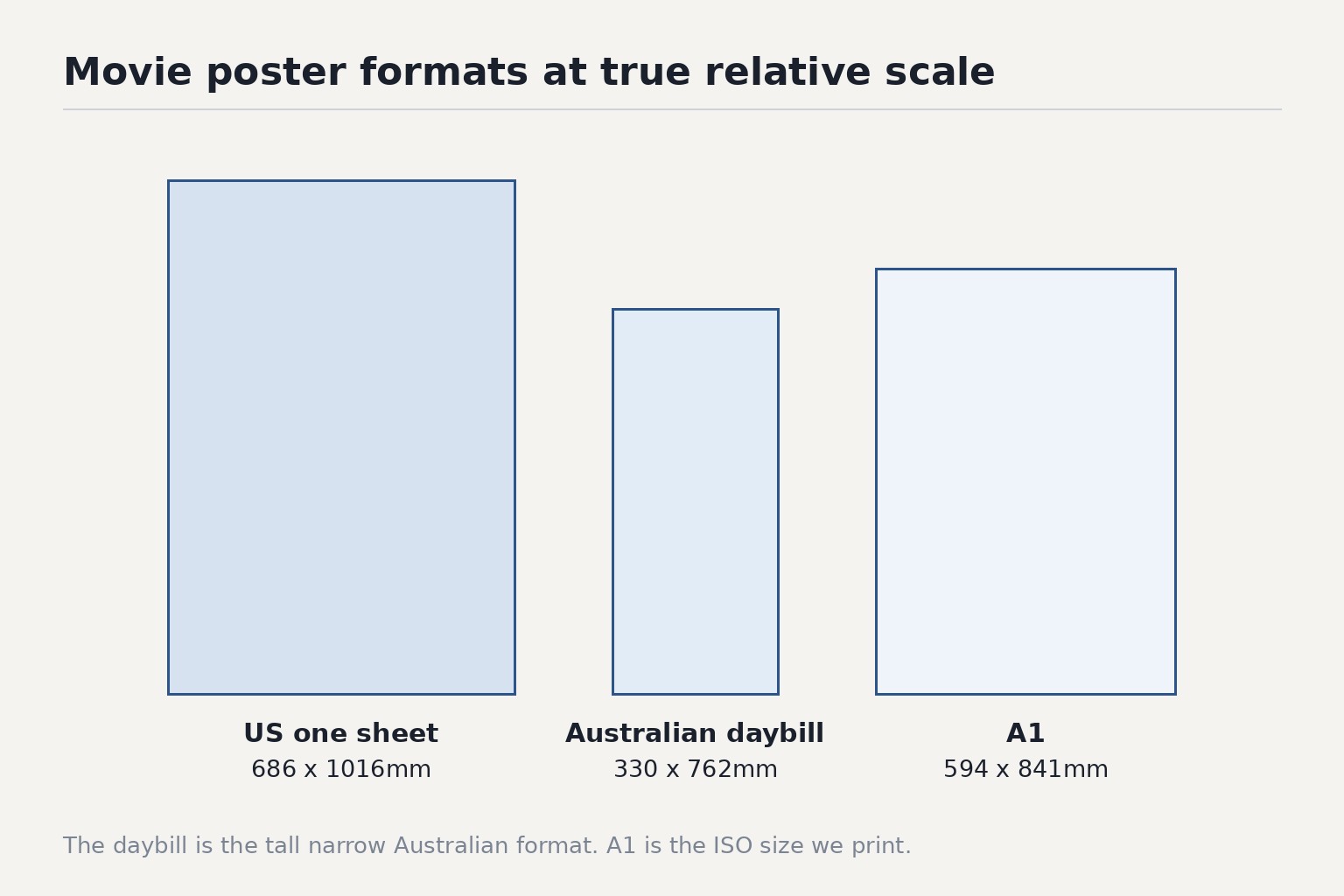
Standard movie poster size is the US one sheet at 686mm x 1016mm, 68.6 x 101.6cm, 27 x 40 inches. In Australia, the daybill measures 330mm x 762mm, 33.0 x 76.2cm, 13 x 30 inches, while cinemas print on A1 at 594mm x 841mm, 59.4 x 84.1cm, 23.4 x 33.1 inches.
| Format | Millimetres | Centimetres | Inches |
|---|---|---|---|
| US one sheet (modern standard) | 686 x 1016 mm | 68.6 x 101.6 cm | 27 x 40 in |
| Australian daybill (post-war) | 330 x 762 mm | 33.0 x 76.2 cm | 13 x 30 in |
| A1 (current AU print standard) | 594 x 841 mm | 59.4 x 84.1 cm | 23.4 x 33.1 in |
- US one sheet (modern standard): 686 x 1016mm / 27 x 40 inches
- US half sheet: 559 x 711mm / 22 x 28 inches / landscape orientation
- US insert: 356 x 914mm / 14 x 36 inches
- Australian daybill, post-war standard: 330 x 762mm / 13 x 30 inches
- Australian daybill, pre-war long: 381 x 1016mm / 15 x 40 inches
- Australian daybill, wartime mini: 254 x 762mm / 10 x 30 inches
- Australian one sheet (from 1970s onward): 686 x 1016mm / 27 x 40 inches
- A1 (current AU print standard): 594 x 841mm / 23.4 x 33.1 inches
- A2: 420 x 594mm / 16.5 x 23.4 inches
- A3: 297 x 420mm / 11.7 x 16.5 inches
Movie Poster Sizes: Complete Reference
Whether you are printing a reproduction, framing a poster you already own, or checking whether your artwork is proportioned correctly, the table below covers every format you are likely to encounter. US formats are listed in inches first, since that is how they are traditionally specified and how most collectors and suppliers describe them. ISO sizes use millimetres as the primary unit.
| Format | Inches | Millimetres | Notes |
|---|---|---|---|
| US one sheet (modern) | 27 x 40 | 686 x 1016 | Standard US cinema poster since mid-1980s; portrait |
| US one sheet (vintage, pre-1985) | 27 x 41 | 686 x 1041 | Slightly taller than the current standard |
| US half sheet | 22 x 28 | 559 x 711 | Landscape orientation; lobby and window display |
| US insert | 14 x 36 | 356 x 914 | Tall and narrow; used in narrow display cases |
| Australian daybill, post-war | 13 x 30 | 330 x 762 | Classic AU cinema format; late 1940s to early 1980s |
| Australian daybill, pre-war long | 15 x 40 | 381 x 1016 | 1920s to early 1940s; rarest in collector markets |
| Australian daybill, wartime | 10 x 30 | 254 x 762 | 1942 to 1945; paper rationing reduced size |
| Australian one sheet | 27 x 40 | 686 x 1016 | Same as US one sheet; common from mid-1970s onward |
| A1 | 23.4 x 33.1 | 594 x 841 | Closest readily available standard to the one sheet |
| A2 | 16.5 x 23.4 | 420 x 594 | Popular for home display and arthouse cinema lobbies |
| A3 | 11.7 x 16.5 | 297 x 420 | Suitable for smaller displays and collector framing |
The Australian Daybill: A Format Built for Local Screens
No other country produced a cinema poster format quite like the Australian daybill. Narrow, vertical and immediately recognisable, it was designed for the physical constraints of Australian picture theatres in the early twentieth century: narrow timber display slots in theatre lobbies, and facade-mounted frames that were built long before the US one sheet became the global default.
At its post-war standard of 330mm x 762mm (13 x 30 inches), the daybill was roughly half the width of a one sheet but only slightly shorter in height. The result was a format that read almost like a vertical banner. Artwork had to be composed accordingly: portrait subjects worked naturally, and horizontal compositions were adapted or redrawn by local lithographers for the daybill dimensions rather than simply cropped.
Pre-war long daybill (1920s to early 1940s)
The original format measured approximately 381mm x 1016mm (15 x 40 inches). These early examples used bold hand-lettered typography and illustrated artwork produced by local lithographers, often working from reference prints supplied by the US studio rather than from original artwork. Pre-war daybills are the rarest survivors in collector markets today, partly because of age and partly because paper quality from the era was not archival.
Wartime daybill (1942 to 1945)
Wartime paper rationing forced a reduction to approximately 254mm x 762mm (10 x 30 inches). The wartime daybill is noticeably smaller and lighter than the pre-war or post-war versions. Paper quality suffered alongside size, and many examples from this period have aged poorly. Collectors sometimes call these “mini daybills” to distinguish them from the post-war standard.
Post-war standard daybill (late 1940s to early 1980s)
This is the daybill most collectors mean when they use the term. The 330mm x 762mm (13 x 30 inches) format was in production for over three decades, covering the golden era of locally produced cinema art. It encompasses hand-lithographed classics from the 1950s and 1960s, the shift toward photographic collage posters in the 1970s, and the final years of the format before international distribution standardised on the one sheet.
The National Film and Sound Archive holds substantial collections from this period. For collectors, condition, printing quality and studio provenance are the primary value drivers. Australian-produced artwork commands a significant premium over locally printed reproductions of US materials.
Post-1980s daybill
In the final years of local production, the format reduced again to approximately 330mm x 660mm (13 x 26 inches). By this point the daybill was already being phased out as Australian distributors adopted the one sheet alongside their international counterparts. Commercially produced daybills effectively ceased by the mid-1980s.
Why Australian Cinemas Now Use A-Series Formats
The shift from the daybill to the one sheet, and then to A-series and lightbox displays, followed a straightforward commercial logic.
International film distributors produce marketing materials for global release. When Australian cinema chains rebuilt and expanded from the 1970s onward, they designed their lobby infrastructure around the US one sheet rather than the local daybill. The daybill required locally produced artwork and a separate Australian print run; the one sheet could be shipped directly from the US studio alongside the film print, with no additional production cost.
By the 1990s, digital printing had made A1 (594mm x 841mm) the most practical choice for cinemas ordering small runs. A1 is close in size to the one sheet, universally available from Australian print suppliers, and compatible with standard A-series frames. Today, independent and arthouse cinemas largely display A1 printed posters. Multiplex chains have moved to backlit lightbox panels in custom dimensions specific to their interior fit-out, updated remotely via digital content management rather than printed and shipped.
The daybill itself is now exclusively a collector’s item. Original production ceased in the mid-1980s, and no major distributor has revived the format.
Printing a Movie Poster in Australia Today
If you want to print a reproduction of a movie poster, A1 (594mm x 841mm) is the closest standard size to a US one sheet (686mm x 1016mm) without ordering a custom print. It is what most Australian print suppliers offer at the large-format end, and it fits standard frames without modification. Our guide to poster sizes in Australia compares the full A-series range and typical uses when you need a different proportion or scale.
That said, the proportions are not identical, and collectors reprinting a one sheet for side-by-side display with an original should understand the difference. The aspect ratios diverge:
| Format | Dimensions | Aspect ratio (width to height) |
|---|---|---|
| US one sheet | 686 x 1016mm | 1 : 1.48 |
| A1 | 594 x 841mm | 1 : 1.41 |
| A2 | 420 x 594mm | 1 : 1.41 |
All ISO A-series sizes share the same 1:1.41 ratio by design (defined by the ISO 216 standard). The US one sheet is slightly taller relative to its width. For most home display purposes the visual difference is minor and will not be apparent from across the room. For a collector print intended to match an original’s proportions exactly, the practical options are to add a small white border at the top and bottom of the A1 output, or to commission a custom-sized print.
Our poster printing is available in A1, A2 and A3 on 200gsm synthetic stock. Synthetic is water-resistant and tear-resistant, which suits display environments where a paper poster would deteriorate over time. A design proof is emailed before anything goes to press; printing begins only once you have approved it.
For sizes larger than A1, a rigid signage panel is the practical option. For indoor foyer or event displays, foam board printing is a rigid choice that reaches A0 at 841 x 1189mm. Our large corflute signs and PVC sign products handle large-format display requirements where a paper poster is not suitable, including outdoor locations.
Framing Movie Posters: What to Know Before You Buy a Frame
A-series posters are straightforward to frame. Standard off-the-shelf frames in A1, A2 and A3 are available at most art supply stores and major homewares retailers across Australia, and prices are competitive because the market is large. We break down stock and finish choices in our poster printing costs guide.
The US one sheet (686mm x 1016mm) and the Australian daybill (330mm x 762mm post-war standard) are a different matter. Neither fits any standard frame size currently manufactured at scale. Owners of either format have two realistic options:
Custom framing. A picture framing shop can cut a frame to any dimension. Costs vary by moulding type and glazing choice, but custom framing for a one sheet typically runs considerably higher than an off-the-shelf A1 frame. For a genuine vintage daybill, UV-protective glazing is strongly recommended: the inks used in lithographic printing from the 1950s and 1960s fade under sustained light exposure, and a daybill that survives 70 years in storage can be damaged in a decade of unprotected display.
Float mounting. A conservation framer can float-mount the poster on an oversized backing board, centred within a larger standard frame with the poster edges revealed against the mat. This approach is common for vintage pieces where the edges and printing marks are part of the artefact’s value.
For a modern A-series print you want on the wall without waiting on custom framing, our framed prints come ready-framed in solid wood in A4, A3 and A2, with shatterproof plexiglass and hanging hardware included. The A2 option is a practical choice for a reprinted movie poster in the home: large enough to read well across a room, and frameable without any additional work.
Resolution and File Preparation: Getting the Print Right
Printing a movie poster at large format is where most people encounter their first disappointment. A file that looks sharp at screen resolution will print softly at A1 or even A2, and the problem becomes more visible as you get closer to the print.
The working standard for large-format print:
- 300 DPI at print size is the minimum for a poster.
- 300 DPI at print size is the target for a framed print viewed at normal reading distance, such as a piece hanging in a study or home theatre.
At 300 DPI, an A1 print requires a source file of approximately 7,016 x 9,933 pixels. Very few files found online reach that resolution, particularly for older films where the original artwork predates high-resolution digital scanning.
The most reliable starting point for a vintage poster reproduction is a high-resolution scan from a physical original. Scanning at 600 DPI on a flatbed scanner and then downsampling to 300 DPI for print gives a clean result for most standard daybill and one sheet sizes. If you are working from a JPEG downloaded from a film database, apply sharpening before scaling rather than after, and commission a small A3 test print before committing to A1.
For original artwork and custom poster designs, supply files at the target print resolution or higher. Vector formats (PDF, AI, EPS) scale without any loss and are the preferred format for text-heavy designs where clean edges on type matter. Raster formats should be submitted at 300 DPI minimum at the intended print size.
Frequently Asked Questions
What is the standard movie poster size in Australia?
Modern Australian cinemas mostly use A1 (594mm x 841mm) for printed displays, or custom lightbox panels. The Australian daybill at 330mm x 762mm (13 x 30 inches) was the local cinema format from roughly the 1940s through to the early 1980s, but it has not been in commercial production since the mid-1980s.
What is the US one sheet size in millimetres?
The modern US one sheet is 686mm x 1016mm (27 x 40 inches). Older one sheets printed before roughly 1985 were sometimes 27 x 41 inches (686mm x 1041mm), slightly taller than the current standard.
Is A1 the same size as a movie poster?
A1 (594mm x 841mm) is close to a US one sheet but not identical. The one sheet has an aspect ratio of approximately 1:1.48, while A1 has a ratio of 1:1.41. The difference is visible if you compare them side by side, but for most display purposes A1 is the practical standard in Australia and the closest readily available option.
What is an Australian daybill?
A daybill is the distinctively tall, narrow cinema poster format produced in Australia from the 1920s through to the early 1980s. The post-war standard measured 330mm x 762mm (13 x 30 inches). The format was designed for the narrow display frames built into Australian theatre lobbies and is now collected as a piece of film and printing history.
What is the difference between a daybill and a one sheet?
The US one sheet (686mm x 1016mm) is wider and follows a more conventional portrait rectangle. The Australian daybill (330mm x 762mm post-war standard) is narrower and considerably more elongated. Distributors produced separate artwork for each format; a daybill is not simply a cropped one sheet. Collectors value Australian daybill artwork independently, particularly for films from the 1950s and 1960s.
Can I get a daybill custom framed?
Standard off-the-shelf frames do not come in daybill dimensions. You will need custom framing from a picture framing shop. UV-protective glazing is recommended for vintage examples to prevent fading. For modern A-series prints, our framed prints come ready-framed in solid wood in A4, A3 and A2 with all hanging hardware included. Choosing a format that suits the wall itself is easier once you understand how different sizes relate to furniture and room proportions, which our guide to poster sizes for walls and frames explains.
What resolution do I need for an A1 movie poster print?
Aim for 300 DPI at print size for a poster or a framed piece. At 300 DPI, an A1 print requires a source file of approximately 7,016 x 9,933 pixels. Scanning a physical poster at 600 DPI and downsampling for print is the most reliable approach for vintage reproductions.
Do you print movie posters at one sheet size?
We print A1 (594mm x 841mm), A2 (420mm x 594mm) and A3 (297mm x 420mm) on 200gsm synthetic stock. A1 is the closest available standard size to a US one sheet without a custom order. For display requirements larger than A1, our signage panel range handles larger rigid format needs.