Both formats print from the same materials, accept the same artwork, and look identical once they are stuck to a surface. The difference is entirely in how the blade cuts and how that affects peeling, packaging, and the customer experience before the sticker lands on its final home.
Understanding the distinction takes about two minutes and prevents you from ordering a thousand stickers that are fiddly to peel or awkward to insert into a mailing box. Both cuts are available across our custom sticker printing range, on the same materials and at the same price.
At a glance
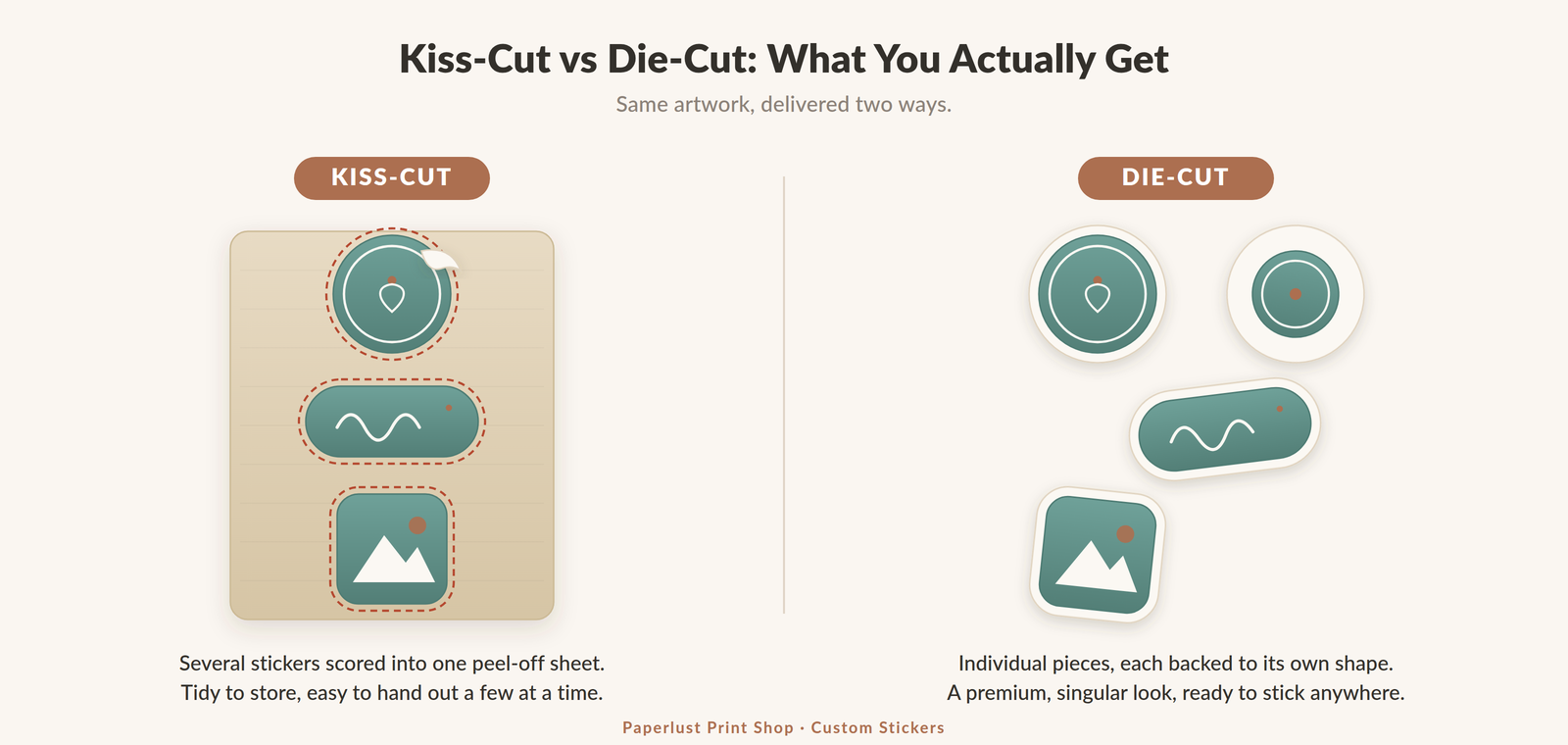
- Die-cut: the blade cuts through the sticker and its backing, leaving each sticker a standalone shaped piece.
- Kiss-cut: the blade cuts the top sticker layer only, and the backing stays whole around the design.
- Same materials, same print quality, same price
- Die-cut is best for individual branded stickers, packaging seals, and premium giveaways
- Kiss-cut is best for sticker sheet printing, intricate designs, and inserts with a printed backing card
- Both cuts come on White Gloss Sticker or White Matte Sticker paper stock with an optional matte or gloss laminate.
How the Cut Works: The One Difference That Matters
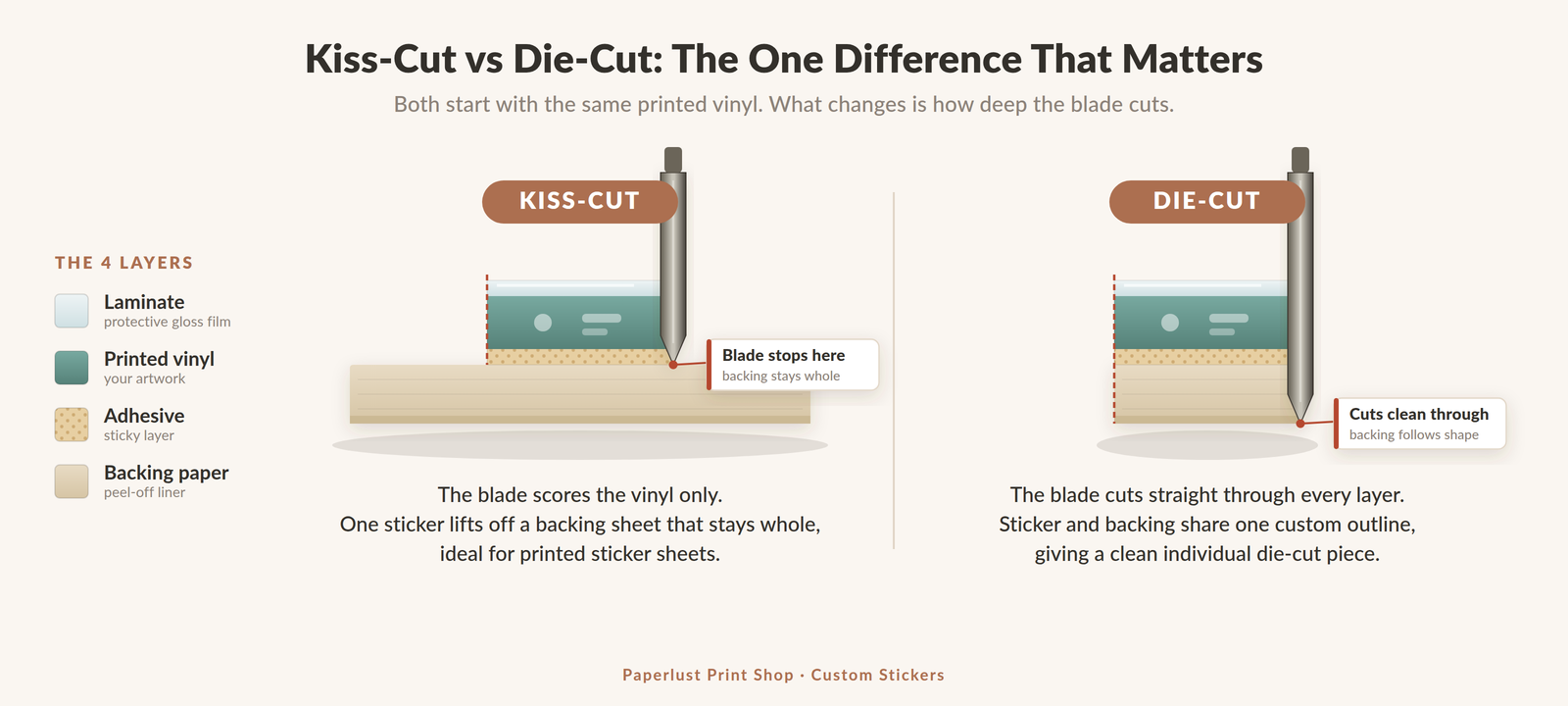
The machinery used to produce both formats is identical. The distinction is the cut depth.
Die-cut stickers use a cutting blade that travels through the sticker layer and the backing paper in a single pass. The sticker and the backing share exactly the same outline. Pick one up and you hold a finished, standalone shape with no surrounding border.
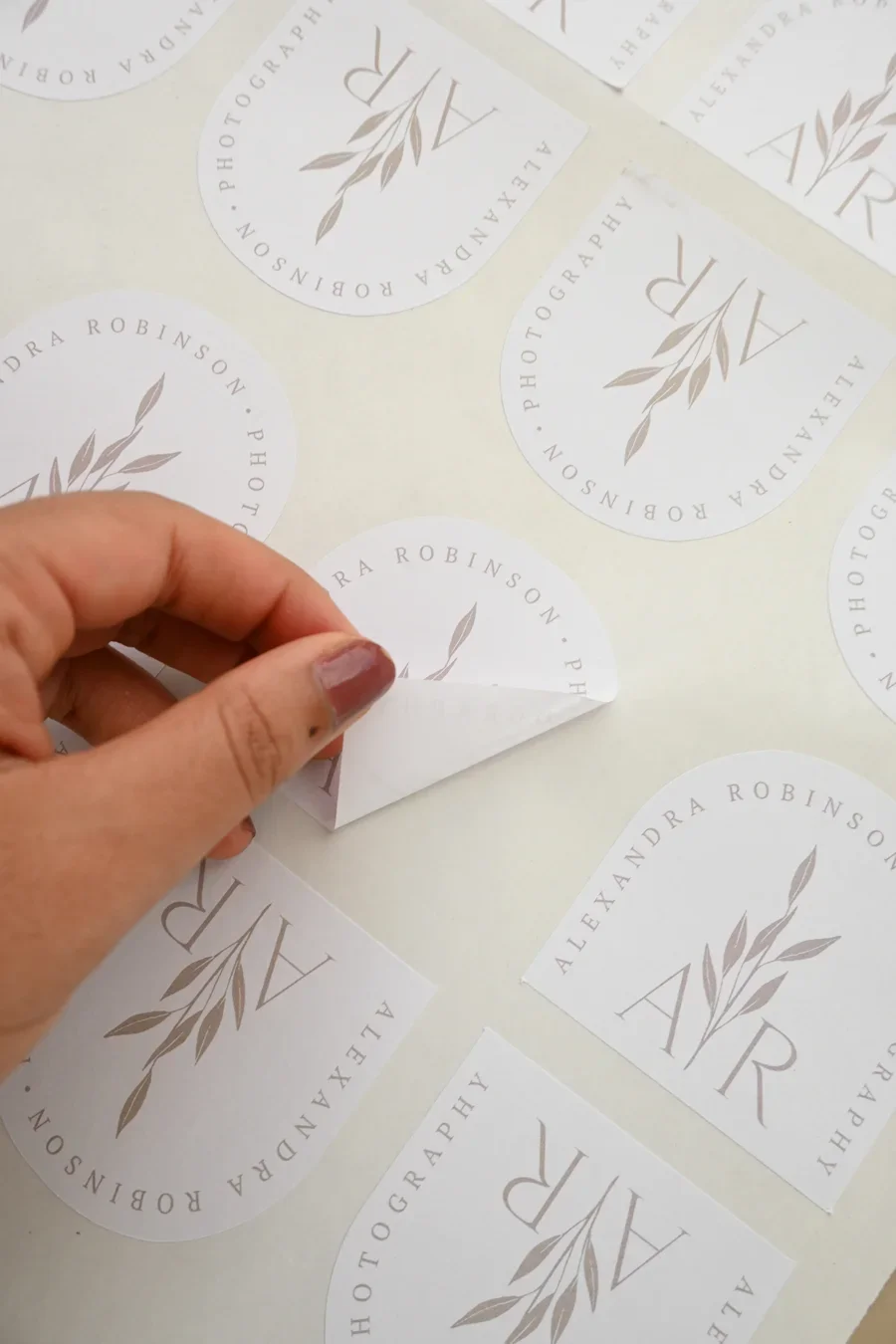
Kiss-cut stickers use the same blade set to a shallower depth. It cuts through the sticker layer only, leaving the backing paper completely intact. The design sits inside a larger square or rectangular sheet. You peel the sticker shape away from that sheet when you are ready to apply it.
Both cuts are controlled by a computer-guided plotter, so complex shapes with tight curves or fine detail are equally achievable in either format.
Kiss cut and die cut sticker meaning: the two cut terms explained
People search for the meaning of kiss cut and die cut at the point of ordering, after the artwork is ready and the size is already chosen. The order form asks for a cut type, the two names sound like they describe the same step, and suddenly a design decision is being made on a guess. That is a costly place to make one, because the cut affects how the sticker comes off the sheet and who can peel it without damage.
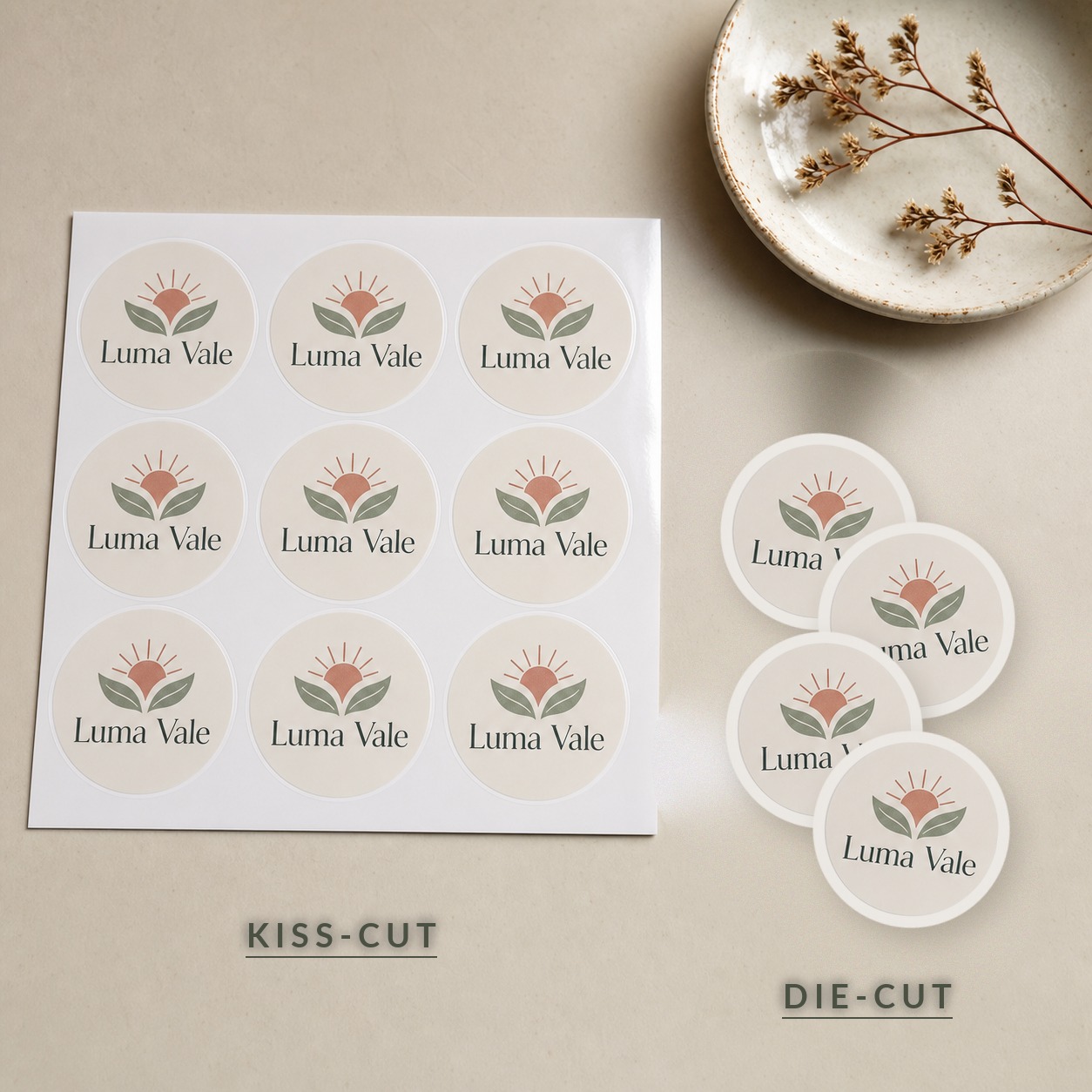
Kiss cut means the blade passes through the top sticker layer only and leaves the backing intact. The sticker stays on its backing sheet, easy to peel one at a time without separating the whole stack. That is why kiss cut works for sheets carrying several designs and for stickers that will be handed out, where a clean peel matters more than the individual outline.
Die cut means the blade cuts through the sticker and the backing all the way, so each sticker arrives as a separate piece with no border. The cut follows the outline of the artwork through contour cutting. Choose die cut when the shape is the point: logos, mascots, illustrations and any intricate outline that should read before the label does.
Spelling trips people up too. The correct term is die cut, named for the cutting die that forms the shape. “Dye cut” is a common misspelling, and it refers to nothing in printing. Dye is a colourant. If your notes say dye cut, you still want the die cut option on the order screen.
There is also no “regular” sticker to compare against. Shoppers who say regular sticker usually mean a plain rectangle or circle on a backing sheet, which is simply a kiss cut sticker. Every sticker in your order is a cut style plus a material, and the two decisions do not belong to one word. Choose the cut for how the sheet is handled, and choose the shape and material for how the sticker is seen.
Full Comparison Table
| Feature | Die-Cut | Kiss-Cut |
|---|---|---|
| Cut depth | Through the sticker layer and backing | Through the sticker layer only |
| Backing after cut | None (sticker is the shape) | Square/rectangular backing retained |
| Peel experience | Peel from the sticker’s own edge | Peel from the wider backing border |
| Minimum peel handle | None on very small stickers | Always a generous border to grip |
| Protecting intricate details | Fragile edges exposed | Backing protects fine lines in transit |
| Sticker sheets | Not suitable | Ideal (multiple designs per sheet) |
| Printed backing area | Not applicable | Can carry logo, URL, care instructions |
| Shelf presence | Premium, finished look | Practical, card-like presentation |
| Cost | Same price for equivalent size/quantity | Same price for equivalent size/quantity |
| Best for | Individual logo stickers, packaging seals, giveaways | Packs, intricate designs, branded backing cards |
Peeling and Handling in Practice
The backing border on a kiss-cut sticker is not just a manufacturing byproduct. It serves real purposes.
For small stickers or designs with thin protruding parts, such as a stag antler silhouette or a detailed botanical outline, peeling from the sticker’s own edge can bend the sticker or nick the design. With kiss cut, you grip the backing instead of the sticker, so the shape lifts away without that pressure on its edge.
For larger, simpler shapes, die-cut stickers are straightforward to peel and there is no handling risk. The cleaner profile also reads as more premium when someone first sees it, because there is no surrounding white border competing with the design.
Die-cut stickers are more likely to develop lifted edges during transit if they are loose in a postage satchel. Kiss-cut stickers, because they stay on their backing, arrive flat and undamaged regardless of how a courier handles the package.
When to Choose Die-Cut Stickers
Die-cut is the right call in most of these situations:
- Individual branded stickers in orders: One logo sticker per dispatched package reads polished and intentional. Die-cut gives it a finished standalone look, not a sheet of backing.
- Packaging seals: Closing a mailer box or tissue paper with a shaped brand logo seal? Die-cut sits flush with the fold and has no visible white rectangle around it. Where the tissue is printed as well, custom printed tissue paper runs in 1 or 2 spot colors, so leave clear space in the pattern where the seal lands.
- Market or event giveaways: Handing stickers to people one by one, die-cut shapes are easier to distribute and feel like a finished product rather than something that needs to be peeled off a sheet.
- Laptop and bottle stickers: Single-use decorative stickers that go straight onto a hard surface. The profile looks clean and intentional.
- Simple to medium complexity shapes: Rounded rectangles, ovals, leaf shapes, shield logos. Nothing with hairline-thin protrusions where the edge would snap or lift.
Explore custom die-cut stickers at Paperlust Print Shop: printed in Melbourne.
In the United States, order die-cut stickers for US delivery from the US shop. Minimum order is 10 stickers per design.
When to Choose Kiss-Cut Stickers
Kiss-cut solves a different set of problems:
- Multi-sticker sheets: If you have five or six design variants and want to sell or send them together on one backing card, kiss-cut is the only practical option. Die-cutting a sticker sheet would separate every piece at the backing layer and the whole thing would fall apart.
- Intricate or delicate designs: Fine lines, tiny text, small isolated elements. The backing protects the sticker in transit and the wider peel border makes application possible even for fiddly shapes.
- Branded backing cards: The retained backing area is printable real estate. Add your website URL, a care instruction, a discount code, or a thank-you message. The sticker and the backing together become a mini product insert.
- E-commerce packaging inserts: A kiss-cut sticker on a printed A6 backing card, tucked into an order, doubles as a brand touchpoint and a gift for the customer. The backing card feels intentional, not accidental.
- Children’s or activity sticker packs: Easy peeling matters. Young users (or customers with long fingernails, textured surfaces, or cold hands) benefit from the generous backing border.
Explore custom kiss-cut stickers at Paperlust Print Shop: printed in Melbourne.
In the United States, order kiss-cut stickers for US delivery from the US shop. The cut goes through the sticker layer only, so pieces stay on the backing until peeled.
In the US shop, both kiss-cut and die-cut stickers offer the same choices. Preset sizes run from 30 x 30 mm (about 1.18 x 1.18 in) to 200 x 200 mm (about 7.87 x 7.87 in). Choose White Gloss Sticker or White Matte Sticker, then No Laminate, Matte Laminate or Gloss Laminate. You can order up to five designs, with a minimum of 10 stickers per design.
Packaging Use-Cases Side by Side
The decision often comes down to how the sticker arrives with the customer and what it is being used for.
| Scenario | Better choice | Why |
|---|---|---|
| One logo sticker per dispatched order | Die-cut | Feels premium, clean profile, no white border |
| Multi-design sticker pack (5+ designs) | Kiss-cut | All designs on one backing, no loose pieces |
| Seal for tissue paper or box lid | Die-cut | Shaped seal sits flush, no rectangular overhang |
| Thank-you insert with branded backing | Kiss-cut | Backing card carries URL/message/discount code |
| Intricate illustrated design with fine lines | Kiss-cut | Protects delicate elements, easier peeling |
| Simple circle or rectangle | Either | Personal preference; die-cut is slightly more minimal |
| Market display hung on a card | Kiss-cut | Backing card can double as the display header |
| Laptop sticker giveaway at events | Die-cut | Instant peel, no backing to discard on the spot |
| Product label on a jar or bottle | Kiss-cut | Backing protects label in transit, peel handle useful |
Ordering the Same Design as Kiss Cut and Die Cut
Order the same artwork both ways and the difference shows in your hand. A kiss-cut sticker arrives on a rectangle of backing with room around the design. The cut goes through the top sticker layer only, so the backing stays whole and the sticker sits flat until you peel it.
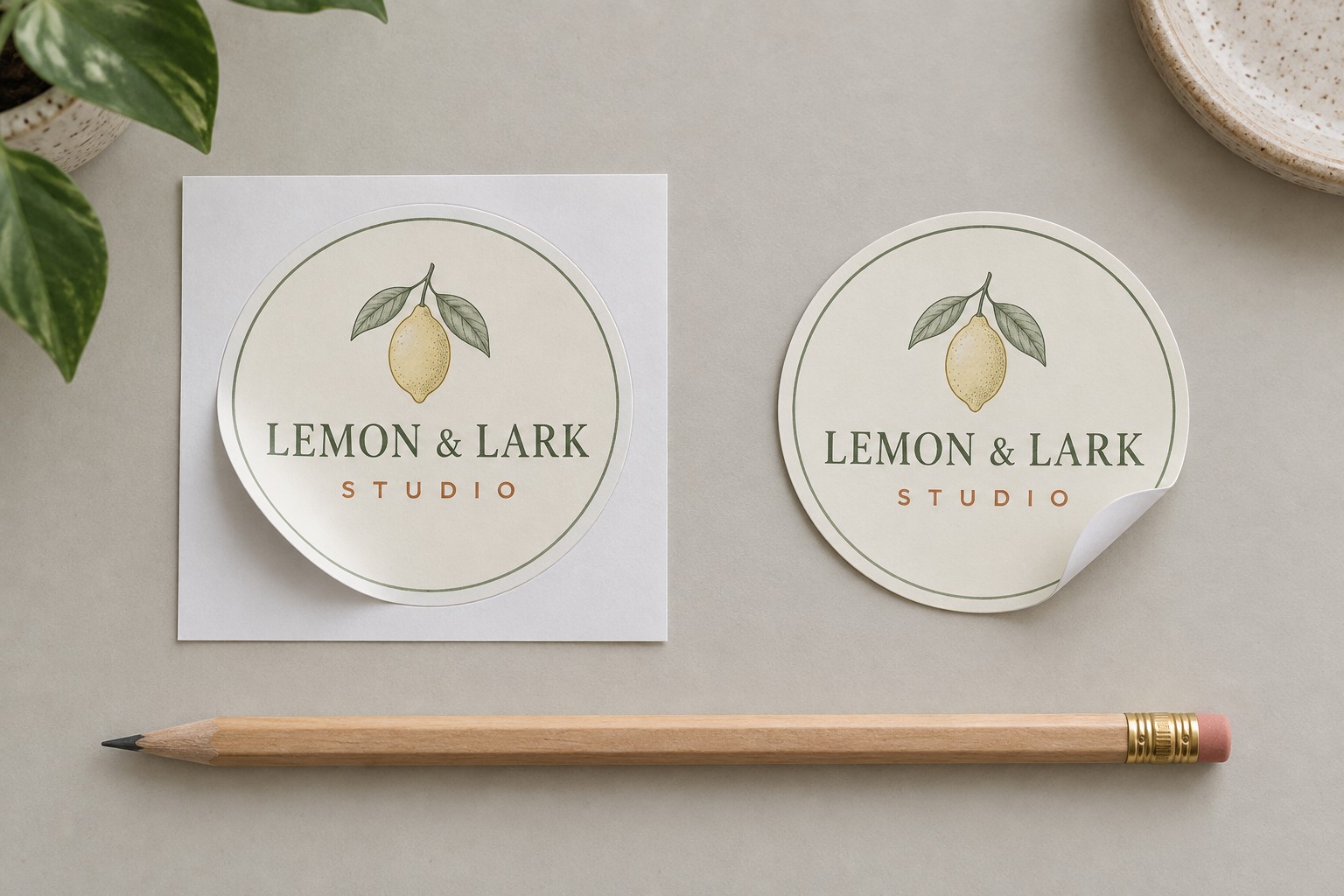
Your thumbnail starts the peel at the edge of the sticker on the backing sheet. With a die-cut sticker, the cut goes through the sticker and its backing, so the piece arrives loose. You remove it by lifting the backing away from the edge of the sticker, and the backing follows the outline of the artwork.
As packaging inserts, the two behave differently. A kiss-cut sticker stays flat and can share its backing with a message or other stickers. A loose die-cut piece slips into a card, envelope or bag without needing a sheet around it.
Keep intricate outlines within the shape. The cut can land up to 0.5 mm either side of the cut line, so thin spikes, small text and fine gaps need to sit comfortably inside the outline. This matters most on die-cut pieces, which are handled by their own edge.
How to choose kiss cut or die cut without overthinking it
Price does not need to be part of the decision at Paperlust Print Shop. Kiss cut and die cut stickers are priced identically across every size, material and laminate combination, so cut style never changes what you pay. That leaves three practical variables: how many you need, how detailed the artwork is, and whether each sticker is handed out loose or stays on a sheet.
Quantity points to kiss cut for high volume handouts and die cut for smaller runs placed by hand.
Artwork detail favours die cut for intricate outlines. Kiss cut leaves a backing border that gives fine art registration margin.
Multiple designs on one backing sheet are only possible kiss cut. One design as a loose sticker is die cut.
| Variable | Points to die cut | Points to kiss cut |
|---|---|---|
| How many you need | 50 to a few hundred, placed by hand | Higher volumes handed out or posted |
| Artwork detail | Intricate outline that has to read as the shape | Fine detail that benefits from a backing margin |
| Handout or sheet | One design, loose in a parcel or on a counter | Several designs on one backing sheet |
There is one case where the usual answer flips. A single design in very high volume for hand-out at an event may feel like a die cut job, but kiss cut on a sheet is faster to distribute. When quantity and artwork disagree, let artwork win. A shape that needs a clean outline cannot be faked with a backing border.
What kiss cut and die cut stickers cost in Australia
Here, kiss cut and die cut stickers cost the same. We checked all 48 size, material and laminate combinations on both product pages on 1 September 2026, and every one returns an identical price. Size, quantity and whether you add laminate are what actually move the cost. Many other printers charge a die cut premium, but our pricing does not. The minimum order is 10 stickers per design, and orders of 10 to 50 are priced the same as 50.
The table below shows per sticker prices for a white gloss sticker with matte laminate, in Australian dollars, by size and quantity.
| Size | 50 | 100 | 200 | 500 | 1000 | 5000 |
|---|---|---|---|---|---|---|
| 30 x 30mm | $0.74 | $0.61 | $0.42 | $0.24 | $0.19 | $0.10 |
| 60 x 60mm | $1.70 | $1.09 | $0.82 | $0.55 | $0.49 | $0.30 |
| 75 x 75mm | $1.82 | $1.39 | $1.16 | $0.87 | $0.63 | $0.41 |
| 120 x 120mm | $3.30 | $2.45 | $2.17 | $1.57 | $1.36 | $1.01 |
| 200 x 200mm | $6.50 | $4.78 | $4.14 | $3.56 | $3.03 | $3.01 |
Price per sticker, Australian dollars, white gloss sticker with matte laminate. Identical on kiss cut and on die cut. Read from both product pages on 1 September 2026.
At 100 stickers, a 75 x 75mm white gloss order totals $110 without laminate and $139 with matte or gloss laminate. At 500, the same order is $329 without and $433 with. At 1000, it is $494 without and $631 with. Matte and gloss laminate cost the same as each other. The laminate premium grows from about 27 per cent more at 100 stickers to about 68 per cent more at 1000. Per sticker prices fall steeply between 50 and 500. Above 1000 the curve flattens, and on the largest size it is almost flat from 2000 up.
Materials: Both Cuts Share the Same Paper Sticker Stock
The cut type does not change the stock choice. Both kiss-cut and die-cut stickers are printed on the same paper-based stock range.
- White Gloss Sticker: a white paper sticker stock with a glossy surface.
- White Matte Sticker: a white paper sticker stock with a flat, non-glossy surface.
- Laminate: choose No Laminate, Matte Laminate or Gloss Laminate to set the finish and the level of protection.
A matte or gloss laminate adds scratch and splash protection. Laminated paper stock is water-resistant, not waterproof, because water can enter at the cut edge. If durability is the deciding factor, see the guide to waterproof stickers for a side-by-side look at the materials.
The other material choices are separate products. A transparent sticker uses clear synthetic film with unprinted areas that stay see-through. For outdoor vinyl stickers, choose the Vinyl Stickers product in white matte or clear vinyl, contour cut to the artwork outline, waterproof and not for the dishwasher.
Setting Up Your Artwork
The setup is the same regardless of cut type. You will need:
- A vector file (AI, EPS, or PDF) or a high-resolution PNG at 300dpi minimum
- A cut path that follows the shape of your design with a 1-2mm offset
- A 1-2mm bleed extending beyond the cut line
- A safety zone of at least 1mm inside the cut path, keeping important elements away from the edge
For kiss-cut, the cut path is still the shape of your design, not the outer border of the backing sheet. The backing is sized automatically around the cut design.
Paperlust’s design team reviews every file before it goes to print. If your cut path is missing or set up incorrectly, they will flag it for you before production begins.
Frequently Asked Questions
What is the main difference between kiss-cut and die-cut stickers?
Die-cut stickers are cut through the sticker layer and the backing, so each sticker is a standalone shaped piece with no surrounding border. Kiss-cut stickers are cut through the sticker layer only, leaving the backing intact beneath the design. The backing acts as a peel handle and protects the sticker before use.
Which sticker type is better for packaging inserts?
It depends on what you want the insert to do. If you are including a single logo sticker per package, die-cut gives a premium standalone feel. If you want the sticker on a printed backing card that also carries your website or a discount code, kiss-cut is the right choice because the retained backing becomes usable space.
Are kiss-cut stickers more expensive than die-cut?
No. Both formats use the same cutting equipment and the same materials, so they are priced identically for the same quantity, size, and material. There is no tooling cost premium for either type when ordering through a digital print shop.
Can I put multiple designs on one kiss-cut sheet?
Yes, this is one of the key advantages of kiss-cut. Multiple designs can be arranged on a single backing sheet, each with its own cut path. This is the standard format for sticker packs. Die-cut does not support this because the backing is cut through, separating each piece.
Is die-cut better for intricate designs?
Not necessarily. For very fine details or thin protruding elements, kiss-cut is actually safer because the wider backing border protects delicate edges during transit and makes the sticker easier to peel without bending. Die-cut works well for simple to medium complexity shapes; kiss-cut handles the detailed stuff better.
What backing shape can I get for kiss-cut stickers?
The backing is typically a standard rectangle or square sized to fit around your design with a small margin. Some suppliers offer custom-shaped backing cards for a more branded presentation, but a standard rectangular backing is the default and suits most applications.
Can kiss-cut or die-cut stickers be clear or vinyl?
Both cut types use White Gloss Sticker or White Matte Sticker paper stock. For a see-through option, Clear Stickers are printed on clear synthetic film, and Sticker Sheets can use Clear Sticker stock. For a waterproof option, Vinyl Stickers come in white matte or clear vinyl and are contour cut to the artwork outline.
What is the minimum order quantity at Paperlust Print Shop?
The minimum order is 10 stickers, and orders of 10 to 50 are priced the same as a 50-sticker run. Both cut types start at the same minimum.
Ready to Order?
Both formats print with the same quality, from the same materials, at the same price. The choice comes down to how the sticker is being used, not the printing.
For individual branded stickers and packaging seals, die-cut stickers give a clean, professional finish. For sticker packs, printed backing inserts, and intricate designs, kiss-cut stickers handle the job better. If the job is branding product packaging in volume rather than handing out stickers, the custom labels range is the closer fit: it is supplied die-cut on rolls of 500 with a permanent adhesive.
Not sure which sticker type fits your broader branding needs? Read our full guide to types of stickers and how to choose the right one for a complete overview across all formats including vinyl, clear, and sheet stickers.