
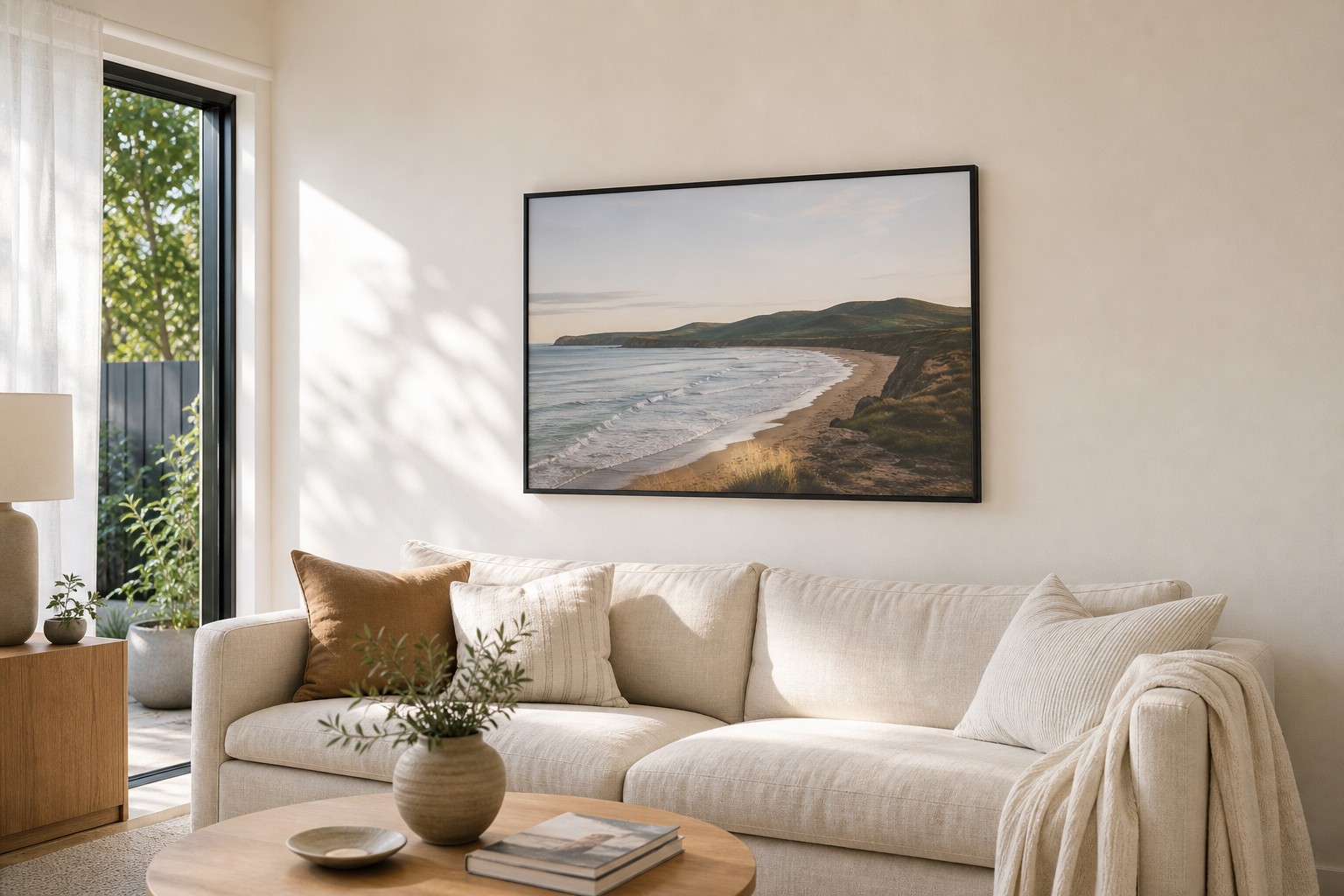
A rough rule: your poster should span roughly two-thirds of the width of the wall (or the furniture below it). For a standard 2.4m-wide wall, that makes A1 (594mm wide) the right standalone piece. A2 (420mm wide) works well above a narrow desk or in a hallway. A3 (297mm wide) suits small spaces, shelves, or gallery walls.
- A1 (594 x 841mm): best above sofas, beds, sideboards, and wide feature walls
- A2 (420 x 594mm): best for hallways, above desks, and narrower walls
- A3 (297 x 420mm): best for gallery walls, smaller rooms, and shelf displays
- Hanging height: centre of artwork at 145 to 150cm from the floor
- Above furniture: leave 20 to 30cm between the top of the piece and the bottom of the frame
- Gallery wall spacing: 5 to 8cm between frames
- Off-the-shelf frames: A3 and A2 are easy to find; A1 needs a specialist framer
How much wall does a poster need?
The proportional rule is more reliable than a fixed size. Aim for the poster to occupy about 60 to 75 percent of the wall width when hanging a single piece. On a narrow hallway wall (say, 900mm wide), that means A3. On a standard bedroom wall (around 3m), A2 starts to look small; A1 is the better choice.
The same logic applies when hanging above furniture. A poster above a sofa should span roughly half to two-thirds of the sofa’s length. A standard three-seat sofa runs 200 to 220cm, so the poster should be 100 to 140cm wide. A1 at 594mm wide falls below that range; for those situations a wider canvas or framed print is often the better answer. We cover that honestly in the final section.
Above a desk or bedside table, you have more latitude. A2 or even A3 can look intentional rather than too small, particularly when paired with a good frame and some breathing room on the wall.
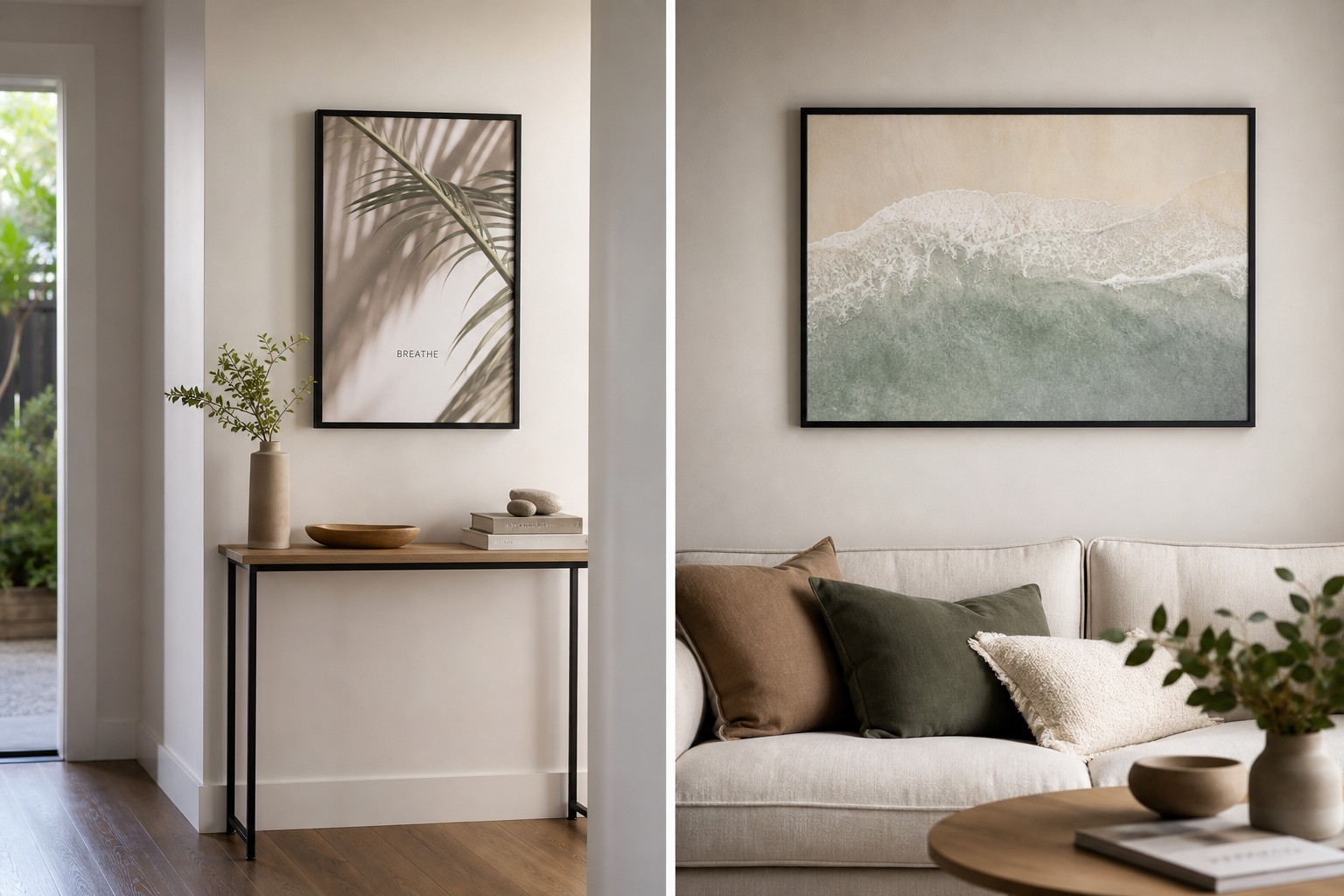
A1, A2, and A3 in real rooms
A3 (297 x 420mm). About the size of a magazine page. In a real room it is smaller than most people expect. It works well on shelves, in clusters of three or more, or in a tightly considered gallery wall. Hanging a single A3 on a feature wall tends to look lost. Think of A3 as a building block, not a statement piece.
A2 (420 x 594mm). This is the workhorse. At just over 40cm wide, it holds its own above a desk, works in a home office, and sits comfortably in a hallway. In a bedroom it suits smaller walls (under 2m wide). It is the size most people picture when they say “a poster.”
A1 (594 x 841mm). A proper statement piece. At nearly 60cm wide and 84cm tall, it fills a wall above a bed or sofa with authority. A1 needs space. If the surrounding walls are cluttered or the room is small, it can feel cramped rather than impressive. Give it at least 30cm of breathing room on each side.
Hanging height
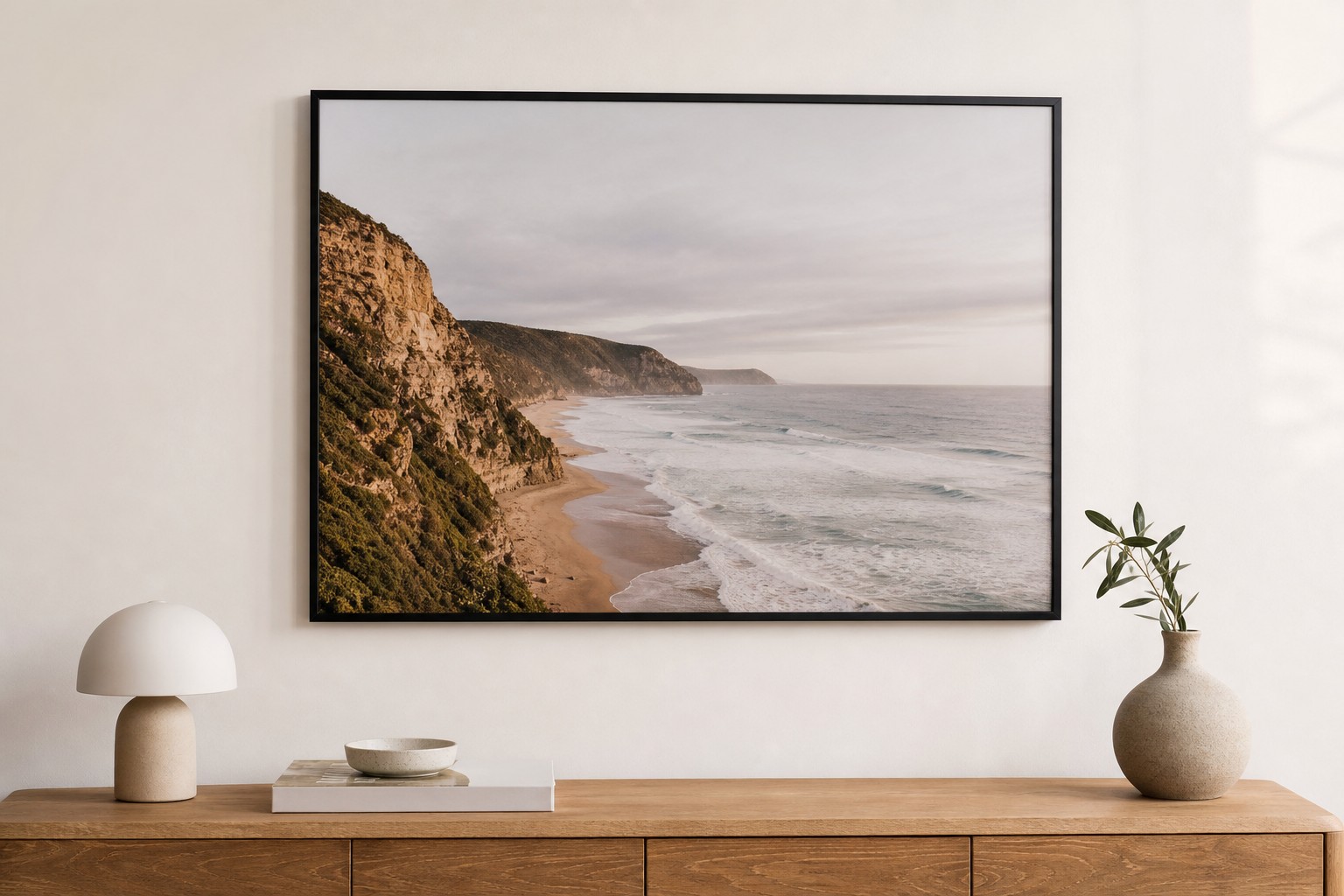
The standard is: centre of the artwork at 145 to 150cm from the floor. That puts the middle of the piece at comfortable eye level for most adults, whether you are looking from a sofa or walking past in a hallway.
If the poster hangs above furniture, the calculation changes. The bottom of the frame should sit 20 to 30cm above the top of the piece (sofa, headboard, console). That gap reads as deliberate and connected rather than floating or cramped.
In practice: hang an A1 above a standard 85cm sofa. The bottom of the frame should sit at roughly 105 to 115cm from the floor. The top of an A1 in a standard 10mm frame would then sit at around 200cm from the floor, which is comfortable under a standard 2.4m ceiling.
Use a spirit level. Poster hardware is often underrated. A single nail works for lighter prints, but heavier framed pieces (A1 in a solid frame can reach 2 to 3kg) deserve picture hooks rated for the load.
Gallery walls and multiples
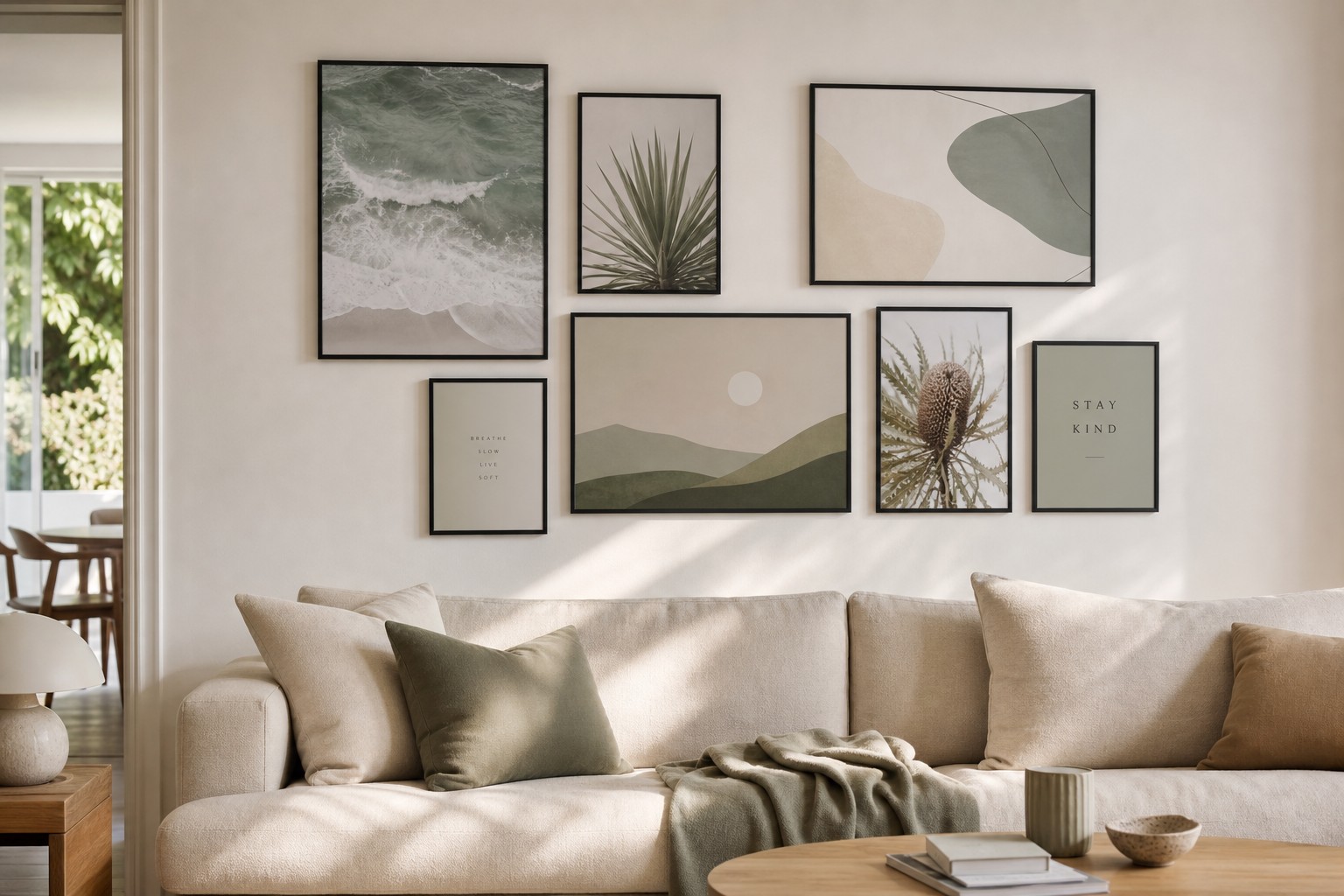
Three A3 posters often look better than one A1 on a wide wall, because you control the composition. A common layout is a horizontal triptych: three A3 prints in identical frames, 5 to 8cm apart, all centred at the same height.
Mixed sizes work when you build around a central anchor. Start with your largest piece at the intended centre height, then build outward, keeping the top or bottom edges of adjacent prints aligned. Avoid centring every piece individually. Staggered clusters read as intentional; uniform grids read as uniform.
Some practical notes:
- Leave at least 5cm between frames. Tighter than 5cm looks crowded; wider than 10cm starts to lose cohesion.
- Mixing A2 and A3 in the same gallery wall works well. Mixing A1 with A3 requires care, since the scale jump is large.
- Matching frames (same colour, same profile) create calm. Different frames add character but need a shared material or tone to hold together (all timber, or all black).
Frames: what fits off the shelf in Australia
A3 frames are available at most major Australian homeware retailers, in black, white, and timber. Prices start around $10.
A2 frames are easy to find at homeware chains and frame specialty stores. Budget $20 to $50 for a simple frame, more for heavier profiles.
A1 frames are where it gets harder. Most high-street homeware retailers do not stock A1 consistently, and when they do the range is limited. A1 usually means a specialist framer or a custom job, and the price reflects it: expect $80 to $200 or more depending on profile and materials.
One thing that catches people: the framed footprint is meaningfully larger than the print. An A1 poster is 594 x 841mm. Add a 40mm frame profile all around and you are looking at 674 x 921mm of wall real estate. Add a mat board inside the frame and the poster itself is pushed inward. The mat adds visual breathing room but the frame footprint stays the same or grows. Plan your wall space around the frame dimension, not the poster dimension.
Mounting options inside the frame:
- No mat: the print fills the frame, colours appear bolder, good for photography and illustrative work.
- Mat board: a 50 to 70mm mat adds a gallery feel, suits line art and botanical prints, and makes A3 look more substantial.
Our custom posters print on 200gsm synthetic stock, which is tear-resistant and water-resistant, a genuine advantage if the frame seal is imperfect or if the print will be near a window.
When a canvas or framed print is the right choice
Posters are the right call when you want flexible decor you can swap out, when you need to match a specific frame, or when the art is graphic, typographic, or illustrative.
A canvas print makes more sense when:
- The wall is large and you want a single hero piece rather than a cluster
- You want a frameless, contemporary look (canvas wraps around a timber stretcher and hangs without a frame)
- The image is photographic and benefits from the slight texture of canvas
A framed print makes sense when:
- You want a complete, ready-to-hang solution with no additional framing step
- The piece needs a formal or gallery-style presentation
- You are gifting art and want it to be immediately ready for the wall
The honest answer: if you are trying to fill a wall wider than 120cm with a single piece, our A1 poster at 594mm wide is unlikely to read at the scale you need. A canvas or framed print can be produced at larger dimensions that will do the job.
Frequently Asked Questions
What poster size should I get for a feature wall?
A1 (594 x 841mm) is the right starting point for a feature wall. If the wall is very wide (above 3m), a single poster will still look small. Consider a canvas print or a gallery wall of three A2 or A3 prints instead. Our detailed guide to A1 poster size explains the dimensions, typical uses and print specifications.
What is the difference between A1, A2, and A3?
A3 suits a small alcove or gallery cluster, A2 suits a feature position above furniture, and A1 suits a large uninterrupted wall. A1 poster size, A2 poster size, A3 poster size each has its own page with exact millimetre dimensions.
How high should I hang a poster?
Centre the artwork at 145 to 150cm from the floor for a standalone piece. If it hangs above furniture, position the bottom of the frame 20 to 30cm above the top of the furniture.
Will an A3 poster look too small on a wall?
On its own, almost certainly yes, unless the wall is very small (under 1m wide). A3 works best in groups of three or more, or as part of a gallery wall.
Can I get an off-the-shelf frame for an A1 poster?
A1 frames are not consistently stocked at major homeware retailers. For A1 you will usually need a specialist framer or a custom job. Budget more than you would for smaller sizes. Once you have shortlisted a size, our poster printing costs guide can help you plan the print side of the budget.
What does 200gsm synthetic poster paper mean?
GSM is grams per square metre, a measure of paper weight. 200gsm is a robust, rigid stock. Synthetic (rather than standard paper pulp) means it is tear-resistant and water-resistant, which makes it more durable in everyday use.
What is the right spacing between frames on a gallery wall?
5 to 8cm between frames is the standard. Tighter feels crowded; wider loses cohesion. Use paper cut-outs taped to the wall to test spacing before you put anything in permanently.
What sizes does Paperlust print?
We print A1, A2, and A3 posters. We do not print A0 or A4 poster sizes. If you need a larger format for signage or displays, our signage range covers those needs.