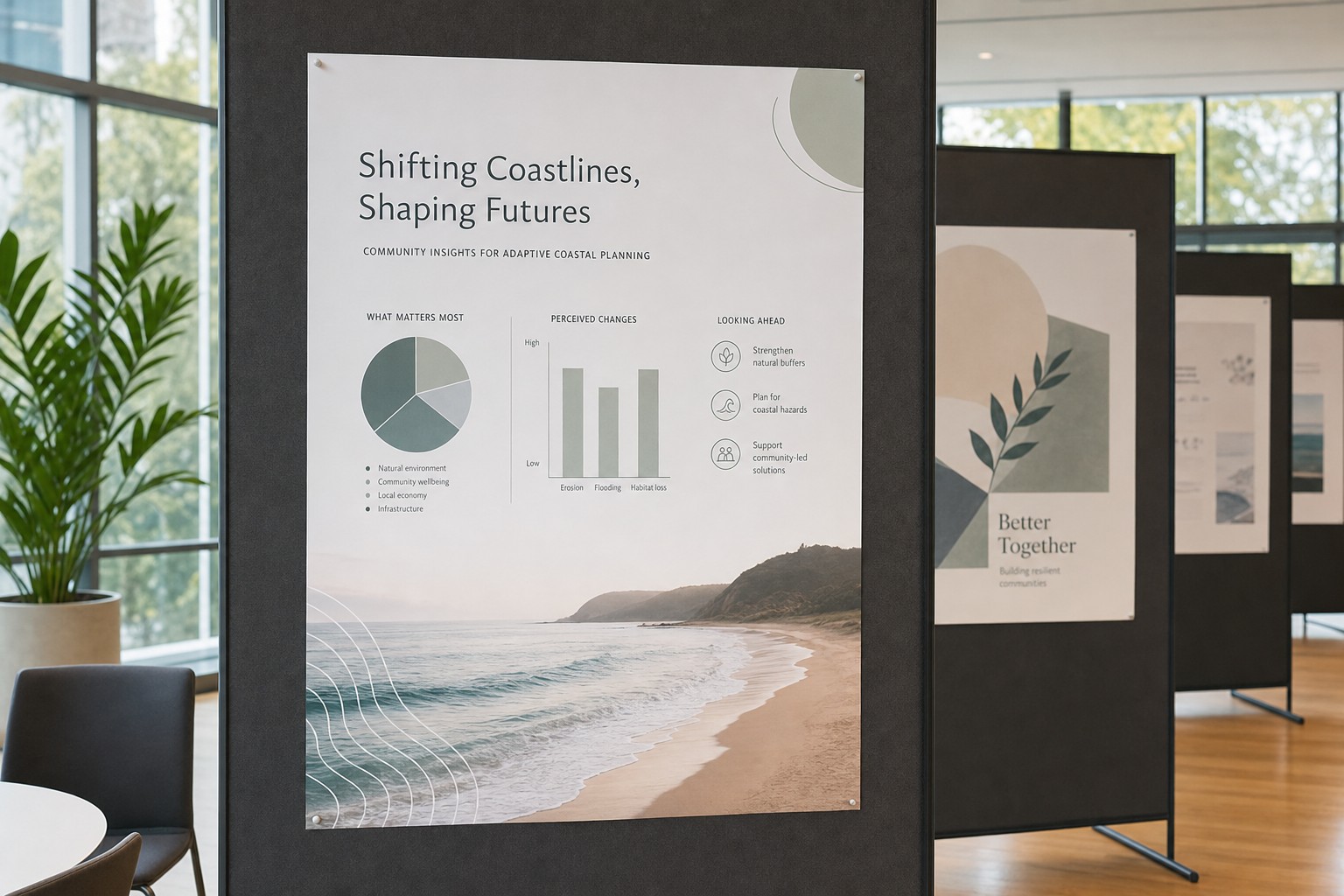
An A0 poster is 841mm x 1189mm (84.1cm x 118.9cm, or 33.1 x 46.8 inches). It is the largest standard sheet in the ISO A series and covers exactly one square metre of paper. Every smaller A size is produced by halving A0 repeatedly: A1 is half of A0, A2 is half of A1, and so on.
| Format | Millimetres | Centimetres | Inches |
|---|---|---|---|
| A0 | 841 x 1189 mm | 84.1 x 118.9 cm | 33.1 x 46.8 in |
Paperlust Print Shop prints posters to A1 (594mm x 841mm), A2 and A3 on 200gsm synthetic stock. For projects that require a display larger than A1, we build them as rigid signage panels at custom sizes. Read on to understand which format fits your project.
- Dimensions: 841mm x 1189mm
- In centimetres: 84.1cm x 118.9cm
- In inches: 33.1 x 46.8 inches
- Area: exactly 1 square metre
- ISO A series position: the largest standard sheet
- What Paperlust Print Shop prints: A1, A2 and A3 on 200gsm synthetic
- Need bigger than A1? We build rigid PVC and corflute signage panels at custom sizes
- Common uses: academic conferences, trade shows, large wayfinding, cinema and event displays
What A0 is and how it fits the ISO A series
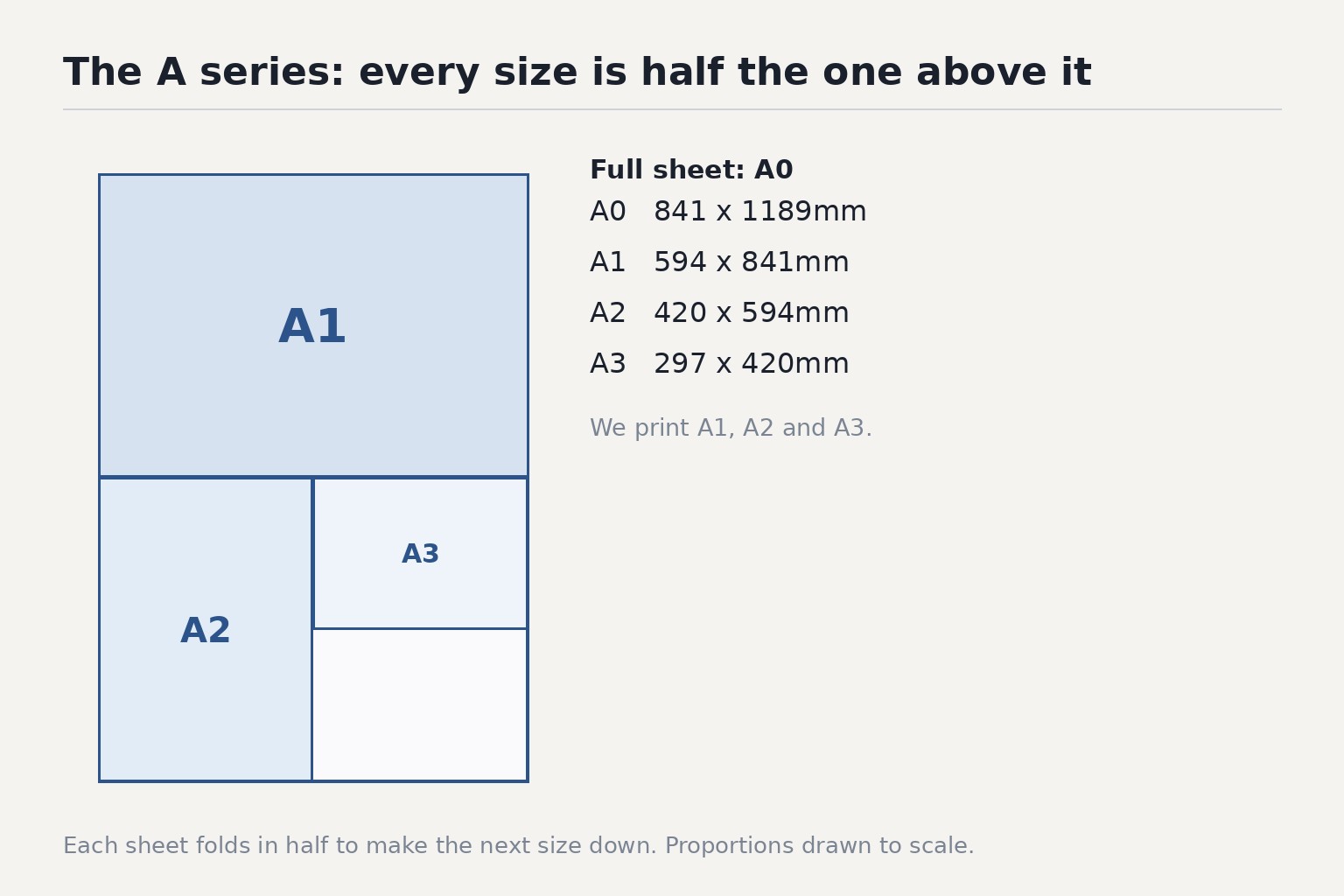
The ISO A series is built on a single rule: each size has exactly double the area of the next size down, and both sizes share the same aspect ratio. That ratio is 1:root(2) (approximately 1:1.414), which is why halving works perfectly without distortion.
A0 is the base of the system, defined as the sheet with an area of exactly one square metre. Every other A size follows from there. Because all sizes share the same proportions, artwork scales between any two A sizes cleanly: a 70.7% reduction takes A0 to A1 exactly, and a 141.4% enlargement takes A1 to A0 exactly.
| Size | mm | cm | Inches |
|---|---|---|---|
| A0 | 841 x 1189 | 84.1 x 118.9 | 33.1 x 46.8 |
| A1 | 594 x 841 | 59.4 x 84.1 | 23.4 x 33.1 |
| A2 | 420 x 594 | 42.0 x 59.4 | 16.5 x 23.4 |
| A3 | 297 x 420 | 29.7 x 42.0 | 11.7 x 16.5 |
What A0 is genuinely used for in Australia
A0 is the format of choice when content needs to be read from several metres away or when physical scale matters.
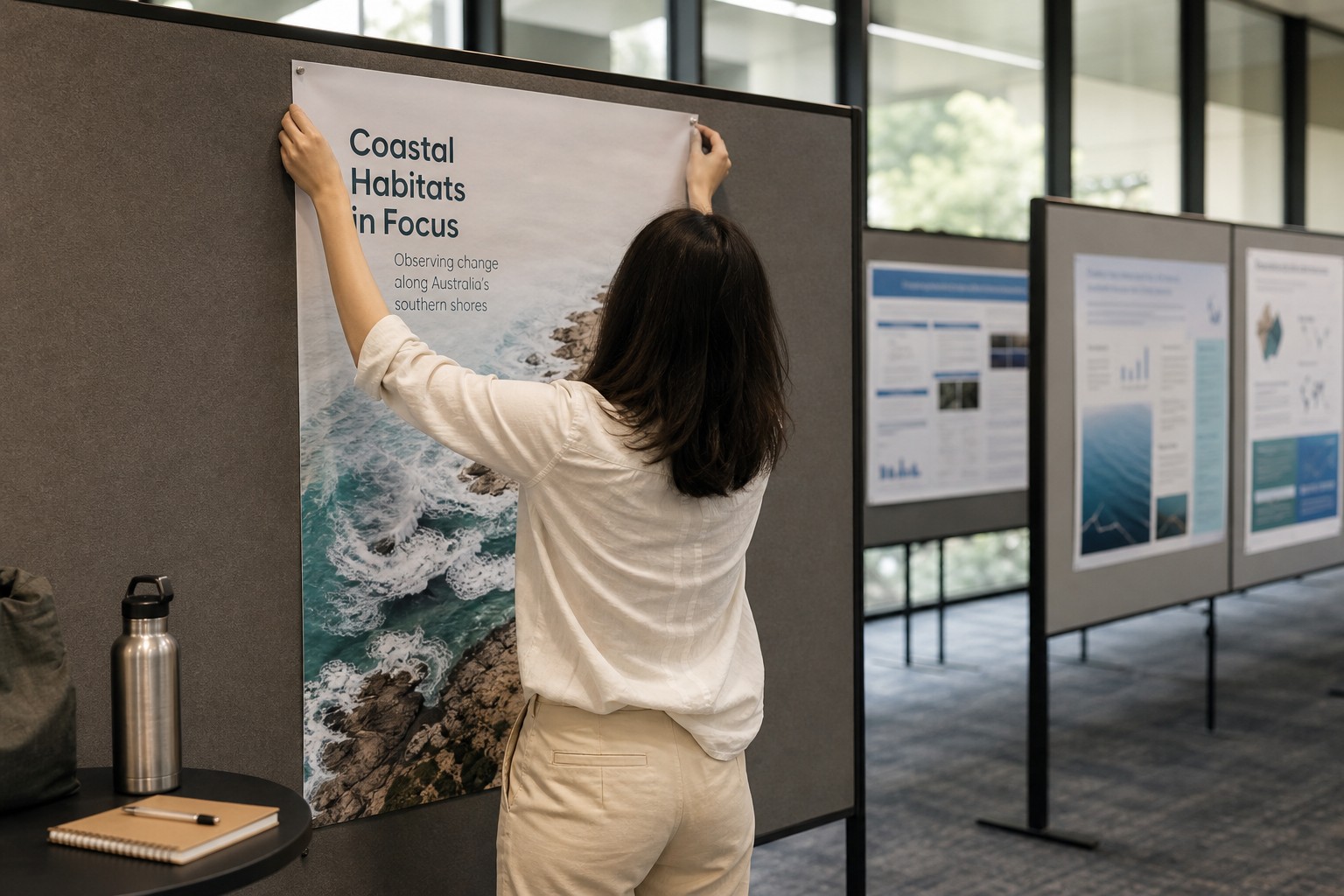
Academic and research conferences. This is the most common real-world use of A0 in Australia. Many universities and professional bodies specify A0 as the required poster size because it accommodates a full data layout, including figures, methodology tables, charts and references, at a size that reads clearly from 2-3 metres. If your conference brief specifies A0, they almost certainly mean it. See the dedicated section below.
Trade show and exhibition graphics. A0 has enough surface to carry a brand story, product grid or large diagram alongside headline copy. It holds its own from a standing distance in a busy exhibition hall.
Large wayfinding and directional signage. Building directories, event floor plans and venue maps often use A0 because the format fits map detail and large location labels at the same time.
Cinema and event promotion. Portrait A0 is close to the classic film one-sheet format (27 x 40 inches). It is a natural fit for cinema lobbies and entertainment venue walls. The one sheet and Australian daybill are covered in our guide to movie poster sizes, along with the other formats used for film promotions.
Why a paper A0 poster is often the wrong choice
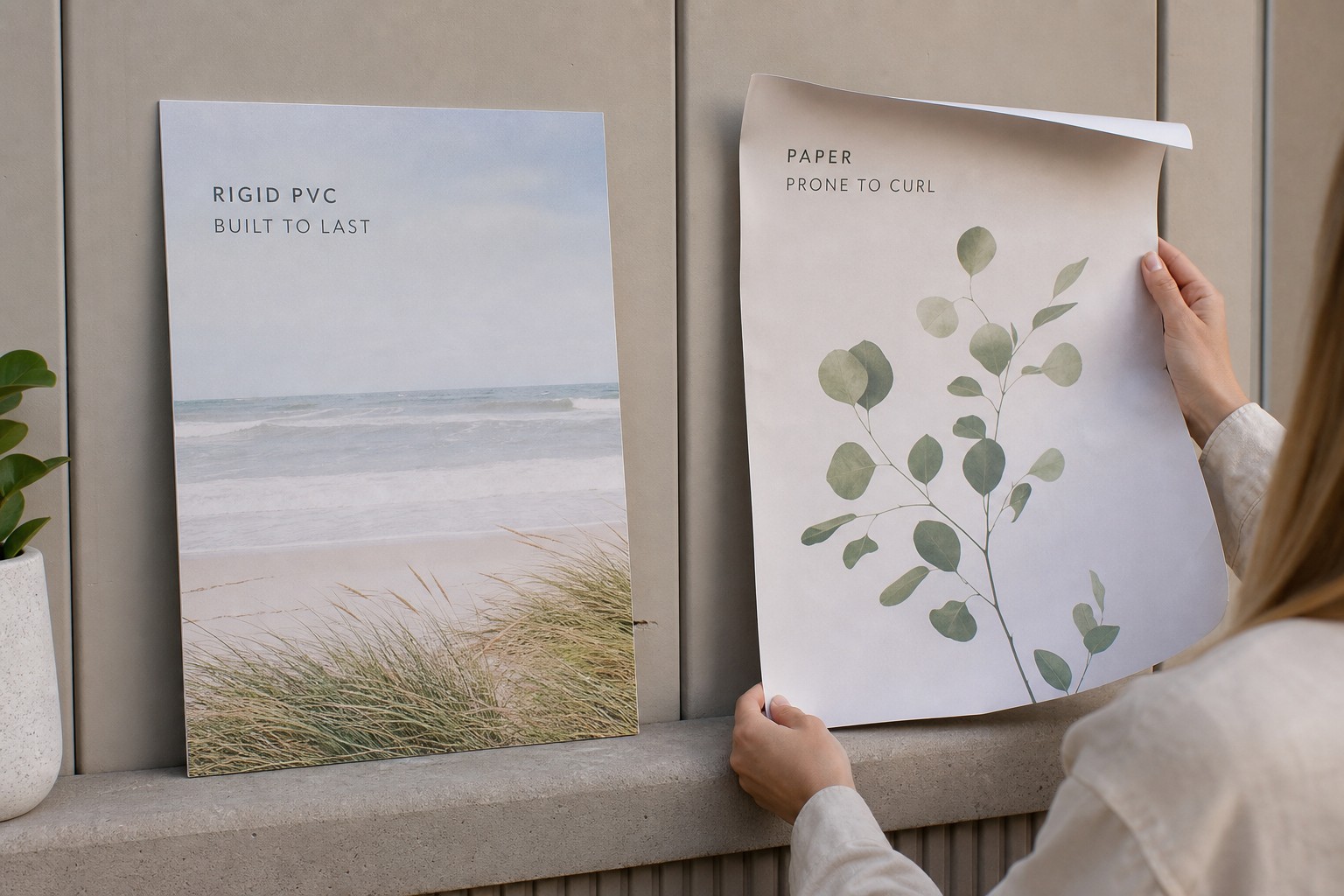
Here is something most poster pages do not say plainly: a paper A0 sheet is fragile at that scale.
At 841mm x 1189mm, unframed paper has significant flex across its surface. It curls in warm conditions, particularly if stored in a cardboard tube for more than a few days. Corner and edge damage from transport is common. Mounting flat at this size requires planning and suitable materials, and even a well-mounted paper poster rarely stays completely flat in a humid room. When you are ready to plan the job, our guide to poster printing costs covers what to expect across common sheet sizes.
The reasons most people search for A0 are: their conference specified it, they need a large event display, or they want a statement piece for a wall. The right solution depends on which of those applies.
For conference work, a specialist conference printer is generally the correct call. We cover that in detail below.
For event displays and trade shows, a rigid panel almost always performs better than paper. A PVC sign or corflute panel at a similar or custom size arrives flat, requires no framing, attaches directly to a stand or wall, and survives the booth pack-down without damage. Our signage panels range covers large-format options at custom sizes. Where the panel is walked past from both approaches, double sided corflute signs carry the artwork on both faces of the same board.
Our poster range covers A1 (594mm x 841mm), A2 and A3 on 200gsm synthetic stock. Synthetic stock is tear-resistant and water-resistant, which makes A1 a practical choice for displays that will be moved, handled or stored. For a statement piece for a wall rather than a display, canvas printing is the closer fit, because a 60x90cm gallery wrap is printed on 400gsm artist-grade canvas, stretched over a solid timber frame and arrives assembled, so it needs no separate frame.
Scaling from A0 to A1: what actually changes
If you have designed at A0 and need to print at A1, the maths is exact: A1 is 70.7% of A0 in both dimensions (the square root of 0.5). There is no distortion because the two sizes share the same aspect ratio.
What to watch when scaling down:
Body text. Conference posters at A0 typically use 24-28pt body text and 60-72pt headings for a viewing distance of 1.5-2 metres. At A1, the same viewing distance applies, so those text sizes remain legible. If viewers will stand closer, body text can be reduced further.
Figures and data tables. Axis labels and legends at A0 are typically 18-20pt. Scaled to A1, these become 12-14pt, which reads clearly at arm’s length. Dense data tables should be proofed at A1 scale before ordering.
Margins. A 20mm margin at A0 becomes 14mm at A1 after a 70.7% scale. That is within normal range. Very tight original margins may need manual adjustment.
The workflow in most design tools: save a copy of the A0 file, change the artboard or page size to 594mm x 841mm (A1), scale all objects to 70.7%, then export to PDF at 300dpi minimum with embedded fonts.
Academic conference posters in Australia: a practical guide
Many Australian academic conferences, particularly in medicine, science, engineering and social research, require A0 posters. Here is what to do.
Step 1: Check the conference requirements carefully. Some conferences specify “A0” but the display boards are A1. Read any document that lists board dimensions. If the board is A1, an A0 paper poster will not fit. If in doubt, email the conference organiser before you print.
Step 2: Design at A0 from the start. If A0 is confirmed, set your file to 841mm x 1189mm and work at that size throughout. Designing at A3 or A4 and scaling up at print time produces soft text and pixellated images on any professional printer.
Step 3: Use a specialist conference printer. University print rooms and commercial conference printers around Australia routinely produce A0 posters on satin or matte paper, and increasingly on fabric. Order at least a week before you travel to allow time for print, dispatch and any corrections.
Step 4: Consider fabric stock. Fabric A0 posters fold flat, pack in a standard suitcase without a tube, and unroll cleanly on most display boards. They cost a little more than paper, but the travel and storage convenience is significant for researchers presenting at interstate or international conferences.
Step 5: Plan for reuse. A rolled paper A0 poster rarely survives more than one or two displays without corner damage. If you want a copy for your lab wall or a second conference, have a scaled A1 version made on synthetic stock. An A1 on waterproof synthetic lies flat, mounts easily with poster strips, and tolerates a humid environment for years.
If your conference allows A1 as an alternative to A0, our A1 synthetic posters arrive flat and are ready to pin to a display board without framing. If you need a rigid free-standing A0 board instead, foam board prints at A0 (841 x 1189mm) in 5mm or 10mm, and one sided boards can be finished with a fold-out strut so they stand on their own for indoor use. Shipping is $15 AUD flat rate Australia-wide with tracking, or $35 AUD internationally via DHL. Confirm with the organiser before ordering.
Frequently Asked Questions
What size is an A0 poster in mm?
841mm wide by 1189mm tall in portrait orientation. In landscape, 1189mm is the width and 841mm is the height.
What size is an A0 poster in centimetres?
84.1cm x 118.9cm.
Does Paperlust Print Shop print A0 posters?
No. Our poster range covers A1 (594mm x 841mm), A2 and A3 on 200gsm synthetic stock. For displays larger than A1, we produce rigid signage panels in PVC and corflute at custom sizes. See our signage printing range.
What is the difference between A0 and A1?
A1 is exactly half the area of A0. A0 is 841mm x 1189mm and A1 is 594mm x 841mm. Scaling from A0 to A1 means reducing both dimensions to 70.7% of their original size.
What resolution should an A0 poster file be?
300dpi at print size is recommended for sharp output, particularly for charts and fine text. Some conference printers accept 150dpi for plain graphics, but 300dpi is the safe standard. Export as PDF with embedded fonts rather than flattening to a raster image.
What paper stock is used for A0 conference posters in Australia?
University print rooms and commercial conference printers typically use 170-230gsm satin or matte paper. Fabric stock is increasingly popular because it folds flat for travel and hangs smoothly on most display boards.
My conference spec says A0 but I want a copy for my office wall afterwards. What should I do?
Print the A0 at a conference printer for the event. Then have a scaled A1 version made on synthetic stock for your lab or office wall. A synthetic A1 lies flat, tolerates pinning and removable adhesive, and lasts for years without curling.
What is the difference between A0 and B0?
B0 (1000mm x 1414mm) is the base of the ISO B series, which runs alongside the A series. B0 is slightly larger than A0 and is used mainly in specialised printing and bookbinding contexts. Most Australian academic conferences specify A0, not B0. Our guide to B series poster sizes explains how the larger B formats sit alongside the A series.