Most label material mistakes start with a reasonable but untested assumption. A cream jar looks dry on the bench, so a paper label is ordered. Then the jar sits in a steamy bathroom and the corner lifts. The packaging still works; the label no longer does. This label materials and adhesives guide is for makers who need roll labels, not sheets or individual stickers. When you are ordering custom labels, separate the base material from the finish and from the adhesive. Those three decisions behave independently.
Start with the conditions the label has to survive
Before any stock talk, ask two questions. Will the label face water, steam, condensation, oil or repeated handling? Does the container surface need to show through? Those answers point you to a stock. Capacity in millilitres or grams does not: measure the actual container’s flat panel. For a straight-sided cylinder, wrap soft tape or a paper strip around the flat zone and subtract your planned seam gap. Tapered, ribbed or shouldered surfaces need a paper fit test before you choose a standard shape. Use the bottle and jar label sizing guide to turn the measured panel into wrap, lid and body options.
The three roll-label stocks
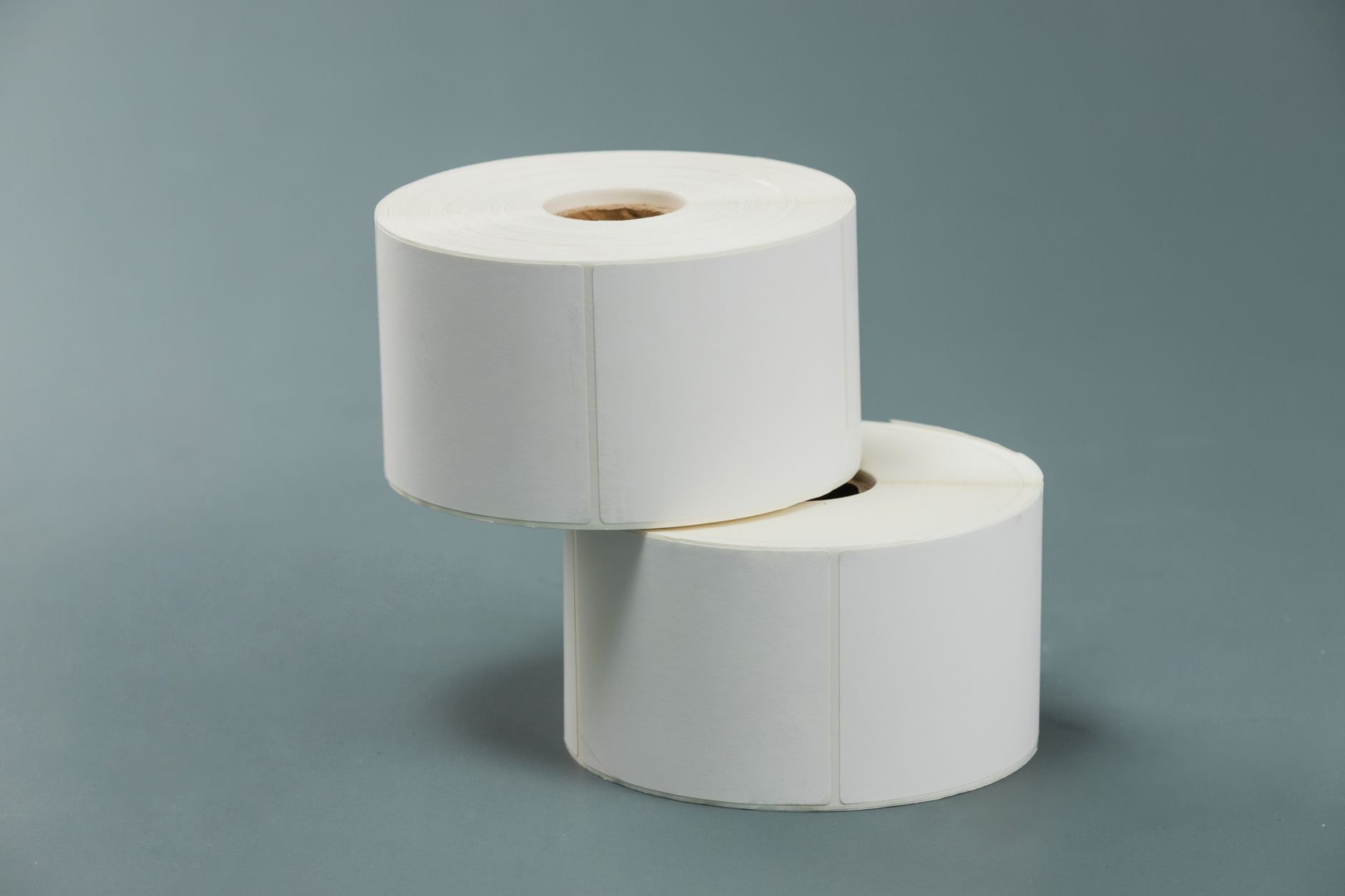
Standard roll labels are printed one up and supplied on rolls of 500. The base material is the first choice. Finish is separate, and adhesive is separate from both.
White Cast Paper
White Cast Paper is the paper option for products that stay dry on the pantry shelf, in a box or inside a dry store. It is a cost-effective stock, not a wet-use one. Water, steam and condensation can wrinkle or lift it. Both matte laminate and gloss laminate are finish choices; neither turns this paper into a wet-use synthetic.
White Synthetic
White Synthetic is the stock for bathroom shelves, fridge doors, condiment jars and packs that get handled or wiped. The material is a synthetic film, not paper. On the waterproof vinyl labels range the white stock is a synthetic polypropylene film with a permanent acrylic adhesive. It is the wet-use roll-label option for moisture, condensation and oil from handling. Service temperature is -20°C to 80°C; that is not an application instruction. Test on your actual container because coatings and texture affect adhesion. For dishwasher, freezer or direct-food-contact use, confirm the conditions with the team before ordering. The synthetic stock itself does not guarantee performance in those situations.
Clear Synthetic
Clear Synthetic is a transparent film with a gloss varnish. It works when the product colour or jar finish is part of the label design. It is not clear PVC vinyl, and there is no frosted or matte clear option in the roll-label stock. Because the film is transparent, colours print lighter than on white stock. White ink itself forms the white areas in your design. A white underprint may be added beneath coloured areas when those colours need a solid base. For premium packaging ideas, read the clear labels product packaging guide and check the clear labels product page for shapes and sizes. Clear stickers are a separate sticker format; they do not inherit this roll-label film’s performance.
Laminate changes the surface, not the base material
Matte and gloss are finishes, not materials. White Cast Paper and White Synthetic both come with matte laminate or gloss laminate. Clear Synthetic comes with a gloss varnish. A matte laminate softens glare; a gloss finish gives saturated colour and a shinier surface. On the paper roll stock, laminate adds a surface layer but does not turn White Cast Paper into the wet-use synthetic product. Select White Synthetic when the label has to handle moisture.
| Stock | Finish | Typical use | Adhesive and removal note |
|---|---|---|---|
| White Cast Paper | Matte or gloss laminate | Dry pantry, bakery boxes, gift hamper tags | Permanent for the product’s life; easy removal is a separate brief |
| White Synthetic | Matte or gloss laminate | Bathroom, fridge, condiment, handled packs | Strong permanent bond; clean removal needs team confirmation |
| Clear Synthetic | Gloss varnish, white underprint available | Clear glass or premium bottles, product colour visible | Transparent stock shows the surface; gloss varnish only |
Permanent and removable adhesive: two different removal expectations
Permanent adhesive is designed to keep the label in place for the product’s service life. It may tear on removal or leave residue. Removable adhesive is designed for easier removal under clean conditions, but heat, time and surface type can change how cleanly it lifts. Removable does not mean it stays repositionable month after month.
Removable adhesive is not a standard choice in the roll-label range at the moment. If you need easy removal on a reusable jar, a promotional lid sticker, or any label your customer will peel off before gifting, confirm that as a specialist brief before ordering. Surface coating matters as much as adhesive choice.

Matching stock to the product shelf
Skincare and body care lines usually sit near steam, so White Synthetic is the common base. Clear Synthetic suits serum or oil bottles where the product colour should show. The cosmetic labels range allows up to five designs in one order, each on its own roll.
Honey and jam jars that go back into the fridge or sit near the toaster belong on White Synthetic. A display jar that stays dry in the cupboard can use White Cast Paper. The honey and jam labels page follows the same stock set; count each design’s minimum separately.
The food labels range is for the outside of the pack, not the food contact surface. White Synthetic suits chilled or damp packs; White Cast Paper suits dry bakery boxes and pantry lines. For candles, keep the label on the outside of the vessel and ask the supplier to confirm suitability for the expected container and use conditions before you commit. The candle labels page shows the available shapes and sizes.
For sauces, spreads and pantry jars, the jar labels page covers the same stocks. If your measured flat panel suits a standard rectangle shape, rectangle labels is the most direct starting point.
Quantities: one design, one minimum
Standard roll labels are sold on rolls of 500 labels per roll. The minimum applies per design and per size. A total of 1,500 labels across three designs with 500 each meets the minimum for all three. A total of 1,500 split as 1,000, 300 and 200 does not, because two designs fall below 500. If you need uneven quantities across designs, confirm the split with the team before ordering.
Packaging faces multiply the count. If 500 jars each need a front, lid and back label, that is 1,500 labels across three designs. The example numbers in this paragraph are hypothetical.
Sample-check before you commit
A material swatch, digital proof and printed own-artwork test answer different questions. The digital proof checks layout, text and declared dimensions; it does not check physical colour, adhesion or stock. If you want to test your own printed artwork on a roll stock, that is a separate small printing order or test run with its own minimum, agreed with the team. The sticker and label sample pack is a fixed, preprinted assortment; it lets you compare available samples but not your own artwork.
When you run a trial, apply labels to a dry surface and follow the product or supplier directions for dwell before exposing the pack to moisture. Record the actual dwell time you used. Check coated glass and plastics on the exact container.
If you only need a handful of shaped promotional stickers, the die-cut sticker range is a different format from roll labels. A small die-cut sticker run does not test how a roll-label stock behaves on a jar. For a tactile finish on dry packaging, the textured stickers range is a separate sticker option, not a roll-label stock.
If you are still deciding between roll labels and individual stickers, use the labels vs stickers guide. For a direct paper versus synthetic comparison in the sticker range, see vinyl stickers vs paper stickers. Then use the how to test sticker samples guide to structure your next trial.
Ordering and approval
Ordering a roll label means choosing shape, size, stock, finish, number of designs and quantity, then uploading artwork. An emailed proof is sent before printing. Nothing prints until you approve the proof. Production takes 48 hours after proof approval. Delivery is a separate step after production.
Follow the artwork instructions for the product you choose. The honey and jam page displays a 3mm bleed as an example. Approving the digital proof checks layout and declared sizes. It is not a physical colour proof, adhesion test or regulatory approval. Confirm any required wording for your product before final artwork.
Frequently asked questions
What is the difference between White Cast Paper and White Synthetic?
White Cast Paper is a paper stock for dry indoor packaging. White Synthetic is a synthetic film for wet, chilled or handled conditions. Both can have a matte or gloss laminate, but the laminate changes surface finish, not the base material.
Does a laminate make the paper roll label waterproof?
No. On the paper roll stock, laminate adds a surface layer but does not turn it into the wet-use synthetic product. Use White Synthetic when the label has to face moisture, condensation or repeated handling.
Can I choose removable adhesive on standard roll labels?
Removable adhesive is not a standard choice in the roll-label range at the moment. If you need easy removal on a reusable container or temporary promotional label, contact the team before ordering so the surface and removal expectation are confirmed.
Is Clear Synthetic a clear PVC label?
No. Clear Synthetic is a transparent synthetic film with a gloss varnish. It is not clear PVC vinyl, and there is no frosted or matte clear option in the standard roll-label stock.
How do I work out quantity across three designs?
Count the minimum per design and per size. If each of three designs orders 500 labels, the total is 1,500 and each design meets its minimum. If the split is 1,000, 300 and 200, the two smaller designs miss the minimum. Uneven splits need team confirmation before ordering.