A hairdresser’s business card is handed over at the most intentional moment in the client relationship – right after a service that made someone feel their best. For salons and stylists across Australia, that card is a brand impression, a rebooking prompt, and a referral engine all in one small rectangle. Getting the design, paper, and finish right is not decoration; it is strategy. This guide covers everything AU hair industry professionals need to choose and print business cards that match their brand, survive daily salon life, and genuinely drive appointments.
Salon type quick-match guide
| Salon Type | Recommended Product | Paper | Best Finish |
|---|---|---|---|
| Boutique salon (1-3 chair) | Coloured Paper BCs | Cream or warm white uncoated | Flat foil logo or name |
| Luxury multi-chair salon | Standard BCs + Duplex upgrade | 350gsm smooth coated | Raised foil or Spot UV |
| Barbershop | Standard or Coloured Paper BCs | Black or dark kraft stock | Gold or copper flat foil |
| Mobile stylist | Standard BCs | 350gsm smooth coated | Flat foil accent |
| Colourist specialist | Coloured Paper or Flat Foil BCs | Cream or warm white | Rose gold or gold foil |
| Extension specialist | Standard or Flat Foil BCs | White 350gsm smooth | Rose gold flat foil |
| Educator / brand trainer | Standard BCs or Scodix | White 350gsm coated | Scodix raised gloss on logo |
Why Hairdresser Business Cards Are Different from Generic Ones
Most professionals hand over a business card once and hope it finds its way onto a desk. Hairdressers and salon owners hand over cards in a completely different context – at the mirror, after a fresh colour, trim, or blow-dry, to a client who is feeling confident and who is already thinking about when they will return. That moment is worth designing for specifically.
A few things distinguish hair-industry business cards from generic professional cards:
- Aesthetic stakes are higher. A card that looks cheap contradicts the premium experience you just delivered. If a client holds a flimsy, dull card after a $300 balayage, the disconnect is immediate. The card needs to match the service quality.
- The card is a rebooking tool, not just contact information. Many salons pre-print an appointment line on the back: “Your next appointment: _____”. This single design decision eliminates friction and converts satisfied clients into booked ones before they leave the chair.
- Instagram handle is as important as a phone number. Hair results are visual and shareable. Clients who follow stylists on Instagram refer their friends, watch reels, and stay emotionally connected to the salon between visits. Your handle belongs on your card in clearly readable type.
- The card lives in a handbag or salon apron pocket. It faces crumpling, moisture, and daily friction. Paper weight and coating choices affect durability in ways that matter for this specific trade.
- Brand identity cycles faster than most industries. Salons rebrand when a senior stylist goes independent, when a new co-owner joins, when the salon moves premises, or when an aesthetic pivot happens. Cards often need reprinting at these junctures – meaning quantity decisions matter more than ordering 1,000 and watching them become obsolete.
Understanding these dynamics is what allows you to make a purposeful decision rather than picking a card that simply looks nice in a preview image.
12 Design Directions for Hairdresser and Salon Business Cards
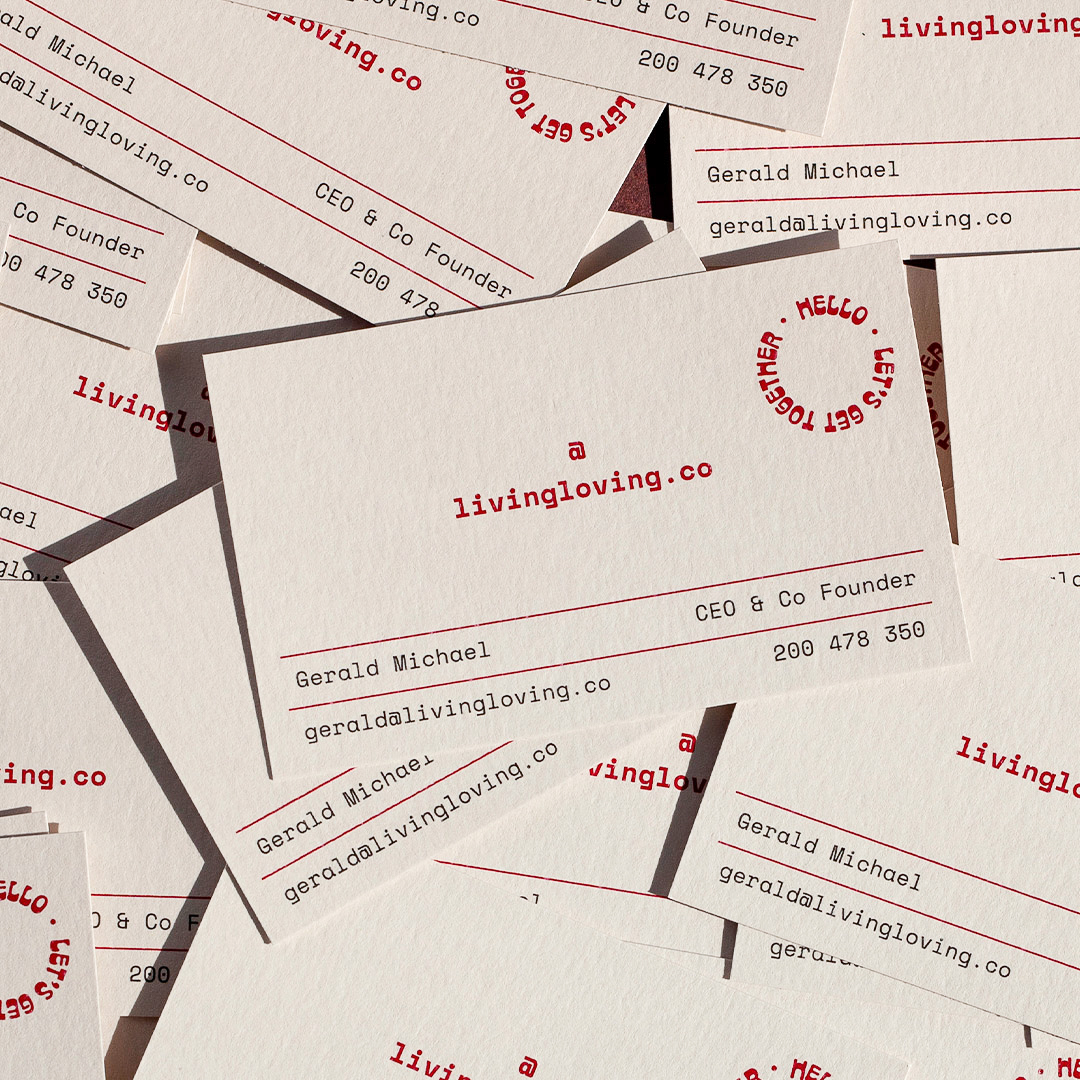
Hair is one of the most aesthetically self-aware industries in Australia. Clients choose their stylist partly on reputation and partly on the visual identity of the brand. The following 12 design directions cover the major aesthetic languages in the AU hair market – from the clean boutique studio to the moody inner-city barbershop.
1. Minimalist black and gold foil
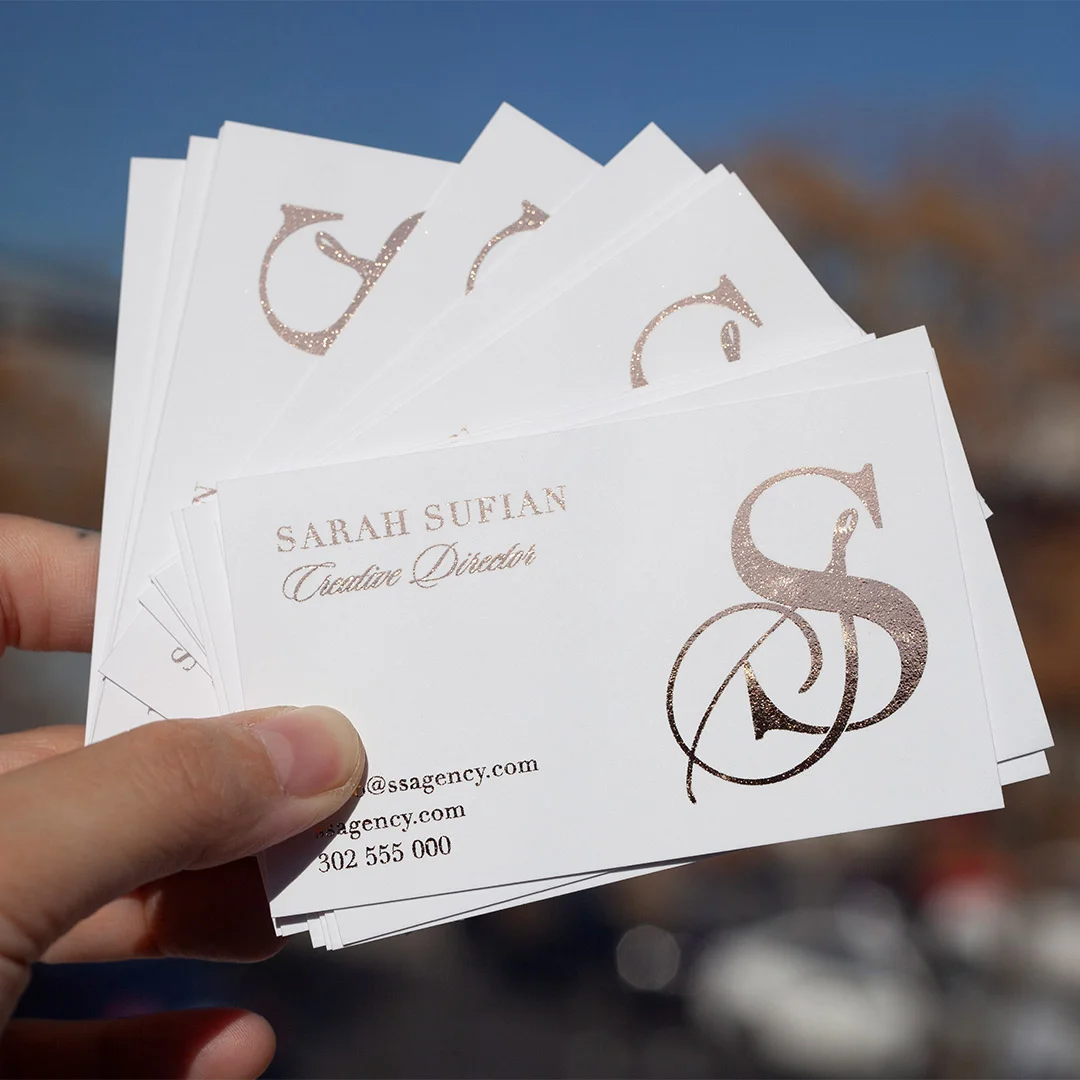
White or very pale stock, a single serif or clean sans-serif wordmark, and a flat gold foil treatment on the logo or name. This direction reads as high-end without overdesigning. Rose gold is increasingly popular for salons targeting a feminine-luxury positioning. Works with both flat foil business cards and raised foil for a more tactile result.
2. Hand-lettered script
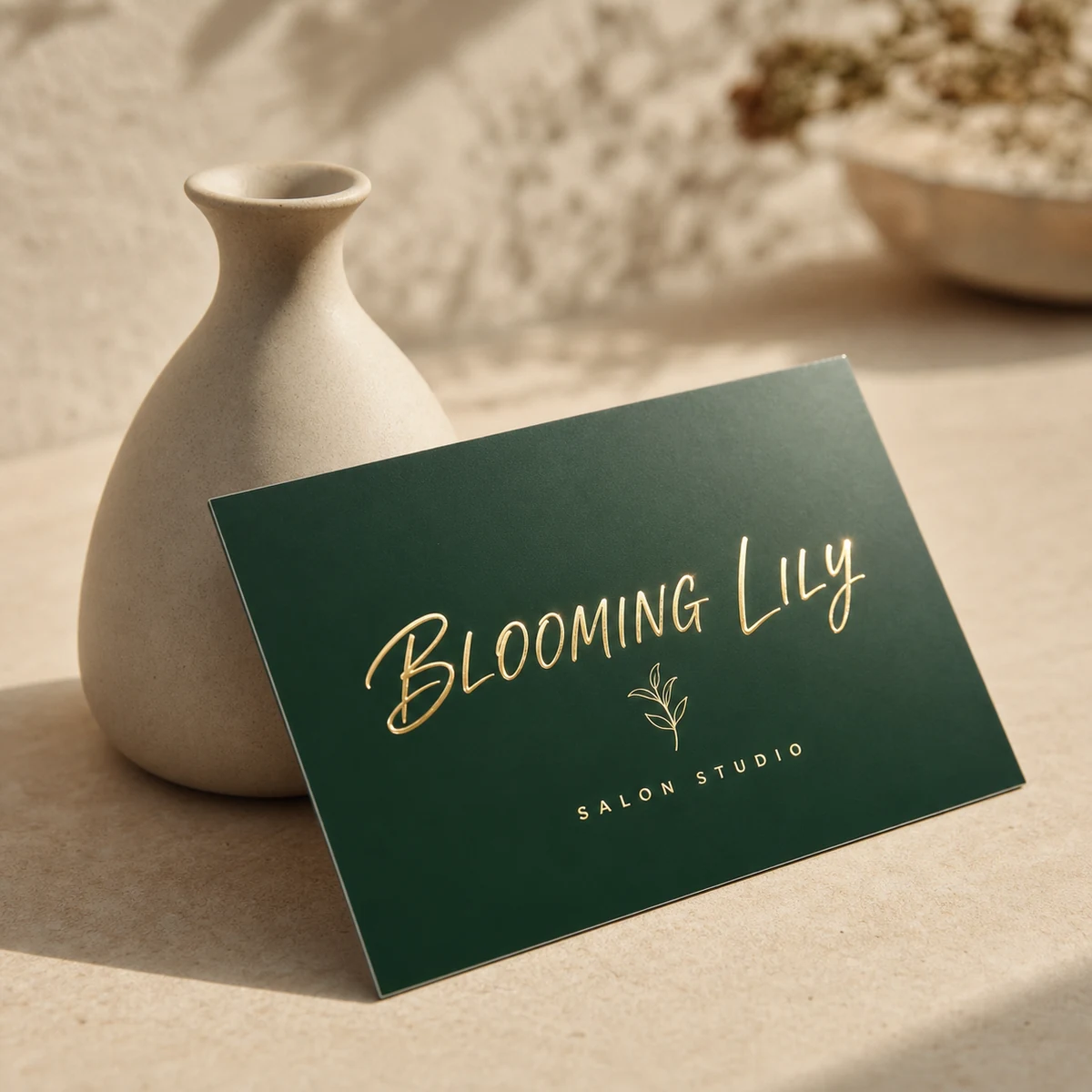
A calligraphic wordmark conveys craft and personalisation – attributes that resonate strongly with boutique salons and solo stylists. Typically paired with a clean body typeface for phone and booking details. Foil on the script element amplifies the premium feel significantly.
3. Photographer-style portrait front
A high-quality photo of the stylist on the front of the card builds immediate familiarity. This works especially well for mobile stylists and salon chairs in shared-space environments where the stylist is the brand, not a venue. Requires a print process that handles full-bleed colour photography cleanly – smooth coated 350gsm stock is ideal.
4. Salon photo on the back
A clean contact information front plus a salon interior photo, before-and-after result, or mood shot on the back. The back becomes a mini portfolio. Standard business cards on a 350gsm coated stock print full-bleed photography cleanly at this format.
5. Cream paper and foil signature
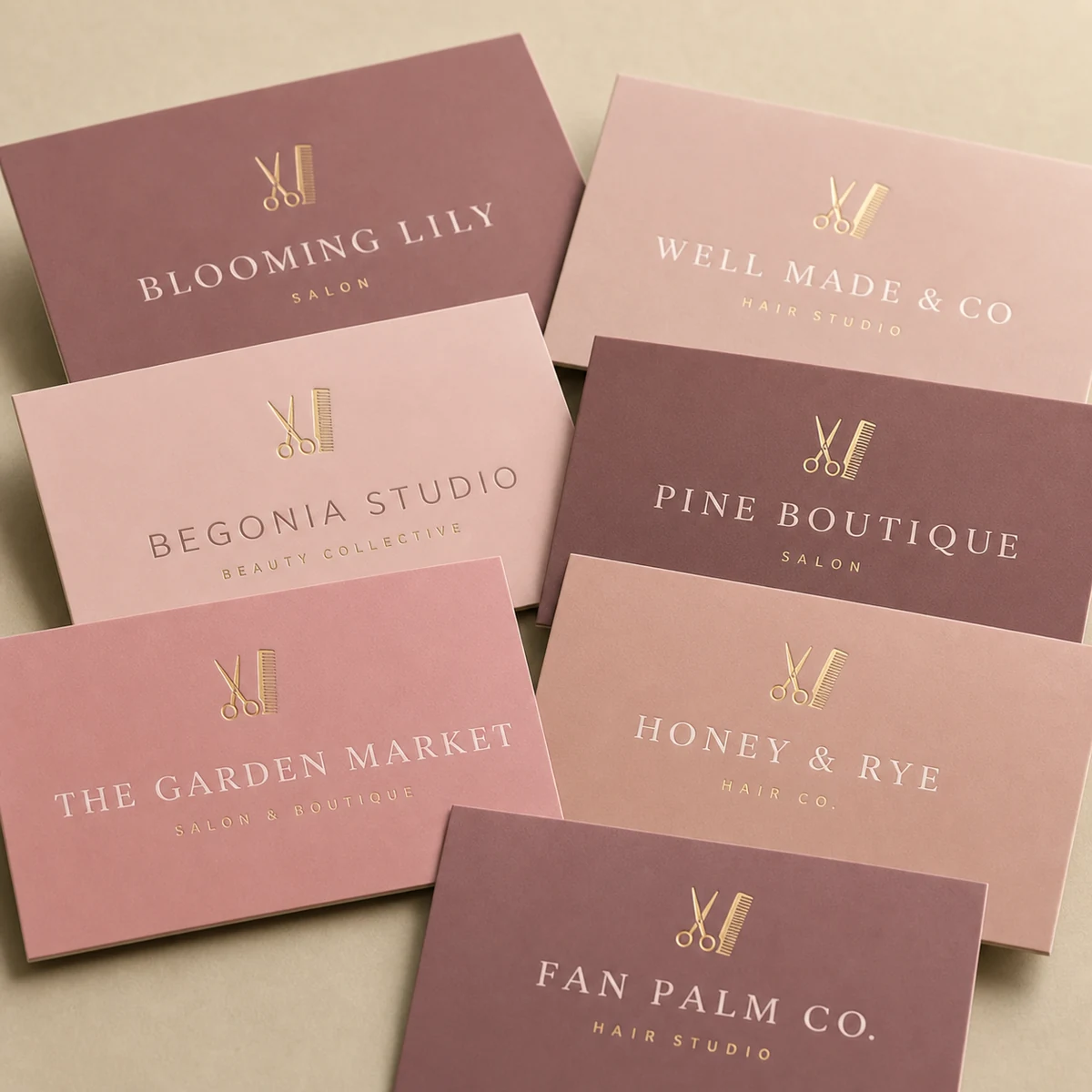
Cream or warm-white coloured stock with a gold or rose-gold foil name is arguably the signature hairdresser card aesthetic in Australia right now. The off-white base reads as organic and handcrafted. Paired with a modest foil treatment it sits firmly in the boutique-luxury tier without the full investment of a duplex card.
6. Colour-block
A bold solid-colour background matching a key brand colour on one side, clean typography on the other. High visual impact at a lower print cost. Coloured paper stocks eliminate the need to print a full-coverage background, which avoids the ink-heavy coated look and produces a sharper, more premium result.
7. Abstract texture or pattern
A subtle geometric or organic texture background gives depth to an otherwise flat design. Linen-embossed or textured stocks achieve this naturally through the paper itself, without any additional printed element.
8. Kraft and dark ink
Warm kraft paper with dark brown, near-black, or forest green ink reads as artisan, eco-conscious, and unpretentious. Pairs well with organic, low-chemical, or nature-inspired salon brands. Add white ink to kraft for high contrast and legibility.
9. Moody dark stock
Black paper with white ink or gold foil is the barbershop and luxury-extension-salon aesthetic. Dramatic, bold, and immediately distinctive in a wallet. Coloured paper business cards on black stock with white ink deliver this combination at an accessible price point.
10. Floral or botanical illustration
Delicate line-work botanical illustrations alongside clean type are popular for garden-inspired, wellness-adjacent, or feminine boutique salon brands. Works best as a single printed back face with a clean information front – the illustration side becomes a reason to keep the card.
11. Retro and heritage typography
Particularly suited to barbershops. Vintage letterform references, striped patterns, and muted earth tones communicate tradition and craft. This direction almost always pairs with a heavier card stock to match the visual weight of the design – 350gsm or a duplex option.
12. Clean geometric with spot accent
Strong graphic shapes with a selective spot UV or Scodix accent on a logo or abstract element. The gloss hits are invisible until the card catches light, creating a high-end material surprise without heavy foil investment. A strong direction for salons with confident graphic identities.
Business Card Recommendations by Salon Type
Different salon models have different card needs. The right paper weight, finish, and design priority varies significantly between a solo mobile colourist and a 12-chair luxury salon group. Here is what to prioritise for each.
Boutique salon (1-3 chairs)
The boutique aesthetic lives on tactile quality. A cream or warm-white coloured paper business card with a flat gold or rose-gold foil treatment on the salon name is the strongest match for this positioning. The uncoated paper base reads more hand-finished and boutique than a smooth gloss surface. At $0.43/card from (inc GST), a 200-card run is genuinely accessible – a worthwhile investment given how directly the card signals quality to new clients.
Luxury multi-chair salon
Volume, weight, and precision matter at this tier. A standard 350gsm card paired with a raised foil logo treatment, or a duplex card for added physical weight, both communicate investment and quality to high-spend clients. Production on raised foil and duplex takes longer than 24-hour standard runs – factor this into ordering timelines, especially before a salon launch or peak season campaign.
Barbershop
The barbershop aesthetic is distinctive: dark, bold, and unapologetically confident. Black coloured paper with gold or copper flat foil is the core combination. Alternatively, a standard white card with a dark printed design and a copper foil logo. Typical barbershop card quantities run lower (100-250 per stylist) as cards serve primarily as referral tools and new-client introductions rather than systematic rebooking cards – most barber clients book by phone or walk in directly.
Mobile stylist
Mobile stylists and colourists operate without a fixed address, which changes the design brief significantly. Cards do double duty as a marketing tool at house calls, markets, and industry events. Key considerations: include your service area or suburb cluster instead of a street address, add your booking platform URL prominently (Fresha, Timely, or Booksy), and consider a QR code linking directly to your booking page.
A standard 350gsm business card with a flat foil accent is the most versatile option – lightweight for the glovebox or kit bag, durable enough for outdoor handouts. If you operate as a sole trader, your ABN is optional on cards but builds trust for new clients who found you through a referral rather than an established salon relationship. Consider pairing your business card with vehicle signage for maximum brand reach – consistent typography and colour between card and vehicle creates a cohesive professional impression.
Colourist specialist
Colour specialists have one specific selling point that separates them: the visual drama of their work. A card that reflects this through a considered paper and finish choice reinforces premium positioning. Cream coloured stock with rose-gold or warm-gold flat foil on the name is the most photographable combination – it looks strong in a flat-lay image for Instagram and outstanding in person. If you share results on social, a card that also looks great in a styled photo is a genuine brand asset, not just a contact card.
Extension and lash specialist
Extensions and lash services command a premium price point and the card should reflect that. White smooth 350gsm with a rose-gold flat foil treatment, or a full flat foil run, positions the specialist as a luxury provider rather than a budget operator. A small portrait or work photo on the back of the card is common in this sector – it works as a portfolio preview for clients who have not seen your work before.
Hair educator and brand trainer
Educators presenting at events like Hair Expo Australia or AHFA awards ceremonies are networking with industry peers, not end clients. The card here is a professional credential. A clean, premium card – Scodix raised gloss on the logo element, or a full raised foil business card – sits appropriately alongside the brand cards being handed out by product company representatives and distributor reps at those events. First impressions in industry circles carry weight.
Paper Stock Guide for Hair Salon Business Cards
Paper choice is one of the most underrated decisions in business card printing. The feel of a card in someone’s hand communicates as much about your brand as the design on the front. The following table maps the main paper categories to salon aesthetics and compatible finishes.
| Paper Stock | Weight and Surface | Finish Compatibility | Best Salon Aesthetic |
|---|---|---|---|
| White coated 350gsm | Smooth, press-coated | All finishes – flat foil, raised foil, spot UV, Scodix, standard digital | Clean modern, clinical, versatile base for most salon types |
| Cream coloured stock | 270-350gsm European uncoated | Flat foil, digital, Scodix, white ink | Boutique, artisan, organic salon brands, colourists |
| Kraft stock | 290gsm uncoated brown | White ink (best), digital print | Eco-focused salons, nature-inspired brands, indie stylists |
| Black coloured stock | 270-350gsm | White ink, flat foil (gold/copper/silver), digital | Luxury, high-fashion, barbershops, moody editorial brands |
| Duplex | 540gsm+ (two bonded boards) | Compatible with standard digital or flat foil front face | Ultra-premium weight for luxury salon launches and high-net-worth clientele |
A note on uncoated versus coated paper: uncoated stock (cream, kraft, and most coloured papers) absorbs ink slightly differently from smooth coated stock, giving it a softer, more handcrafted appearance. This reads as boutique and artisan in a salon context. Coated paper delivers sharper colour and finer detail reproduction, which suits photography-heavy designs or clean geometric layouts.
For salons running high-quality photography on cards – a salon interior or a hair result on the back – smooth coated 350gsm standard stock will render that image most sharply. If the design is typography-led and the brand wants a tactile softness, uncoated or textured stock is the better call. If you want to assess the difference in hand before ordering, a business card sample pack lets you feel the paper options before committing to a full run. For a deeper overview of all paper options, see our business cards design guide.
Finishes That Work for Hair Salons
The finish category is where hair-industry business cards genuinely differentiate themselves. Foil and tactile finishes are not decorative extras in this market – they are brand signals. A stylist who charges $350 for a colour treatment hands over a foil card. The finish tells a pricing story before a client has even read the name on the front.
Flat foil (rose gold, gold, silver, copper)
Flat foil is the most popular premium finish for hairdresser business cards in Australia. It applies a mirror-bright metallic layer to a selected area of the card – typically the salon name, logo, or signature icon – without any debossed impression. The result is clean, contemporary, and visually striking. Rose gold is particularly popular in the beauty salon sector. Gold reads more classic and suits heritage or luxury positioning. Copper aligns with barbershop and artisan aesthetics.
A significant practical advantage for hair professionals: flat foil business cards are available with 24-hour production on selected stocks. If you run out of cards the week before a busy wedding season or ahead of Hair Expo Australia, a fast reorder is achievable. From $0.18/card (inc GST), a flat foil run is an investment with clear return in client perception.
Raised foil
Raised foil adds a dimensional element to the metallic finish – the foil sits above the surface of the card on a UV substrate, creating a tactile as well as visual premium impression. This finish suits luxury multi-chair salons and high-end freelancers who want the card to communicate investment at a physical level. It has a longer production run than flat foil – allow 3-5 business days plus delivery – but the result is tangibly more impressive held in the hand. From $0.24/card (inc GST).
Spot UV
Spot UV applies a high-gloss clear varnish to selected elements of the card while leaving the rest matte. The contrast is subtle but distinctive – particularly effective on salon photography, logos, or textural pattern elements on the back face. Spot UV business cards start from $0.14/card (inc GST), making them one of the most accessible premium-finish options for higher-volume runs.
Scodix raised gloss
Scodix is a digital raised UV process that deposits a clear raised coating on selected print areas. Unlike raised foil, it requires no metallic element – the effect is a selective three-dimensional gloss that catches light. This works well for salons that want tactile depth on a logo or pattern without committing to a metallic aesthetic. From $0.20/card (inc GST). For a full comparison of foil finish options, the foil business cards guide covers the differences in detail.
Flat foil business cards – mirror-bright rose gold, gold, copper and silver
Foil on your salon name or logo. Available on a range of paper stocks including cream and white. 24-hour production on selected stocks. Delivery is not included in the card price: standard delivery is $10 per order and express delivery is $15 per order, Australia-wide.
What Information Goes on a Hairdresser’s Business Card
Getting the information hierarchy right is one of the most common pain points for stylists designing their first card. There is limited space, and not all information is equally important. Here is a recommended hierarchy for hair-industry cards in 2026.
Primary information – front of card
- Your name – first and last, or first name only if you trade under your first name
- Your title or specialisation – “Senior Colourist”, “Balayage Specialist”, “Hair Stylist”, “Barber”, “Extension Technician”
- Salon name – if different from your personal trading name
- Instagram handle – in clearly readable type, not footnote size. For many AU stylists under 40 this is the primary referral pathway in 2026 – it deserves proportional prominence
- Booking platform URL or QR code – Fresha, Timely, Booker, or your own booking link. Keep it short; a custom short URL or QR code is cleaner than a long platform string
Secondary information – back of card or below primary
- Phone number – still important, especially for older clients and initial consultations
- Email – optional for most stylists; less essential if bookings are handled entirely through a platform
- Address – include if you operate from a fixed salon. For mobile stylists: replace with your service area (e.g. “Servicing Inner West, Sydney” or “Mobile across Melbourne’s Southeast”)
- Website – if you have one; if it is primarily a link-in-bio redirect, the booking platform URL is more functional
Optional but effective
- ABN – useful for sole traders who do commercial, film, or editorial work alongside salon services
- Referral prompt – “Refer a friend – you both receive 10% off” as a back-of-card line is an effective word-of-mouth driver that costs nothing extra to print
- Rebooking line – “Your next appointment: __________” on a pre-printed back is one of the most effective appointment-retention tools available to salons at any size
One clear instruction: do not try to include everything. A card that lists two phone numbers, an email, an address, a website, an Instagram, a Facebook page, and three taglines is unreadable. Pick the three or four contact points that actually drive bookings and put them in legible type. Everything else is noise.
Business Card Sizes for Hair Industry Professionals
The standard Australian business card is 84 x 55 mm – the most widely used size across all industries, fitting wallet card slots, standard desk holders, and business-card albums. For the vast majority of hair professionals, this is the right default choice. It is expected, practical, and available in every paper stock and finish.
Square cards
Square cards (55 x 55 mm or 65 x 65 mm) are a boutique salon differentiation move. They stand out in a cardholder or on a desk, and the format suits minimal designs with a single central image or monogram. The trade-off: they do not fit standard wallet card slots, which means they get moved, set aside, or misplaced faster than a standard card. Best reserved for salons where the brand identity is strong and distinctive enough to justify the format choice – and where the client demographic is the type to appreciate the detail.
Mini or slim cards
A slimmer rectangle (e.g. 85 x 45 mm) sits neatly in a clutch purse or folio-style wallet and is occasionally used as a gift-with-service insert in a branded bag. At small sizes, design simplicity is essential – there is not enough space for photography, complex pattern backgrounds, or multi-column type layouts. Wordmark, handle, and booking URL only.
For first-time card buyers and anyone ordering for a salon with mixed clientele, the 84 x 55 mm standard size remains the safest and most practical choice. Starting with a standard size also maximises the number of print suppliers that can handle your job, which is relevant if you need a fast emergency reorder.
Using Business Cards as Rebooking and Referral Tools
Two of the most powerful commercial functions of a salon business card are rarely discussed in design guides: rebooking and referral. Both can be built directly into the card design at zero extra print cost.
The rebooking card workflow
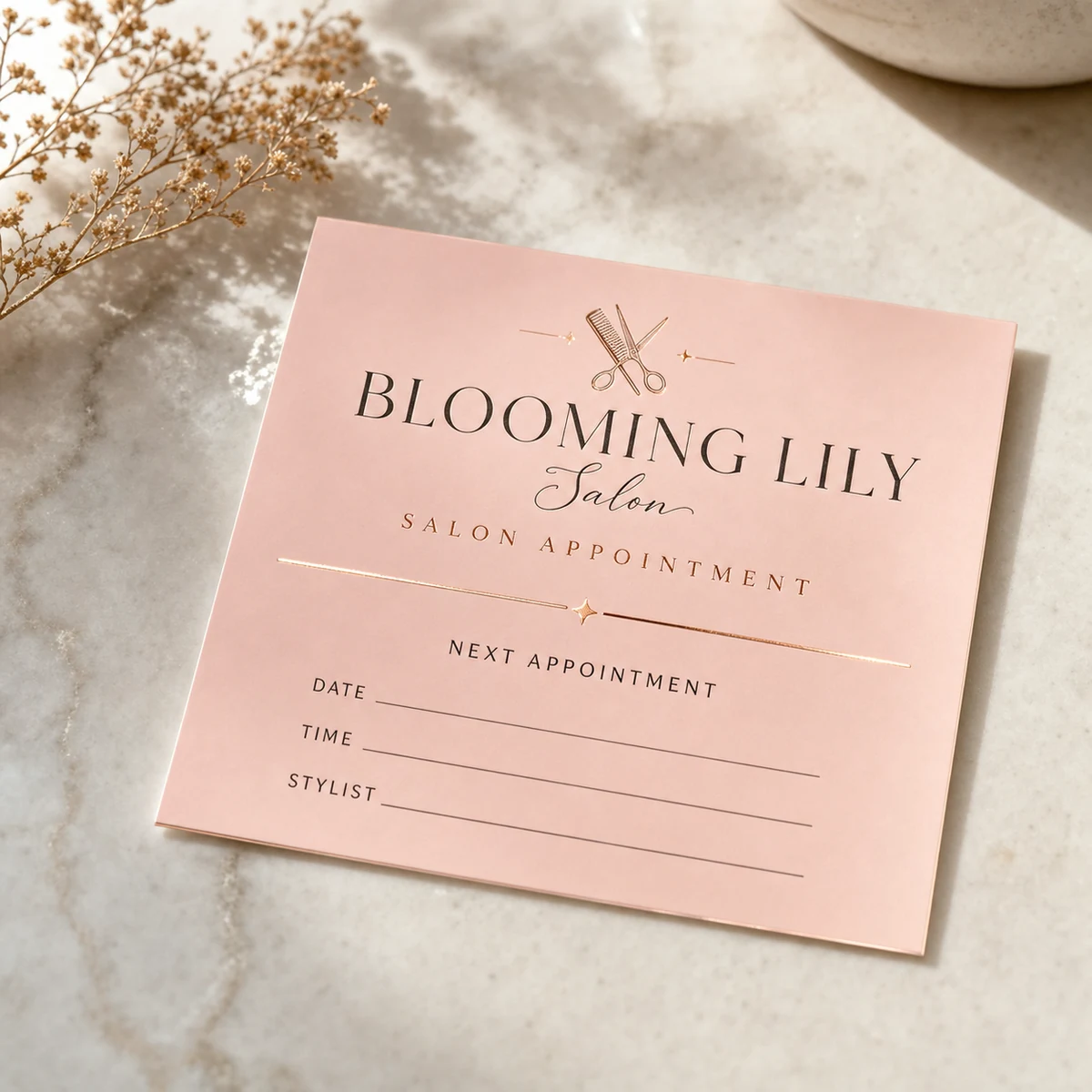
The most effective operational use of a salon business card is also the simplest: using the back of the card as a pre-booked appointment reminder. A client who leaves with their next visit already written on the card in hand is significantly more likely to keep that appointment than one who leaves with a verbal booking only.
The design approach is straightforward. Front: branding, name, Instagram, booking link. Back: a pre-printed line reading “Your next appointment:” followed by a blank space (approximately 60-70 mm of line length) where the stylist writes the date and time by hand after the service. Some salons add a faint secondary line for the service type. Others keep it to one line and generous white space.
A rebooking card only earns its keep if the writing side accepts pen ink cleanly. Gloss or laminate tends to resist pen, so keep the face that records the next visit uncoated. Order uncoated 300 GSM Matte, Linen or Cotton appointment cards with no laminate, and the front desk can write the next booking without smudging. Avoid gloss lamination on the back face wherever a pen will touch the stock. Salons using Fresha, Timely or Booker can also add a QR code that links straight to the salon’s booking page, so clients self-manage the appointment through the app, a hybrid that suits pen and paper and digital-first clients alike. Before the artwork is set, work through which details to print and which lines to leave blank in an appointment card layout guide.
Referral card variants
A referral card is a separate design variant from your main business card, printed specifically to drive word-of-mouth. Where a standard business card says “here is how to contact me,” a referral card says “here is a reason to tell your friends about me.”
Common referral card formats for salons:
- Discount referral: “Give this card to a friend and they receive $20 off their first visit” – the card itself becomes the offer carrier
- Mutual benefit: “Refer a friend who books – you both receive 10% off your next service” – drives both the initial referral and a return visit from the referrer
- Unique code per batch: A pre-printed referral code that tracks where new clients came from – useful for multi-stylist salons managing referral attribution
Referral cards can use the same front design as your standard card with a back-face change, minimising design cost. Consider running them on a coloured stock that is visually distinct from your standard card – clients who receive one immediately register it as an offer, not just a contact card. At quantity tiers of 50-100, referral cards are an accessible addition to any standard card order.
A stamp card rewards a client for returning, so it works differently from rebooking and referral cards. Each visit earns a stamp or a tick at the counter, and the face must stay unlaminated for the ink to mark it cleanly. Printed loyalty cards on 300 GSM Matte, Linen or Cotton with no laminate give that writable surface and keep the reward grid legible visit after visit. Before ordering, set the stamp box size, reward wording and conditions line in a loyalty stamp card design guide.
File Preparation, Production Specs and Lead Times
Sending a correctly prepared file avoids delays, prevents colour surprises, and ensures your card prints exactly as designed. Here are the key specifications for Australian business card printing in 2026.
File format and resolution
- Supply files as high-resolution PDF, AI (Adobe Illustrator), or PSD (Photoshop) where possible
- Minimum resolution for photography: 300 DPI at print size – not screen resolution (72 DPI)
- Vector logos and wordmarks are strongly preferred over rasterised versions – they scale cleanly to any size without pixelation
- Fonts should be outlined (converted to shapes) before export to avoid font substitution during processing
Dimensions and bleed
- Standard AU card: 84 x 55 mm finished size
- Add 3 mm bleed on all four sides: set up your artboard at 90 x 61 mm
- Keep all critical content – text, logos, key design elements – at least 3 mm inside the finished edge (the safe zone)
- Centre-aligned designs tolerate printing tolerances better than elements placed very close to card edges
Colour mode and foil artwork
- All files must be supplied in CMYK colour mode, not RGB. RGB files converted at print shift in colour, typically producing less saturated results than expected
- For foil cards, supply a separate spot colour layer or overlay indicating exactly which areas receive the foil treatment. Your printer will specify their preferred method on the product order page
- White ink requires a separate layer on dark stocks – the white layer acts as a base for any CMYK colours printed on top
MOQ and production lead times
- Standard business cards: 24-hour production available on most standard stocks
- Coloured paper business cards: 24-hour production available
- Flat foil business cards: 24-hour production on selected stocks
- Raised foil, Spot UV, Scodix, Duplex: Longer production timelines – allow 3-5 business days for production plus express Startrack delivery (1-2 business days for metro)
For events like Hair Expo Australia, AHFA awards nights, or a salon opening, order at least 10 business days before the date to allow production and delivery with a comfortable safety margin. Delivery is not included in the card price: standard delivery is $10 per order and express delivery is $15 per order, Australia-wide.
Standard business cards from $0.08/card (inc GST)
350gsm premium stock, full-colour double-sided print, 24-hour production available. Delivery is not included in the card price: standard delivery is $10 per order and express delivery is $15 per order, Australia-wide.
How Much Do Hair Salon Business Cards Cost in Australia?
Business card pricing scales with paper stock, finish type, and quantity. Higher quantities reduce per-card cost significantly. The table below shows from-pricing for each finish category at Paperlust Print Shop (all prices inc GST). For exact pricing at your preferred quantity, check the individual product pages – the calculator updates live as you adjust quantity.
| Card Type | From (per card, inc GST) | 24hr Production | Best Salon Use Case |
|---|---|---|---|
| Standard Business Cards | $0.08/card | Yes | All-rounder, high-volume runs, rebooking card variants |
| Coloured Paper Business Cards | $0.43/card | Yes | Boutique cream, kraft, or black aesthetic |
| Spot UV Business Cards | $0.14/card | No | Selective gloss on logo or photo, volume runs |
| Scodix Business Cards | $0.20/card | No | Raised tactile gloss on logo or icon element |
| Raised Foil Business Cards | $0.24/card | No | Luxury multi-chair salons, hair educators |
| Flat Foil Business Cards | $0.18/card | Yes (selected stocks) | Signature foil on salon name or logo |
| Duplex Business Cards | $0.45/card | No | Ultra-premium weight for high-end salon launches |
How to think about quantity: Most stylists operating chair-side benefit from 100-250 cards per order cycle. A 250-card run of standard cards represents a very low investment for approximately 6-12 months of chair-side use at typical handout rates. Salons with multiple stylists typically order 250-500 per stylist per cycle. For a boutique salon with a strong brand, 100 flat foil cards at $159 or 250 at $199 ($0.80 a card) is a small outlay beside the value of one high-value colour appointment. It is the handover moment that keeps the salon in the client’s wallet.
For a broader overview of finish selection by budget, see how to choose the right business cards. The 2026 business card design trends guide covers the broader market direction if you are planning a rebrand alongside a new card order.
Common Mistakes on Hair Salon Business Cards
After seeing salon cards at every tier of the AU market, the same design and production mistakes appear repeatedly. Each one costs something – either a client impression, a missed rebooking, or wasted print spend.
Too-busy back panel
The back of a business card is prime visual real estate and many designers fill it entirely out of anxiety about leaving space empty. A back panel with five design elements, a pattern background, three social media icons, a tagline, and a QR code is exhausting to look at. Choose one or two back elements: either the rebooking line (clean and functional) or a single strong visual (salon photo, botanical element, abstract graphic). White space is not wasted space – it is breathing room that makes everything else more legible.
Dated taglines
Taglines like “Where beauty begins” or “Your hair is our passion” read as generic at best. If a tagline does not say something specific about your salon or approach, leave it out. Your Instagram handle and a strong photograph communicate more about your brand than a generic phrase ever will.
Instagram handle in illegible type
This is the most expensive invisible mistake in salon cards. An Instagram handle in 6pt type tucked at the bottom of a card is functionally useless. If Instagram is your primary lead source – and for most AU stylists under 40 it is – put the handle in body-copy-sized type, clearly labelled, at minimum 9-10pt in high-contrast colour. Some stylists run the handle as a secondary visual hierarchy element immediately below their name, which is an even stronger signal of how central it is to their booking funnel.
Low-resolution salon photography
A salon photo printed from a screen-resolution image (72 DPI) looks pixelated and amateurish – the opposite of what the photo is meant to achieve. If you are including photography on the back of the card, supply it at 300 DPI minimum at print dimensions. If your existing photography does not meet this standard, use a typographic or illustrated design instead rather than print a blurry photo that undermines the whole card.
Missing booking platform URL
Many stylists still print cards with only a phone number and email. In 2026, a significant percentage of new clients – particularly those finding you through Instagram – want to book online without a phone call. A Fresha, Timely, or Booksy booking link, or a QR code that opens your booking page directly, removes a friction point that costs real appointments. Every client who wants to book but has to play phone tag is a potential lost rebooking.
Ordering 1,000 cards before testing the design
Printing 1,000 cards of a first design is a common and expensive mistake. Salon brands evolve quickly – a rebrand, a move to a new booking platform, a name change, a new specialisation – can make a large card order obsolete. Start with 100-250 cards per design cycle. If you are uncertain about finish or paper choice before your first order, a business card sample pack lets you assess physical quality before committing to a full run. See also our business card mistakes to avoid guide for the full list of common errors across industries.
Frequently Asked Questions
What paper stock feels most boutique without going over the top?
A cream or warm-white coloured paper stock (270-350gsm) paired with a flat gold or rose-gold foil treatment on the salon name is the most popular boutique combination in the AU salon market. The uncoated surface reads as considered and hand-finished rather than mass-produced. You do not need to reach duplex or raised foil territory to achieve a premium result – the right paper base does most of the work.
Can I print my Instagram handle in foil?
Yes. Flat foil can be applied to any element of the design, including text elements like an Instagram handle or name. This works particularly well when the handle is the primary booking driver. Note that very small foil text (below approximately 8-10pt) can lose fine detail with some foil applications – your printer can advise on minimum recommended sizes for your chosen finish and typeface.
What is the minimum order quantity if I am just starting out?
Minimum order quantities vary by product type and paper stock – check the specific product page for current minimums, as they vary between card ranges. As a general principle, starting with a smaller quantity (50-100 cards) while you refine your design and verify all contact details is a sensible approach for any new stylist or salon launch. It is far better to reorder than to be stuck with 500 cards that need to be reprinted after a booking URL changes.
Will a salon photo on the back of my cards look good on matte paper?
Matte paper reproduces photography cleanly but with slightly less colour vibrancy and sharpness than a coated gloss surface. For salon photography with rich colour – balayage results, vivid fashion colour – a smooth coated 350gsm stock will show the image more vividly. Matte is better suited to lifestyle or ambient interior shots where warmth and depth matter more than colour punch. Whichever stock you choose, supply the image at 300 DPI minimum at the intended print dimensions.
Do you offer business cards on black paper with white ink?
Yes. Coloured paper business cards are available on dark stocks including black, with white ink printing available for high-contrast designs. This combination is popular for barbershops, luxury hair studios, and dark-aesthetic salon brands. You can also combine flat foil (gold, copper, or silver) on black coloured stock for a dramatic, high-contrast result that photographs well for brand social content.
Can I include my Fresha or Timely booking URL on my cards?
Absolutely, and it is strongly recommended. A direct booking URL or QR code removes a significant friction point for new clients who find you through Instagram or a referral. You can include the full URL in body-copy-sized type, or generate a custom short URL or QR code that opens your booking page directly. QR codes are particularly effective on the back of the card where there is space for a slightly larger element.
What is the lead time for foil business cards in Australia?
Flat foil business cards are available with 24-hour production on selected paper stocks, making them one of the faster premium options. Raised foil business cards have a longer timeline – allow 3-5 business days for production, plus express Startrack delivery (1-2 business days for metro) within Australia. For events or salon launches with a hard deadline, order with at least 10 business days to spare.
How many cards should I order for my first salon launch?
For a first launch, 200-300 standard or foil cards per stylist is a practical starting quantity. This covers the launch period and initial client handouts without committing to a large run before you know how quickly cards move through the salon. If you are also planning referral cards, a ratio of approximately 100-150 referral cards per 250 standard cards is workable for most boutique salons.
What size are standard Australian business cards?
The standard Australian business card size is 84 x 55 mm. This is the size that fits wallet card slots, standard desktop card holders, and most business-card albums. It is the default size across Paperlust Print Shop products unless an alternative size is requested. Square and slim card formats are available for boutique applications but fall outside the universal standard size.
Can I include both a QR code and a booking URL on the same card?
Yes, and the two can complement each other well on a double-sided card. A QR code on the back can link to a booking page, Instagram profile, or a link-in-bio aggregator. It serves clients who prefer to scan rather than type a URL. If you include both, ensure they link to the same destination – inconsistency between the two creates confusion and erodes the professional impression you are trying to build.
What is the difference between flat foil and raised foil on business cards?
Flat foil sits flush on the card surface – it is mirror-bright and visually striking but has no dimensional height. Raised foil adds a UV substrate layer beneath the metallic film, so the foil element sits above the surface and is tactile as well as visual. For most hair salons, flat foil provides the right premium signal at a more accessible price point and faster turnaround. Raised foil is the top tier – reserved for luxury multi-chair salons or educators who want maximum tactile impact on a card that gets passed around a conference floor.
I am a mobile stylist with no fixed address – what do I put on my business cards?
Replace the address field with your service area. For example: “Mobile | Sydney’s Inner West” or “Servicing Brisbane Inner City and Surrounds.” Add your booking platform URL prominently (Fresha, Timely, or Booksy), your phone number, and your Instagram handle. If you operate as a sole trader, you may optionally include your ABN to build trust with new clients who have not met you through a salon context. Do not leave the address field blank – replace it with something purposeful that tells clients exactly how to access you.
Browse the full range of custom business cards for hair professionals
Standard, flat foil, raised foil, spot UV, Scodix, duplex, and coloured paper business cards. Fast turnaround, delivered Australia-wide.