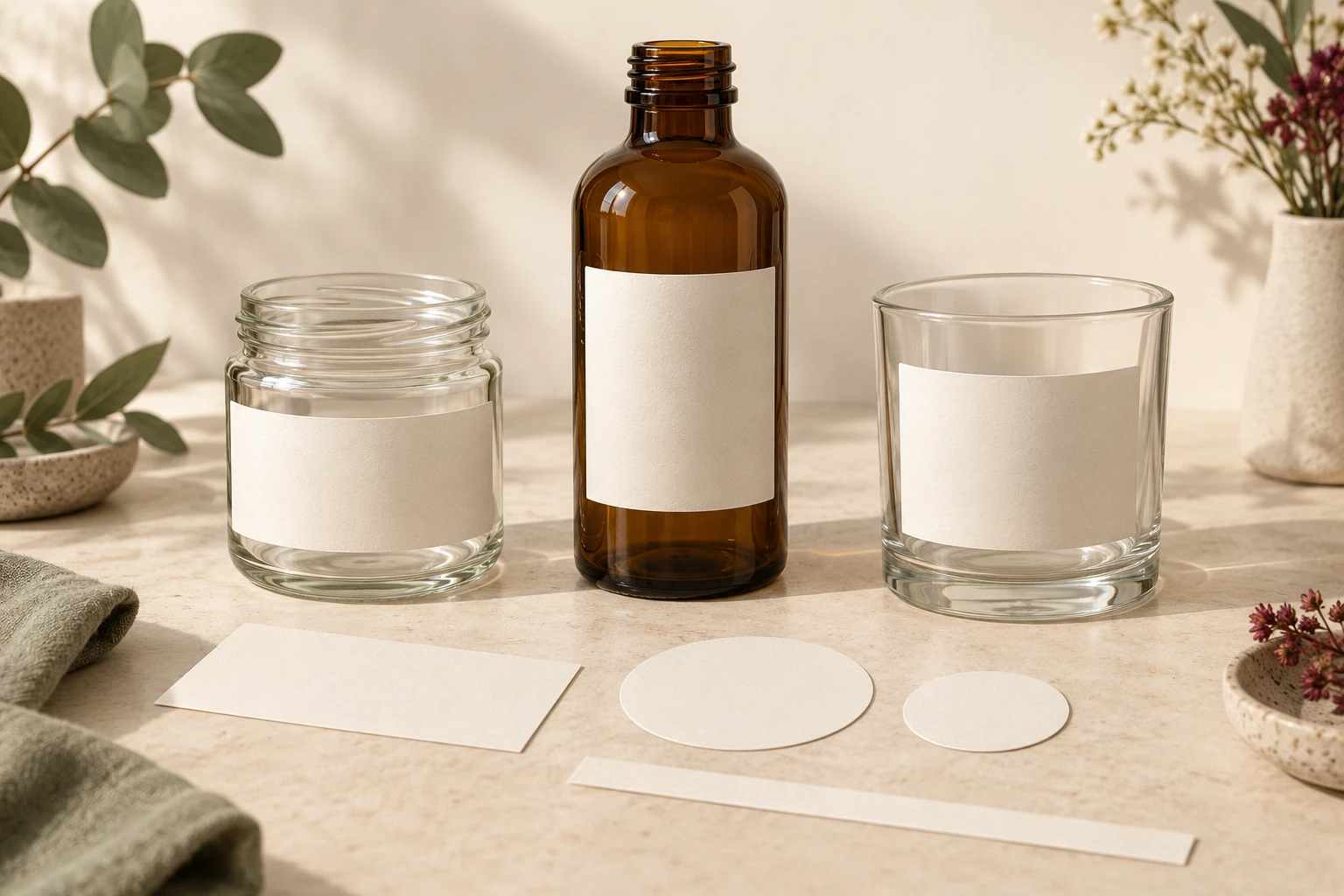
The label file that looked crisp on the screen lifts the moment it crosses a jar shoulder. Before you order, you need to size a label for a bottle or jar from the container itself, not from the catalogue description. The two numbers that matter are the flat label height and the working width. Most fit failures come from guessing one of them.
Measure the container, not the catalogue
A 250ml jar from one glass supplier is not the same label panel as a 250ml jar from another. Fill weight and capacity describe the volume, not the printable surface. Measure the containers you will actually run, including the current batch, before you select a shape or start artwork.
Find the flat label height
Stand the container on a level surface and locate the straight labelled zone. The shoulder is where the body begins to curve into the neck or lid thread, and the base radius is where it curves into the floor.
- Hold a ruler vertically along the side.
- Measure from the lower edge of the shoulder curve to the upper edge of the base radius.
- Choose a top and bottom clearance that keeps the label off both curves. There is no universal margin; larger jars may tolerate more, shallow panels may need less.
Take the circumference and choose your gap
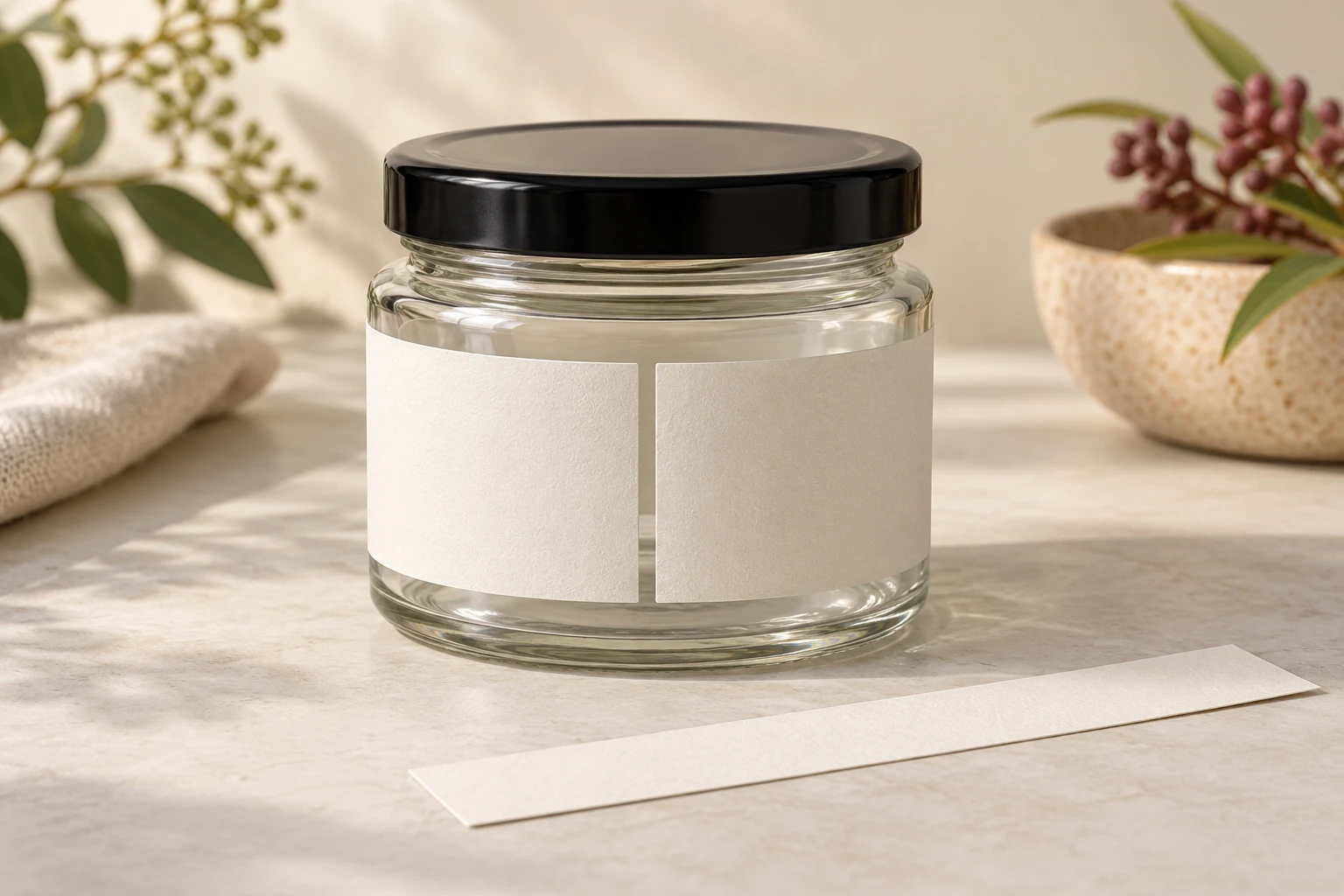
Wrap a soft tape measure or paper strip around the widest part of the straight zone and note the full circumference. For a full wrap, subtract the gap you actually want at the seam. The gap lets the label clear the seam or sit without overlapping. You choose this clearance based on the container, not a fixed rule.
Run a paper fit test before you commit
Cut a paper strip to your proposed finished height and wrap it around the container where the label would sit. If the strip lies flat and the ends meet at your chosen gap, the measurement is a workable starting point. If it creases at a shoulder, base curve, rib or taper, reduce the height or talk to the team about a custom shape.
Check your ruler with a 100mm calibration line
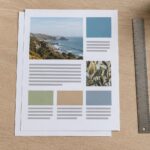
A printed ruler is only useful if the printer does not rescale it. Use the calibration line in the blank measurement worksheet the same way every time.
- Set the print menu to actual size or 100%.
- Turn off fit-to-page and any similar scaling option.
- Print the page and place a physical ruler against the 100mm line.
- Use the printed ruler only if the line matches exactly. If it does not, reprint with scaling disabled.
Turn the measurements into a wrap width
Here is a hypothetical example to make the arithmetic clear. Suppose a straight-sided jar measures 200mm around the circumference and you choose an 8mm seam gap. The working wrap width is 200mm minus 8mm, which is 192mm. Use that method for your own numbers. It is not a product size suggestion or a promise that 192mm suits your jar.
| Container surface | Measured circumference | Chosen seam gap | Working wrap width | Flat label height |
|---|---|---|---|---|
| Hypothetical straight-sided jar | 200mm | 8mm | 192mm | Your own measured height |
Use the blank measurement worksheet to record additional containers without mixing up the numbers.
If you want a front label rather than a wrap, measure the flat front panel instead of the full circumference. An overlap is a different brief; if you want the label ends to overlap, confirm that separately before ordering.
Size it container by container
The same measuring method adapts to jars, honey and jam, candles, and wine bottles. The difference is which faces you label.
Jar labels
A jar often uses a round lid label and a body label. The lid round is measured across its flat recess or panel, while the body label is sized from the height and either the front face or the circumference. For a straight-sided body, a rectangle label option is a common starting point, but only if the measured panel suits it. The jar labels range supplies these shapes as roll labels, so you still need one measurement set for each label face.
Honey and jam labels
Honey and jam jars often carry a front label, a lid label and a back or care label. That is three design records and possibly three sizes. A wrap label uses the circumference method, while a front label uses the flat panel width. Honey and jam labels are ordered as one roll of 500 for each design and each size, and separate designs or sizes do not combine into one quantity. When the faces start to multiply, use the honey and jam jar label layouts planning reference before artwork begins.
Candle labels
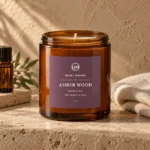
Candle vessels can look simple because many are straight-sided amber glass or metal tins. Measure the full flat body height and either the front panel or the circumference, then check the lid panel separately. Straight sides give you room, but they do not remove the need to paper-fit the specific vessel. The candle label product range follows the same 500 label roll minimum and 48 hour production sequence after proof approval. For vessel heat suitability during actual use, confirm the finished container and candle system details with your supplier. Printing approval is not a safety or performance certification.
Wine and bottle labels
Wine packaging usually works as a front label and a back label, not as a full wrap. Measure the front panel that faces the shelf and keep that as the width. A full wrap is a separate decision and needs the full circumference measured properly. Wine bottle labels can be paired across the front and back once you know both measured panels.
Match the stock to the surface
Stock choice is a use question, not only a visual one.
- White Cast Paper with Matte Laminate or Gloss Laminate: dry indoor packaging on shelves and market tables.
- White Synthetic with Matte Laminate or Gloss Laminate: the wet-use stock for moisture, condensation and handling. Test it on the actual container rather than treating it as a universal guarantee.
- Clear Synthetic with Gloss Varnish: a transparent film for the no-label look on glass and coloured containers. White ink underprinting is available, and white ink can also form white printed areas. An underprint may sit beneath coloured areas to keep them opaque on clear film.
For the no-label look, work from the clear labels product page. Keep in mind that clear roll stock is not automatically removable, and the standard roll-label range does not have a selectable removable adhesive option. If the container must return, refill or be relabelled, confirm a specialist removal or application requirement with the team before you finalise the order.
Application starts with a clean, dry surface
The surface should be clean and dry before application. Apply dry and follow the material supplier’s dwell guidance before exposing the label to moisture or handling. If you use a cleaner, test it on a discreet area first. Do not apply to a wet or soapy surface. Coated glass and some plastics respond differently, so a simple home check on the real surface is useful before a full run.
Artwork, quantity and proof checks
The order path for roll labels is shape, size, stock, finish, number of designs and quantity, followed by artwork upload and an emailed proof. The Honey and Jam page advises 3mm bleed in its artwork guidance, but that page does not include a downloadable template. Where a product has a template, use its file settings for bleed, trim and safe area. Circle Labels, Die Cut Stickers and Sticker Sheets have PDF, SVG and Canva PNG guides available. Keep document size, finished trim, bleed and safe area separate in your note set.
The digital proof is for checking layout, text and the declared dimensions. It does not prove physical colour, adhesion or stock performance on your container. Production takes 48 hours after you approve the proof, and delivery is separate from production.
The standard roll-label minimum is one roll of 500 labels, counted separately for each design and each size. If you run 500 jars with a front, lid and back label, you are ordering three designs of 500 labels each, which is 1,500 labels in total. The number of containers is not the same as the number of labels. Honey and jam labels in this range allow up to five designs on one order, each design on its own roll. Different sizes, stocks and finishes do not share one configuration in the planner. Set each variation as a separate configuration or ask the team to confirm the mixed brief.
For shared artwork, record each variant with its own identifier, filename, shape, finished width by height in millimetres, material, finish, quantity, version and proof status. If each label must vary one by one, ask the team before setting up the artwork; the standard roll workflow is not an automatic variable-data or serialisation service.
Test the real surface before a bulk roll
A paper fit test checks the geometry, but it does not test adhesion on coated glass, condensation or handling. For that, run a small sample on the actual container and keep notes. The same record-keeping works for any sample check; our guide to testing sticker samples before a bulk order sets out a process you can adapt. A small sample run answers application questions, but it does not replace checking the real roll stock on the real container.
For regulated product wording, confirm the current requirements for your product type before final artwork. Printing approval is not regulatory approval.
Frequently asked questions
How do I calculate the maximum label width for a round bottle?
Measure the full circumference around the straight label zone with a soft tape or paper strip. Subtract the seam gap you choose. If the circumference is 200mm and you choose an 8mm gap, the working wrap width is 192mm.
Should I use the jar capacity to choose a label size?
No. Millilitres and grams describe volume or weight, not the printable panel. Two containers with the same capacity can have different flat label heights and circumferences, so measure the actual container.
Can I put a wrap label on a tapered jar?
Tapered, ribbed and heavily shouldered surfaces are not a simple cylinder measurement. Run a paper strip around the proposed label zone first. If the strip creases or pulls away, you may need a reduced height, a different shape or custom advice before ordering.
What stock should I choose for a jar that goes in the fridge?
White Synthetic with Matte Laminate or Gloss Laminate is the wet-use stock for moisture, condensation and handling. Test it on the actual container and surface before committing the full run, because a home check is not a certification.
What happens after I upload artwork?
You receive an emailed proof. The proof checks layout, text and declared dimensions. Production takes 48 hours after proof approval, separate from delivery.
How many labels do I need for front, lid and back labels?
Count each design and each size separately. A run of 500 jars with a front, lid and back label is 1,500 labels across three designs, because every design and size sits on its own 500 label roll.
Every label in the roll carries the same dimension. Measure before artwork, because the proof will not catch a size that was wrong from the start.