A label that looks right on a dry bottle can fail at the edge, not the face. The bottle leaves a coolroom, condensation forms, and the label is working against the bottle before the product reaches the bench. Waterproof labels for bottles are not one material decision. They are a stock choice shaped by how cold and wet the bottle actually gets.
Start with the bottle’s worst hour, not the word waterproof
Buyers often ask for waterproof when the bottle only has to handle condensation or a few hours in an ice bucket. Those are different jobs. A bottle sweating in a fridge has moisture sitting on the label surface. A bottle packed in ice has water around the label and pressure from the container. The right stock depends on which job is on the table.
For the roll-label range, White Cast Paper with Matte Laminate or Gloss Laminate is the dry indoor packaging stock. It is not the recommended choice for a bottle that needs to survive cold condensation, extended chilling or wet service. A synthetic stock is the safer direction for wet conditions.
| Stock or product | Minimum | Where it fits |
|---|---|---|
| White Synthetic roll labels | 500 per roll per design and size | Cold, wet or condensation-heavy bottle labels |
| Clear Synthetic roll labels | 500 per roll per design and size | Transparent no-label look; test on your bottle exposure |
| Vinyl Stickers | 10 per design | Small artwork and placement trials; no laminate option |
| White Cast Paper roll labels | 500 per roll per design and size | Dry indoor packaging only |
White synthetic roll labels for cold, wet bottles
For a bottle that faces condensation, cold storage or chilled service, start with the Waterproof Vinyl Labels stock. The face material is synthetic polypropylene film, paired with a permanent acrylic adhesive. The finish options are Matte Laminate or Gloss Laminate. Matte gives a flat surface. Gloss adds sheen. Both sit on the same white synthetic base.
The product page lists a service temperature range of -20°C to 80°C for the material. That describes the material in use, not a target application temperature. Apply to a dry, clean container in a production setting that suits the adhesive and follow the supplier’s application instructions. If you need the label to be removable later, treat that as a specialist requirement to confirm before ordering. The standard roll product does not list a selectable removable adhesive.
The store name mentions vinyl, but the white roll face stock is polypropylene film. It is not the same material as the Vinyl Stickers range.
The same white synthetic stock is set up on two bottle pages with common sizes ready to choose. The Wine and Bottle Labels page lists a 750ml bottle front at around 70mm W x 120mm H or 100mm W x 150mm H. The Beer and Spirits Labels page sets a slim 330ml bottle face at 50mm W x 100mm H, with cap and neck seals set as small circles.
Clear labels are transparency, not an immersion pass
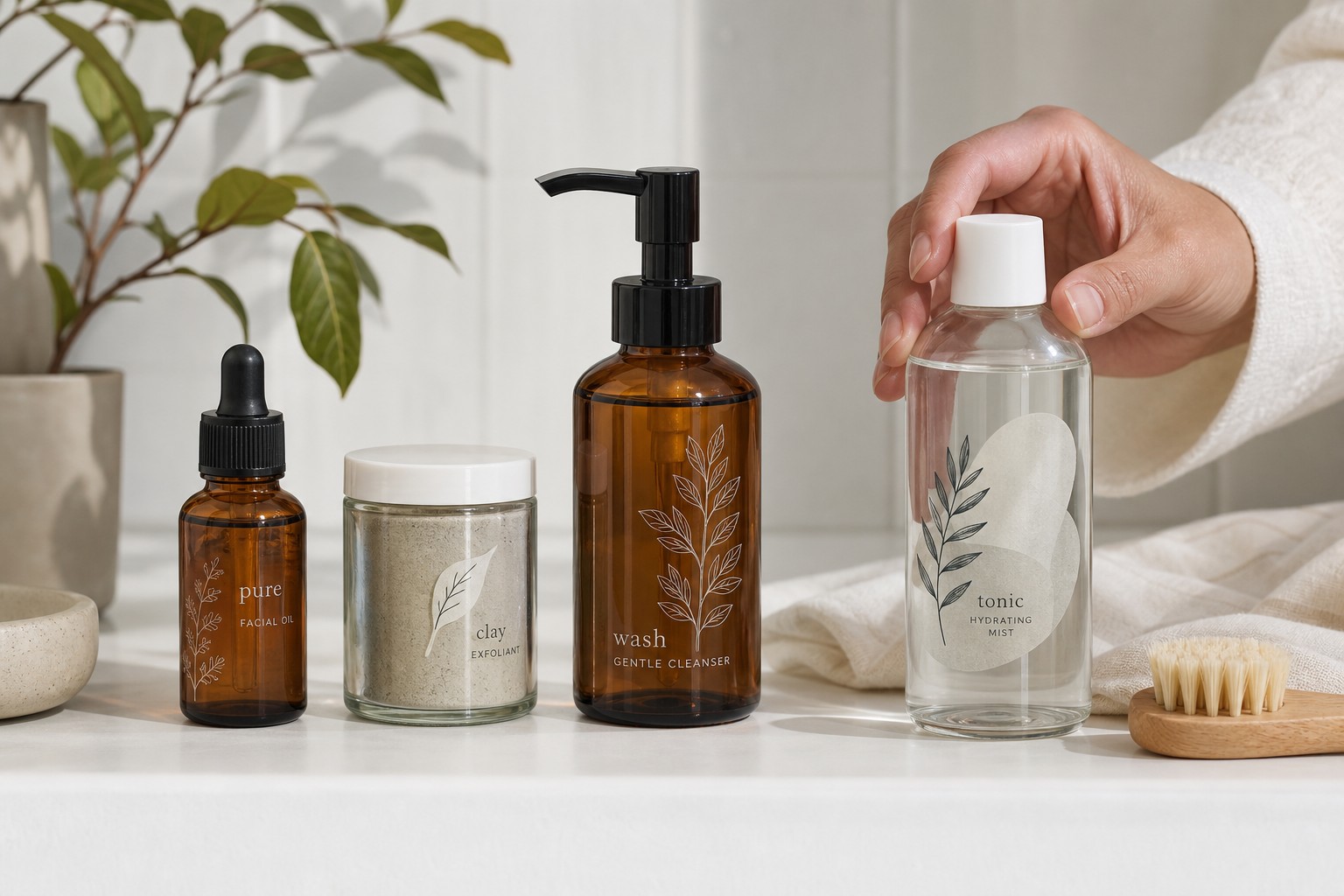
For a no-label look, the roll choice is Clear Labels on Clear Synthetic with Gloss Varnish. White ink can be used for white text and white design areas, and a white underprint can sit behind coloured areas when the design needs extra opacity against the bottle. There is no frosted or matte clear stock in the standard range.
A clear label shows the bottle surface behind it, but that does not prove how the label will behave in an ice bucket or on a wet service rail. Coated glass, plastic surface energy and condensation patterns all change performance. Test the clear label on the actual bottle in the actual condition before you order a full roll.
Vinyl stickers are a separate contour-cut format
A small sticker run is useful for artwork, shape and placement, but it is not a mini version of a roll label. Vinyl Stickers start at 10 per design and are contour cut to the outline of your artwork. They do not have a laminate option in this range. The material is different from the white synthetic roll stock. Use a small sticker order to check how a design looks, not to prove how a 500-label roll will adhere under cold, wet conditions.
Run a sample log, not a guess
Before a full roll, run a sample on the actual container. Apply the sample to a clean, dry bottle and let it rest for the dwell period recommended for that material and adhesive. Keep a matched unexposed control sample on the same type of container, prepared the same way and left dry for the same time. Then place the test bottle into the real storage or service condition you expect. Check both samples at the same intervals and record the time, condition and any change.
The sample pack is a preprinted, fixed assortment. It helps you compare available materials and finishes side by side, but it does not carry your own artwork, and it does not guarantee that a specific new finish is in the pack. If a sample is not clearly identified, write down what you believe it is and confirm with the team before drawing a conclusion. Use this sample testing guide as your bench reference.
Size the bottle before the label
Container capacity in millilitres does not tell you the panel size. Measure the actual bottle. For a straight cylindrical section, wrap a soft tape or paper strip around the bottle to get the circumference, then subtract the seam gap you want to produce the wrap width. There is no universal seam gap or top margin. A tapered shoulder, ribbed body or raised base needs a paper fit test on the curved panel before you commit to a file. For the full sequence and curved-panel method, see the bottle and jar label sizing guide.
Count faces as designs, not total labels
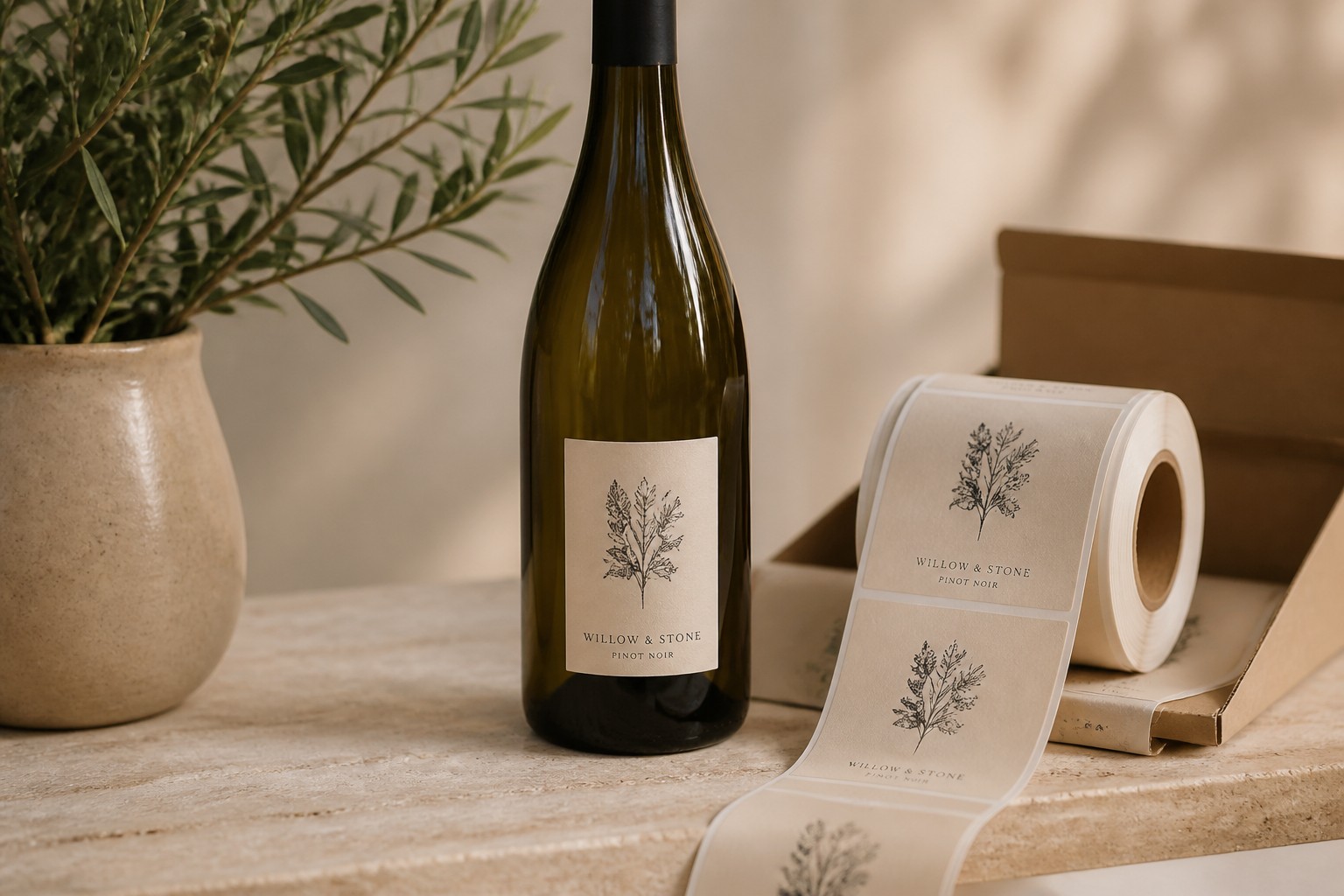
Each roll-label design and each size has a 500-label minimum. A total across flavours or faces does not combine into one configuration. A 500-bottle run with a front and a back label is two designs, so plan two 500-label rolls. If the same run uses three faces at 500 labels each, that is three rolls and 1500 labels in total, and each design is actually at its minimum.
If your brief mixes sizes, stocks or finishes, handle each different configuration separately or confirm with the team before uploading. Price only the configurations you are actually selecting on the product page, or ask for a quote on a mixed brief.
For each variant, keep an identifier, filename, shape, finished width by height in millimetres, material, finish, quantity, version and proof status. Store the approved file and quote reference together. If every label must carry a different code, ask the team before you upload. The standard roll workflow does not create automatic variable data.
Proof checks layout, not physical performance
Ordering a roll label follows a sequence: choose shape, size, stock, finish, number of designs and quantity, then upload artwork. You receive an emailed proof, and nothing prints until you approve it. Standard roll-label production takes 48 hours after proof approval. Delivery is a separate step.
The digital proof checks layout, text and the declared dimensions. It does not check physical colour, adhesion, stock behaviour or how the printed label behaves on your bottle. Use the artwork instructions shown on the chosen product page, and do not assume every product page has the same template or file setup. A material sample, a digital proof and a printed run each answer a different question.
Proof approval is not a substitute for your sample test.
Check the surface, not just the stock
A label performs differently on a wet surface than a dry one. Condensation after the label is applied is different from moisture trapped under it during application. Start with a dry, clean container. For coated glass and some plastics, adhesion can shift. If you plan to clean the container before labelling, test the cleaner on a small, out-of-the-way area first. There is no single alcohol-cleaning instruction that suits every bottle. The label materials and adhesives guide covers those surface questions in more detail.
Frequently asked questions
Should I use a clear label for a bottle that sits in an ice bucket?
Clear Synthetic with Gloss Varnish gives a transparent no-label look, but clarity is not immersion certification. If the bottle will spend time in an ice bucket or wet service rail, test the clear label on the actual bottle. The white synthetic roll stock is the working choice for cold or wet exposure.
Can I use vinyl stickers to test a waterproof roll label?
No. Vinyl stickers are a different contour-cut material and there is no laminate choice on that sticker product. They are useful for checking artwork, shape and placement, but they are not a substitute for testing the actual roll stock and adhesive on your container.
What is the difference between condensation and application moisture?
Condensation forms on the outside of a cold label after it is applied. Application moisture is water trapped between the label and the container before the adhesive can seat. Always apply to a dry, clean container and allow the recommended dwell before wet or cold exposure.
How many labels do I need for a 500-bottle run with a front and back label?
That is two designs, so the minimum is 500 front labels and 500 back labels, or 1000 labels in total. Each design and each size carries its own 500-label roll minimum. A total across faces does not reduce that.
Is there a removable adhesive option on white synthetic roll labels?
The standard roll-label range has no selectable removable adhesive. Permanent adhesive is the default assumption. If the label must come away cleanly much later, treat that as a specialist requirement and ask the team before ordering.
Does proof approval mean the label will survive my bottle conditions?
No. The proof checks layout, text and declared dimensions. It does not check physical colour, adhesion, stock behaviour or how the label performs on your bottle. You still need to test the actual bottle before committing to the run.