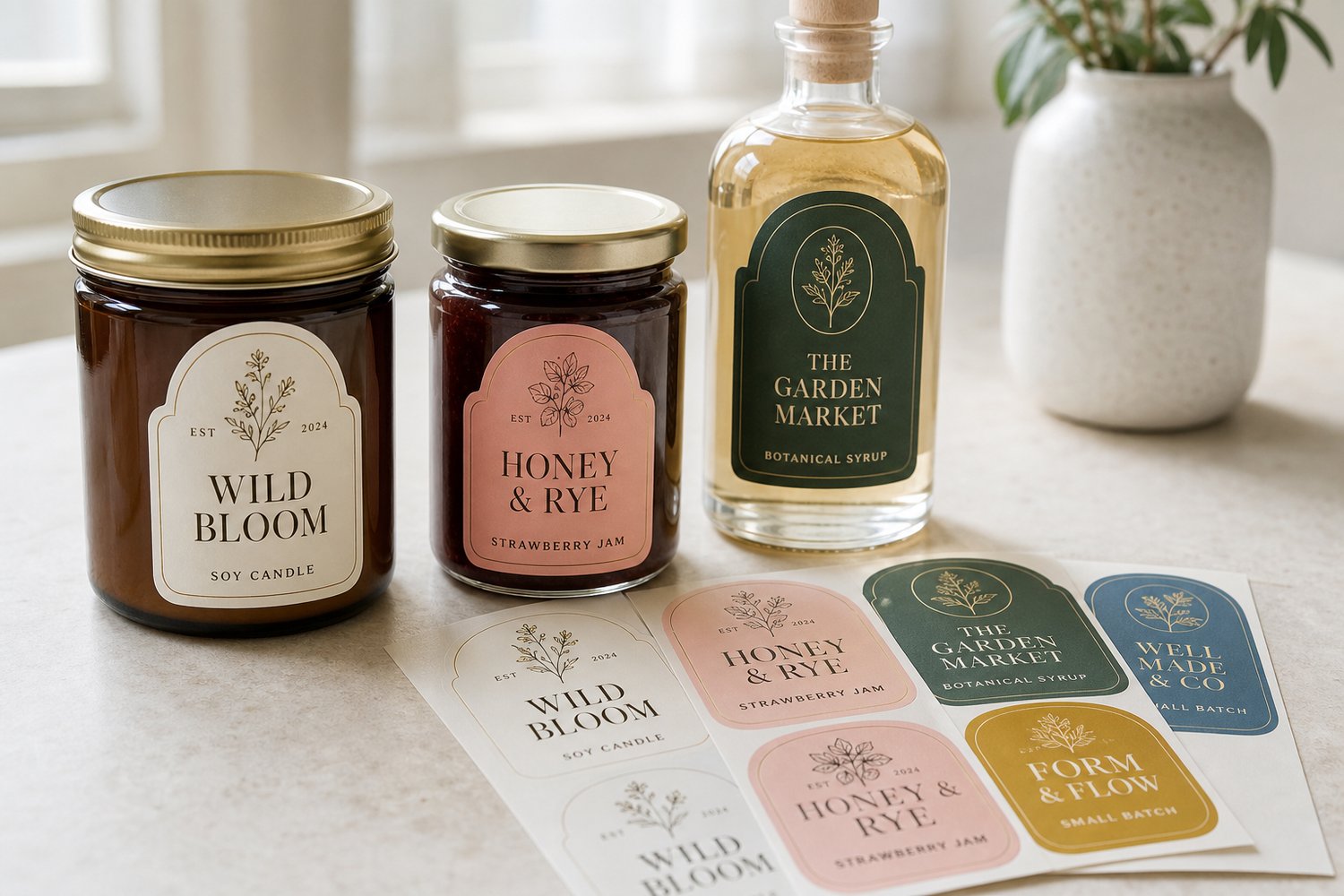
Most Australian product businesses hit the label decision the same way. The jars are on the bench, the launch date is set, and someone asks what size the front panel should be. The answer is not on the jar’s capacity sticker. It is on the surface you are actually labelling. This guide to custom product label printing in Australia walks through the decisions that affect a roll label order: stock, finish, shape, sizing, quantity and artwork.
Start with the surface, not the product name
Measure the flat or straight zone on your actual container before you choose a size. A 500ml jar and a 250ml jar can share the same front panel, or one can sit on a completely different panel. Millilitres and grams tell you capacity, not label dimensions. For a cylindrical container with a straight zone, wrap a soft tape or paper strip around it and read the circumference. If you want a visible gap at the seam, subtract your chosen gap from that measurement to get the wrap width. There is no universal gap or top margin. If the surface is tapered, ribbed or shouldered, do a paper fit test in the flat before you order, because a straight label on a curved shoulder will lift at the edges. A custom shape may be the cleaner answer.
If you are measuring from a printed ruler, check it against a physical ruler first. The bottle and jar label sizing guide covers curved and seamed containers in more detail.
Roll-label stock, finish and application
Standard roll labels are supplied on rolls of 500, one-up, in the shape and size you select. There are three stock routes in the standard range.
- White Cast Paper with Matte Laminate or Gloss Laminate: for dry indoor packaging.
- White Synthetic with Matte Laminate or Gloss Laminate: the waterproof stock for moisture, condensation and handling.
- Clear Synthetic with Gloss Varnish: transparent film, with white ink underprinting available.
Clear synthetic is not clear PVC vinyl, and the standard clear roll stock has no matte or frosted option. For a no-label look on glass, clear labels let the product or packaging show through. White ink itself forms white printed areas; the underprint may sit beneath coloured areas where opacity matters.
The white synthetic stock is the wet-use route. The waterproof vinyl labels range is supplied on rolls and covers the waterproof roll details. For more on how stock and adhesive behave, see the label materials and adhesives guide.
Apply to a clean, dry container, and allow the supplier’s recommended dwell time before exposing the label to moisture or heavy handling. Permanent and removable are different concepts. The standard roll-label range does not list a removable option, so if you need labels that peel off cleanly, ask the team before ordering. Coated glass and plastics can behave differently, so test the exact container and cleaning method rather than assuming one wipe works for all.
Shape routes for the surface you have
Shape is a fit decision. Rectangle labels sit flat on boxes, bags and wide bottle bodies. Rounded corner labels soften the sharp corner that can catch. If the labelling zone is a lid, cap or round seal, the circle and round labels guide explains how to choose a diameter. A shape that matches the surface helps the label sit cleanly, but adhesive, container surface and end use still determine whether it stays put.
Foil is not a finish inside the standard roll range. It sits in a separate product range with its own choices. If metallic accents matter, review the foil labels page rather than assuming the standard roll options carry foil.
Quantity: 500 means per design and per size
Standard roll labels are sold in one-up rolls of 500, with a minimum of one roll per design and per size. To confirm minimums, check the quantity for each design separately. A combined total across flavours alone does not tell you whether each design has the required 500. The honey and jam labels range allows up to five designs in one order, with each design on its own roll. A different size, stock or finish is a separate configuration, so plan it as its own order or ask the team to confirm a mixed brief. Price each selected configuration on its product page or ask for a quote.
For a simple one-design order, one front label design in one size is one roll of 500 labels. As a hypothetical example, say you have 500 jars and need a front, lid and back label. That is three designs of 500 labels each, 1500 labels total. The total of 1500 does meet those minimums because each of the three designs has 500, but the total alone would not show compliance if any design fell below the 500 minimum. Jar count is not label quantity.
Artwork path and what the proof does not check
The order path is: choose shape, size, stock, finish, number of designs and quantity, then upload artwork. You receive an emailed proof, and production takes 48 hours after you approve it. Delivery is separate.
Give each variant its own identifier: filename, finished width and height in millimetres, material, finish, quantity, version and proof status. These details are planning aids, not a quote. There is no automatic per-label variable data or serialisation, so ask if each label must vary. For coordinated front, lid and back artwork, the multiple product variant label artwork guide sets out a workable naming pattern.
Upload artwork as described on your chosen product page. The Honey & Jam product page shows a 3mm bleed in its guidance, but that is not a template for every product and range. Follow the product’s artwork instructions or ask the team for the guide. Distinguish document size, finished trim, bleed and safe area. The digital proof checks layout, text and declared dimensions. It does not verify physical colour, adhesion or stock behaviour.
Decision routes at a glance
| Decision | What to confirm | Route | Why it matters |
|---|---|---|---|
| Stock and finish | Dry shelf or wet handling, and visual tone | White cast paper or white synthetic; matte or gloss laminate | Stock and finish work together for look and surface behaviour |
| Shape | Flat face, lid, wrap or curved surface | Rectangle, circle, rounded corner, oval, square or die cut | Shape helps the label sit cleanly; adhesive and use still matter |
| Size | Actual panel or straight zone, not capacity | Measure circumference or flat face | Millilitres do not equal panel millimetres |
| Quantity | Number of designs and sizes | 500 per design per size | Minimums apply separately |
| Artwork | Proof scope and variant identifiers | Approved proof precedes production | Proof checks layout, text and dimensions |
Product guides versus shape guides
Use-case guides and shape guides answer different questions. A shape guide helps you fit a known surface. A product guide helps you choose stock, layout and compliance direction for a known product. For cosmetics and soap, start with the cosmetic and soap label printing guide. For bottles, the wine bottle label printing guide covers bottle formats and waterproofing choices, and the wine bottle labels product page is the direct route for a wine label order. For jars, candles and food containers, the jar, candle and food label printing guide walks through common surfaces. For breweries, the craft beer and brewery label printing guide steps through can and bottle labelling. If honey or jam layout is the issue, the honey and jam jar label layouts guide is the closer fit. If the main concern is a round lid or cap, use the circle guide rather than a product guide.
If you already know what you are labelling, the Product Labels category gathers the pages set up for one product type at a time: wine and bottle, beer and spirits, food, jar, candle, cosmetic and skincare, and honey and jam. Shapes, sizes and stocks are preset for each container, with rolls of 500 labels.
Sample checks and sticker routes
A material sample, a digital proof and a printed own-artwork run answer different questions. The Sticker and Label Sample Pack is a preprinted, fixed assortment. It helps you compare available samples, but it does not include your own artwork. If your own design on a chosen stock is what you need, that is a separately agreed print run with its own minimum, not part of the pack. Record the product and material identity when a sample arrives, and confirm anything ambiguous with the team. A small sticker run is not an exact test of a different roll-label stock, so do not use a sticker as a substitute for the roll material. The how to test sticker samples before a bulk order guide explains the bench-check method.
If you want a tactile finish for dry packaging, textured stickers are a separate sticker range, not a standard roll-label stock. If you are deciding between labels and stickers for a job, the labels vs stickers guide explains when to use each.
Frequently asked questions
Do I always have to order 500 labels per design?
Yes. Standard roll labels have a minimum of one roll of 500 per design and per size. Some ranges, such as Honey & Jam and Cosmetic, allow up to five designs in one order, but each design still sits on its own roll. A total across designs does not reduce the per-design minimum.
What is the difference between paper and synthetic roll labels?
White cast paper is for dry indoor packaging. White synthetic is the waterproof stock for moisture, condensation and handling. Clear synthetic is a transparent film with a gloss varnish and optional white ink underprinting. Synthetic does not automatically mean PVC.
How long does production take?
Production takes 48 hours after you approve the proof. It is measured from proof approval, not delivery. Delivery is separate.
Can I put multiple sizes or stocks in one order?
A different size, stock or finish is a separate configuration. You can plan them as separate configurations or orders, but they do not share a combined minimum. Ask the team to confirm a mixed brief before you build it. Price each configuration on its product page or ask for a quote.
What does the digital proof check?
The proof checks layout, text and declared dimensions. It does not verify physical colour, adhesion or stock behaviour. Use a printed sample test on your actual container for those questions.
How do I work out the wrap width for a round jar?
Measure the circumference of the straight zone with a paper strip or soft tape. If you want a visible seam gap, subtract your chosen gap from that measurement. There is no universal gap or top margin, and tapered or shouldered surfaces need a paper fit test first.